Faraday's Law of Induction Explained: A Clear Guide for Students (and Tutors)
Let's be honest. You see the formula emf = -N(ΔΦ/Δt) in your textbook, and your eyes glaze over. What's the triangle? What's the weird Φ symbol? And why, oh why, is there a negative sign? If you've ever felt that wave of frustration, thinking physics is just a secret code you'll never crack, you are not alone. This is one of the most common points of confusion for students.
But what if we told you that this intimidating formula is the secret behind how your electric guitar screams, how you can charge your phone without plugging it in, and how nearly all the electricity in your home is generated? It's not magic; it's physics. And you can absolutely understand it.
This guide is here to finally make Faraday's Law of Induction 'click.' We'll break it down step-by-step, explaining the 'why' behind the formula, not just the 'what.' By the end, you won't just be able to solve the problems—you'll be able to see it happening in your head.
What Is Faraday's Law, Really? (Forget the Formula for a Second)
Before we touch the math, let's get the main idea down. At its heart, Faraday's Law of Induction is surprisingly simple:
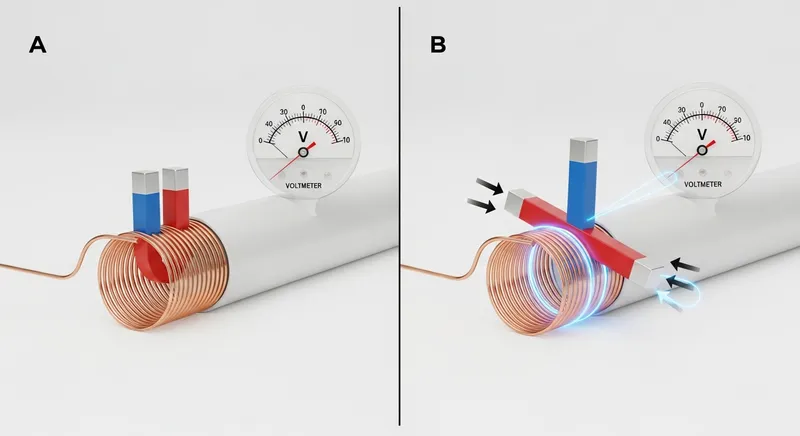
If you change the magnetic environment near a loop of wire, electricity will start to flow in that wire.
That's it. That's the core concept. Think of it as a cause-and-effect relationship. The cause is a changing magnetic field, and the effect is an induced electric current. This groundbreaking discovery by scientist Michael Faraday in the 1830s connected the forces of magnetism and electricity for the first time, paving the way for the modern world.
Imagine a row of dominoes. A single moving magnet is like the first push—it doesn't touch all the dominoes (or electrons), but its influence travels through the line, causing them all to move. This induced flow of electrons is what we call an electric current. According to the University of Texas at Austin's Physics Department, this can happen in two main ways: either by moving the wire or by changing the magnetic field around it.
First, You Need to Understand Magnetic Flux
To understand a changing magnetic environment, we first need a way to measure the environment itself. This is where magnetic flux (Φ) comes in. 'Flux' is just a scientific term for measuring how much of something flows through a certain area.
Let's use a simple analogy: Imagine magnetic field lines are invisible streams of rain, and your wire loop is a bucket.
Magnetic flux is the amount of rain falling into your bucket.
It's not just about how hard it's raining (the strength of the magnetic field), but also about the angle of your bucket. If you hold the bucket upright, you catch a lot of rain (high flux). If you tilt it sideways, you catch very little, or none at all (low or zero flux).
So, you can change the magnetic flux in two primary ways:
- Change the Magnetic Field Strength: Make it rain harder or softer.
- Change the Area/Angle: Tilt the bucket or change its size.
Actionable Tip: Grab a piece of paper and a pen. Draw a circle (your wire loop). Now, draw parallel lines with arrows passing through the circle (your magnetic field). See what happens to the number of lines passing through the circle as you imagine rotating it? You can also use your hand as the loop and imagine field lines passing through your palm—rotate your hand to see the flux change visually. This simple visualization is the key to everything that follows.
Faraday's Law Formula Explained, Piece by Piece
Okay, are you ready? It's time to look at the formula again, but this time, it won't be intimidating. We're going to break down every single part.
emf = −N(ΔΦ/Δt)
As explained by educational resources like Lumen Learning, this formula tells us the size of the induced voltage.
What is 'emf' (ε)? The 'Push' That Creates Current.
'Emf' stands for electromotive force. That's a fancy name for what is essentially voltage. It's the 'push' or 'pressure' that gets the electrons moving and creates a current. More emf means a stronger push and more current.
What is 'N'? The 'Multiplier' Effect of Coils.
'N' is simply the number of turns in your wire coil. If you have a single loop of wire, N=1. If you wrap the wire into a coil with 50 turns, N=50. Each loop contributes to the total voltage, so more turns give you a much bigger effect. It's like having 50 buckets catching rain instead of just one.
What is 'ΔΦ / Δt'? The CRITICAL Part - The Rate of Change.
This is the heart of the law. Δ (delta) means 'change in,' so:
- ΔΦ is the change in magnetic flux.
- Δt is the change in time.
So, ΔΦ / Δt represents the rate at which the magnetic flux is changing. It's not about how much flux there is, but how fast it's changing. A magnet sitting still next to a wire does nothing, no matter how strong it is. But a weak magnet moved quickly can induce a significant current.
TutorAI Feature Spotlight: Staring at complex physics formulas with handwritten notes and Greek symbols? An AI-powered tool can be a lifesaver. The best AI science solvers use advanced OCR that can recognize symbols like Φ (Phi) and Δ (Delta) instantly from a photo of your notebook, explaining each component just like we're doing here.
The #1 Point of Confusion: Lenz's Law (The Negative Sign)
We've finally arrived at the most confusing part for most students: that little negative sign. The minus sign isn't there to make your life difficult; it represents a fundamental law of physics called Lenz's Law.
Here's what it means: The induced current will always flow in a direction that creates its own magnetic field to oppose the change that created it.
Think of it this way: Nature resists change. If you try to increase the magnetic flux through a loop, the loop will generate a current that creates an opposing magnetic field to try and stop you. According to sources like Britannica, this is a direct result of the law of conservation of energy—the work you do pushing against this opposing field is what gets converted into the electrical energy of the current.
Actionable Tip: Using the Right-Hand Rule To figure out the direction of the current, you can use the 'right-hand rule.'
- Point your right thumb in the direction of the induced magnetic field (the one that opposes the change).
- Curl your fingers around the wire.
- The direction your fingers curl is the direction of the induced current!
This can be tricky to visualize. If you're working through problems and get stuck on the steps, don't be afraid to use a helper tool. Following a step-by-step guide, like in the guilt-free guide to Photomath, can help you internalize processes like the right-hand rule.
Real-World Applications of Electromagnetic Induction
This isn't just an abstract concept for a physics test; it's everywhere. Understanding its applications can make the topic much more interesting.
- Electric Generators and Power Plants: This is the big one. Whether it's a hydropower dam using falling water or a wind turbine using wind, they all work by turning a turbine. That turbine spins a massive coil of wire inside a magnetic field (or spins magnets inside a coil), inducing the current that powers our world.
- Everyday Tech: Your wireless phone charger uses a coil in the charging pad to create a changing magnetic field, which induces a current in a coil inside your phone. An induction stovetop does the same thing, but it induces a powerful current directly in the metal of your pot, causing it to heat up.
- Fun Examples: An electric guitar pickup has a tiny magnet wrapped in a coil. When a metal string vibrates nearby, it changes the magnetic flux, inducing a current that goes to the amplifier. Some traffic light sensors are just large loops of wire under the pavement; when your car (a large piece of metal) stops over it, it changes the magnetic field and signals your presence.
Mastering these applications is often a key part of higher-level exams. For more tips on tackling advanced science topics, check out this guide on AI for A-Level Revision.
Common Mistakes to Avoid
When you're working on homework, watch out for these common traps:
- Forgetting that only a changing flux matters.
- Student Sees: A 50-turn coil is placed in a uniform 2.0 T magnetic field. What is the induced emf?
- Student Thinks: I need to use the formula!
emf = -50 * (something...) - Correct Approach: The problem says the coil is just placed there. Nothing is moving or changing strength. The change in flux (ΔΦ) is zero. Therefore, the induced emf is 0.
- Mixing up the direction of the magnetic field and the current. The magnetic field lines and the flow of current are perpendicular to each other.
- Check Your Work: Use the right-hand rule carefully. Your thumb represents the magnetic field, and your curled fingers represent the current's direction. Don't mix them up!
- Ignoring Lenz's Law (the negative sign). If a question asks for the direction of the current, you must use Lenz's Law to determine if it opposes an increasing or decreasing flux.
- Check Your Work: First, decide if the flux is getting stronger or weaker. Then, determine which way the induced field must point to fight that change.
Key Takeaways for Acing Faraday's Law
We've covered a lot, but it all boils down to a few core ideas. Before you tackle those problem sets, lock in these concepts.
Quick Summary Box:
- Takeaway 1: No Change, No Current. The magnetic flux must be changing over time. A steady, constant magnetic field induces zero voltage.
- Takeaway 2: Faster & More is Better. A faster change in flux (small Δt) or more coil turns (N) means a bigger induced voltage (emf).
- Takeaway 3: Nature Fights Back. The induced current will always create its own magnetic field that opposes the change that created it (Lenz's Law).
If you're a parent or tutor trying to help, focusing on these points can make a huge difference. For more study strategies, see our guide on how to help your teen with high school math and science.
Frequently Asked Questions
What is the difference between Faraday's Law and Lenz's Law?
Think of them as a perfect partnership. Faraday's Law is the part of the equation (N(ΔΦ/Δt)) that calculates the magnitude of the induced voltage—it answers 'how much?'. Lenz's Law provides the direction of the resulting current by adding the negative sign. It tells you that the induced current will always flow in a way that opposes the change causing it. So, Faraday's Law gives you the number, and Lenz's Law gives you the direction.
Can you have an induced current without a magnetic field?
No, you cannot. A magnetic field is the essential ingredient for magnetic flux. Without a magnetic field, there is no flux, and therefore no change in flux. However, it's critical to remember that the reverse is not true: you can have a strong, steady magnetic field passing through a wire loop and have zero induced current, because the flux is not changing.
What are 3 ways to induce a current in a wire loop?
There are three main ways to change the flux and induce a current, all of which are used in real-world technology:
- Change the magnetic field strength: Move a permanent magnet closer to or farther away from the loop, or use an electromagnet and vary the current running through it.
- Change the position of the loop: Move the wire loop into or out of a stationary magnetic field.
- Change the orientation of the loop: Rotate the loop within the magnetic field, which changes the effective area pointing into the field (this is the principle behind most electric generators).
Why is there a negative sign in Faraday's Law?
The negative sign is the mathematical representation of Lenz's Law. It's one of the most important parts of the formula because it embodies the principle of conservation of energy. It signifies that the induced current creates its own magnetic field that actively opposes the change in flux. If the sign were positive, it would mean the induced field assists the change, leading to a runaway feedback loop that creates infinite energy from nothing, which is impossible. As explained in physics education research, this rule is fundamental to how electromagnetism works.
Does Faraday's Law work in reverse?
Yes, and this reverse principle is just as important! While Faraday's Law describes how changing a magnetic field creates a current (the principle of an electric generator), the reverse is also true: passing an electric current through a wire inside a magnetic field will create a force that causes motion. This is the principle of an electric motor. Generators turn motion into electricity; motors turn electricity into motion. They are two sides of the same electromagnetic coin.
Stuck on a physics problem at 11 PM? Snap a picture of any formula with Tutor AI and get instant, step-by-step breakdowns that make the concepts click. Download free on iOS and Android today!


