Staring at a string of letters and numbers like CH₄ + O₂ → CO₂ + H₂O can feel overwhelming, especially late at night when homework is due. You might know you're supposed to "balance" it, but the steps feel confusing and the rules seem arbitrary. You're not just looking for a quick answer from a calculator; you're looking for a simple, reliable method that you can actually understand and use on any problem-a method that builds your confidence for the next quiz or test. You want to learn the why behind the process, not just copy an answer.
This guide is here to do exactly that. We'll break down how to balance chemical equations into a simple, step-by-step process that anyone can follow. Whether you're a student aiming for better grades, a parent trying to help with chemistry homework, or a tutor looking for a clear way to explain a tricky topic, this guide will turn confusion into confidence.
What Is a Balanced Chemical Equation?
Before we start balancing, let's understand what we're looking at. Think of a chemical equation as a recipe for a chemical reaction. It tells you the ingredients (called reactants) and what they turn into (called products).
- Reactants: The substances you start with. They are always on the left side of the arrow.
- Products: The new substances that are formed. They are always on the right side of the arrow.
The arrow (→) simply means "yields" or "produces."
So, in our example CH₄ + O₂ → CO₂ + H₂O, methane (CH₄) and oxygen (O₂) are the reactants, and they react to produce carbon dioxide (CO₂) and water (H₂O). A balanced equation is one where the number of atoms of each element is exactly the same on both the reactant and product sides. It's a fundamental concept in any chemistry curriculum, from middle school science to A-Level revision.
Why Do We Balance Chemical Equations? The Law of Conservation of Mass
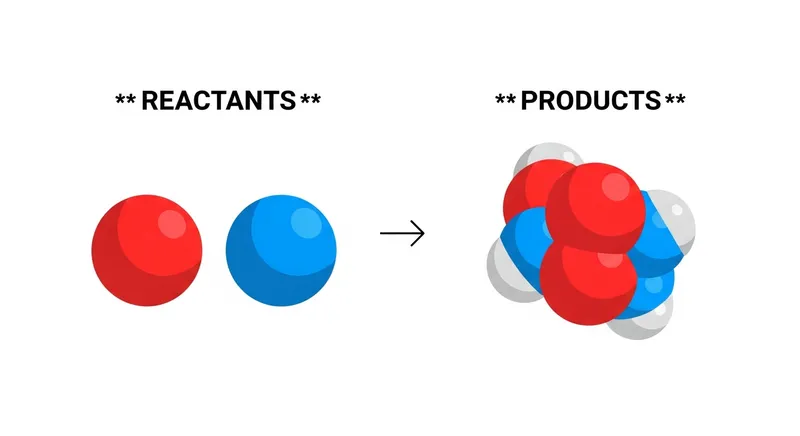
So, why do the atoms have to be equal? The answer is one of the most important rules in science: the Law of Conservation of Mass. As explained by sources like Britannica, this law states that matter cannot be created or destroyed in a chemical reaction. You can't start with 4 atoms of hydrogen and end up with only 2.
The atoms simply get rearranged into new molecules, like swapping partners at a dance. Educational resources like Khan Academy emphasize that balancing an equation is how we show this law in action. The number and type of atoms you begin with must be the same as the number and type of atoms you end with. While free resources like Khan Academy are a great starting point, some students find they need more interactive help, which is why many top students use an AI tutor to get unstuck.
The Easiest Way to Balance Chemical Equations: Our Simple 4-Step Method
Forget complicated algebraic methods for now. The most common and useful way to balance equations is through inspection, a form of trial-and-error. According to Chemistry LibreTexts, this method is the most practical for most equations you'll encounter. Here's how to do it in four manageable steps.
Step 1: Create an Atom Inventory
First, draw a simple T-chart under your equation. List all the elements present in the reaction in the middle. On the left, write down how many atoms of each element you have on the reactant side. On the right, do the same for the product side.
Let's use P₄ + O₂ → P₂O₅ as our example.
| Reactants (Left) | Element | Products (Right) |
|---|---|---|
| 4 | P | 2 |
| 2 | O | 5 |
Right away, you can see it's not balanced. Don't worry, that's what we're here to fix.
Step 2: Pick an Element to Start
Start with an element that appears in only one reactant and one product. Avoid elements that appear in multiple places on the same side of the equation until the end.
Pro-Tip: Always save single elements (like
O₂orFe) and especially Hydrogen and Oxygen for last. They often appear in multiple molecules, so balancing them at the end is much easier.
In our example, Phosphorus (P) is a great starting point. We have 4 P on the left and 2 P on the right. To balance the phosphorus, we need to make the numbers equal.
Step 3: Adjust Coefficients, Never Subscripts
This is the most important rule. You can only change the numbers in front of the molecules, called coefficients.
⚠️ WARNING: You can NEVER change the small numbers within a formula, called subscripts.
As the American Chemical Society (ACS) explains, changing a subscript changes the actual chemical identity of the molecule (e.g., changing H₂O to H₂O₂ changes water into hydrogen peroxide, a completely different substance!).
To balance the Phosphorus in our example (P₄ + O₂ → P₂O₅), we need 4 P atoms on the right. Since the product P₂O₅ has 2 P atoms, we place a coefficient of 2 in front of it.
P₄ + O₂ → 2 P₂O₅
Now, let's update our inventory. The '2' multiplies everything in P₂O₅.
| Reactants (Left) | Element | Products (Right) |
|---|---|---|
| 4 | P | 4 (2 x 2) |
| 2 | O | 10 (2 x 5) |
Our Phosphorus is balanced! Now for the Oxygen. We have 10 O on the right and only 2 on the left. To get 10 on the left, we need to place a coefficient of 5 in front of O₂.
P₄ + 5 O₂ → 2 P₂O₅
Step 4: Check Your Work and Simplify
Let's do a final count.
| Reactants (Left) | Element | Products (Right) |
|---|---|---|
| 4 | P | 4 |
| 10 (5 x 2) | O | 10 |
Everything is equal! Our equation is balanced. Finally, as educational publisher OpenStax notes, it's standard practice to ensure all coefficients are the smallest possible whole numbers. In this case, 1, 5, and 2 cannot be simplified further, so we are done.
Final Balanced Equation: P₄ + 5 O₂ → 2 P₂O₅
Let's Practice: Balancing Chemical Equations Examples
Practice is key. Let's walk through another one together.
Example: The combustion of methane: CH₄ + O₂ → CO₂ + H₂O
- Atom Inventory:
| Reactants (Left) | Element | Products (Right) |
|---|---|---|
| 1 | C | 1 |
| 4 | H | 2 |
| 2 | O | 3 (2+1) |
-
Pick an Element: Carbon is already balanced. Hydrogen is not. Let's start there.
-
Adjust Coefficients: We have 4 H on the left and 2 on the right. Let's place a coefficient of 2 in front of
H₂Oto get 4 H on the right.CH₄ + O₂ → CO₂ + 2 H₂ONow, update the inventory. Remember the new
2 H₂Oaffects both H and O.
| Reactants (Left) | Element | Products (Right) |
|---|---|---|
| 1 | C | 1 |
| 4 | H | 4 (2 x 2) |
| 2 | O | 4 (2 + (2x1)) |
Carbon and Hydrogen are balanced. Now for Oxygen (which we saved for last!). We have 2 O on the left but 4 O on the right. To fix this, we place a coefficient of **2** in front of `O₂`.

`CH₄ + 2 O₂ → CO₂ + 2 H₂O`
4. Check and Simplify:
| Reactants (Left) | Element | Products (Right) |
|---|---|---|
| 1 | C | 1 |
| 4 | H | 4 |
| 4 (2 x 2) | O | 4 |
It's perfectly balanced! The coefficients 1, 2, 1, 2 are the simplest whole numbers.
Quick 30-Second Check
After balancing any equation, ask yourself these three questions:
- Are the atoms for each element equal on both sides? (Do a final count.)
- Did I only change coefficients and NOT subscripts? (Double-check the formulas.)
- Are the coefficients in their simplest whole-number ratio? (Can they all be divided by the same number?)
A Visual Guide to Balancing Equations
For many, the abstract nature of chemical symbols is the hardest part. A study in the Journal of Chemical Education highlights that the main challenge for students is connecting the written symbols to the actual atoms they represent. This is where a visual approach can make all the difference.
Let's visualize balancing H₂ + Cl₂ → HCl.
Unbalanced State: H₂ + Cl₂ → HCl
- Reactant Atoms (Left Side):
H₂: 2 Hydrogen atomsCl₂: 2 Chlorine atoms
- Product Atoms (Right Side):
HCl: 1 Hydrogen atom, 1 Chlorine atom
Result: The counts don't match. We have leftover atoms on the reactant side.
Balanced State: H₂ + Cl₂ → 2 HCl
- Reactant Atoms (Left Side):
H₂: 2 Hydrogen atomsCl₂: 2 Chlorine atoms
- Product Atoms (Right Side):
2 HCl: 2 Hydrogen atoms, 2 Chlorine atoms
Result: It's balanced! Now every atom from the left side is accounted for on the right side.
Tackling Trickier Equations: Advanced Tips
Once you have the basic method down, you can handle more complex equations.
Balancing with Polyatomic Ions
Polyatomic ions (like NO₃⁻ or SO₄²⁻) are groups of atoms that act as a single unit. If a polyatomic ion appears unchanged on both sides of the equation, you can balance it as a whole chunk instead of breaking it down into individual atoms.
Example: AgNO₃ + CaCl₂ → AgCl + Ca(NO₃)₂
- Inventory (treating NO₃ as one unit):
| Reactants (Left) | Ion/Element | Products (Right) |
|---|---|---|
| 1 | Ag | 1 |
| 1 | NO₃ | 2 |
| 1 | Ca | 1 |
| 2 | Cl | 1 |
-
Balance
NO₃: We have 1NO₃on the left and 2 on the right. Place a 2 in front ofAgNO₃.2 AgNO₃ + CaCl₂ → AgCl + Ca(NO₃)₂ -
Update and Balance
AgandCl: This now unbalances Ag. We have 2 Ag on the left and 1 on the right. Place a 2 in front ofAgCl.2 AgNO₃ + CaCl₂ → 2 AgCl + Ca(NO₃)₂ -
Final Check: Left side: 2 Ag, 2 NO₃, 1 Ca, 2 Cl. Right side: 2 Ag, 2 Cl, 1 Ca, 2 NO₃. It's balanced!
How to Balance with Fractions
Sometimes, you'll end up with an odd number of atoms that's hard to balance, especially with diatomic molecules like O₂. You can use a fraction temporarily.
Example: The combustion of ethane C₂H₆ + O₂ → CO₂ + H₂O
- Balance C first:
C₂H₆ + O₂ → 2 CO₂ + H₂O - Balance H next:
C₂H₆ + O₂ → 2 CO₂ + 3 H₂O - Count Oxygen on the right: (2x2) + (3x1) = 7 Oxygen atoms.
How do you get 7 Oxygen atoms from O₂? You would need 3.5 molecules. You can write this as a fraction: 7/2.
C₂H₆ + 7/2 O₂ → 2 CO₂ + 3 H₂O
This is technically balanced, but we need whole numbers. To clear the fraction, multiply the entire equation by the denominator (in this case, 2).
Final Answer: 2 C₂H₆ + 7 O₂ → 4 CO₂ + 6 H₂O
Common Mistakes in Balancing Chemical Equations
- Changing Subscripts: This is the #1 mistake. It changes the ingredients of your recipe. Only ever add or change coefficients.
- Forgetting to Recount: After you change a coefficient, you must update your entire atom inventory. A single change can affect multiple counts.
- Ignoring Polyatomic Ions: Breaking down a polyatomic ion that stays intact makes the process much harder. Treat it as a single block when you can.
- Not Simplifying: Always do a final check to see if your coefficients can be divided by a common number to get the simplest ratio.
The Parent & Tutor's 'Cheat Sheet' for Chemistry Homework Help
Watching your student struggle with chemistry can be tough, especially if it's been a while since you took the class. The goal isn't to give them the answer, but to guide them to find it themselves.
Here are some questions to ask:
- "What's our very first step? Let's make our list of atoms."
- "Which element looks like the most complicated? Maybe we should save that one for last."
- "Okay, you've added a coefficient. What does that change in our atom count?"
- "Are the coefficients in their simplest form?"
Using technology can also be a powerful learning tool, not a shortcut for cheating. The key is to focus on tools that explain the how and why. Understanding how to use AI solvers for real learning can empower you to support your student effectively.
When You're Still Stuck: Getting Instant, Step-by-Step Help
Even with the best guide, there will be times when you're completely stuck. It might be late, your tutor isn't available, and frustration is setting in. This is where modern tools can provide a crucial lifeline.
Instead of searching for fragmented answers online, you can use a dedicated tool built for learning. The best AI science solvers allow you to simply snap a picture of the problem and get an immediate, detailed explanation.
Tutor AI is designed around the principle of "Snap. Solve. Learn." It provides more than just the final balanced equation; it breaks down the entire process step-by-step, showing you exactly how to create the atom inventory, adjust the coefficients, and arrive at the correct answer. This way, you're not just getting the homework done-you're actually learning the method so you can solve the next problem on your own.
Key Takeaways
Balancing equations is a skill that gets easier with practice. Here are the most important things to remember:
- The Goal: Make the number of atoms of each element the same on both sides of the equation.
- The Golden Rule: Only change coefficients (the big numbers in front), never subscripts (the small numbers in the formula).
- The Strategy: Create an atom inventory, balance complex molecules first, and save single elements like H and O for last.
- The Final Step: Always do a final check to ensure everything is balanced and coefficients are in their simplest form.
You've Got This!
Balancing chemical equations is a fundamental skill in chemistry that seems intimidating at first but becomes second nature with practice. Remember the core principles: it's all about honoring the Law of Conservation of Mass, and it's a systematic process of counting and adjusting.
By following the simple 4-step method, using visual aids, and learning how to handle trickier cases, you can turn confusion into mastery. For those moments when you need a little extra support, learning tools are available 24/7 to help you understand the process, not just get the answer.
Want instant help balancing your next equation? Snap a picture with Tutor AI to get a step-by-step explanation and master the method.
Frequently Asked Questions
What is the easiest way to balance chemical equations?
The easiest and most common method is "balancing by inspection," which is a systematic trial-and-error process. Our 4-step guide (Inventory, Pick an Element, Adjust Coefficients, Check) is built around this simple and effective technique, perfect for most high school chemistry problems.
What is the number one rule of balancing equations?
The absolute most important rule is to never change the subscripts (the small numbers within a chemical formula). You can only change the coefficients (the large numbers in front of the formulas), which alter the quantity of a substance without changing its chemical identity.
Why can't you change subscripts when balancing an equation?
Changing a subscript fundamentally changes what the substance is. For example, H₂O is water. If you change the subscript to make it H₂O₂, you have created hydrogen peroxide, a completely different chemical. The goal is to show the correct ratio of the original reactants and products, not to create new ones.
Can AI tools help me learn to balance equations?
Yes, but it's important to choose the right tool. Instead of a simple calculator that just gives an answer, a learning tool like Tutor AI acts as a digital tutor. It shows you the step-by-step process, explaining why each coefficient is adjusted, so you learn the method instead of just copying the solution.
How do you balance an equation with polyatomic ions?
If you see a polyatomic ion (like SO₄ or NO₃) on both sides of the equation, you can treat it as a single unit. Instead of counting individual atoms, just count the number of "SO₄" or "NO₃" groups on each side. This simplifies the inventory and makes balancing much faster.