
It's a familiar scene: It's late, you're staring at a physics diagram or a chemistry equation, and it feels like a foreign language. You've heard of apps like Photomath, and you might even be a pro at using them for algebra. But as you search for a solution, you can't help but ask, "Is there a Photomath for science?"
The frustration is real. Science homework introduces a new level of complexity with diagrams, conceptual questions, and multi-step calculations that go far beyond a simple math equation. The great news? The answer to your question is a resounding yes. Modern AI-powered tools are now built specifically to tackle these challenges, and we're here to show you how they work.
Is There a Photomath for Science? Yes, and Here's Why You Need One
Photomath is a fantastic tool that has changed the game for math homework. Its brand name, however, tells you exactly what it's best at: math. When you need an alternative for chemistry or physics, you need a tool designed with science in mind.
This is where an AI science solver app comes in. Instead of just calculating numbers, these apps are designed to interpret diagrams, understand scientific concepts, and provide step-by-step explanations that actually help you learn. They are the answer for students, parents, and teachers looking for a reliable way to solve complex science problems. And if you've ever wondered how to use these tools without just getting the answer, our guilt-free guide to learning with AI can help you build the right habits.
Why Science Homework is a Different Challenge for AI
Science homework isn't just about finding x. It's about understanding why. Problems in physics and chemistry are often visual and conceptual, combining math with abstract principles. This presents a unique challenge that requires more than a simple calculator.
Consider the known hurdles in science education:
- Visual Interpretation: Many science problems are based on diagrams. A study in the Journal of Physics: Conference Series found that over 75% of university students struggle to correctly draw vector forces in free-body diagrams—a foundational skill in physics.
- Conceptual Gaps: Simply getting the right number isn't enough. The U.S. National Center for Education Statistics reports that only about a third of 8th-grade students perform at or above a proficient level in science, highlighting a nationwide gap in conceptual understanding.
- Multi-Step Processes: Chemistry topics like stoichiometry require a methodical, multi-step approach that can be confusing. Research shows that stoichiometry is one of the foundational concepts in general chemistry, yet many students struggle to fully understand its underlying principles. It's a common area where students need extra science homework help.
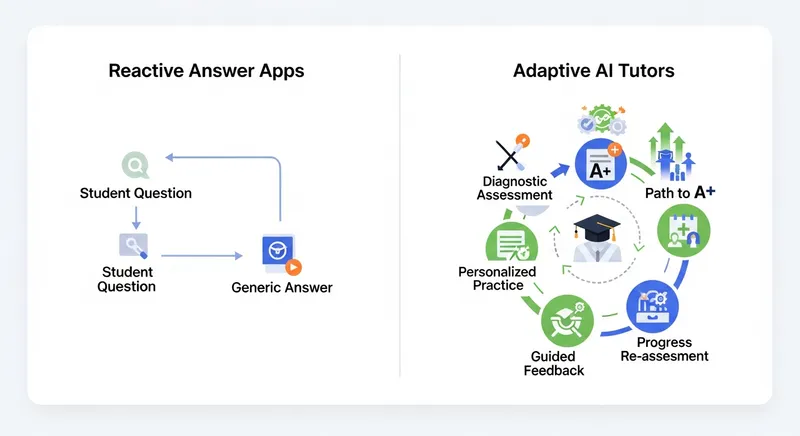
An effective AI science solver needs to see a diagram, understand the underlying concepts, and guide you through the entire process. This is exactly why a new generation of AI tools was built with these challenges in mind. Let's see how they work in action.
Meet Your AI Physics Solver: Snap, Solve, and Understand
This is where TutorAI shines. As an all-in-one science homework helper, we've built a tool designed for the visual and conceptual nature of STEM. It acts as an AI physics solver that can interpret your handwritten notes, textbook diagrams, and complex word problems from a single photo.
Forget trying to type complex symbols or describe a diagram in words. You can now get help with the trickiest problems instantly. Let's walk through how to use our photo solver for science with two common, high-difficulty physics topics.
Example 1: Solving a Free-Body Diagram Problem
Imagine you're given a problem with a block on an inclined plane, and you need to find the acceleration. This involves identifying forces like gravity, friction, and the normal force—something students often find difficult, as the Journal of Physics: Conference Series study confirmed.
Here's how you can solve it with an AI physics solver app:
- Snap a Photo: Open the app and take a clear picture of the entire problem, including the diagram and the question.
- Let AI Analyze: The AI immediately recognizes the diagram, identifies the forces at play, and understands the goal (e.g., "find acceleration").
- Get a Step-by-Step Breakdown: Instead of just an answer, you get a full explanation that shows you how to break down forces, write the equations using Newton's Second Law, and solve for the final acceleration.
Actionable Tip: The next time you're stuck on a forces problem, snap a picture and pay close attention to step 1 of the explanation—how the forces are identified and drawn. This is often the most crucial part of the process.
Example 2: Untangling a Circuit Analysis Problem
Circuit diagrams with multiple resistors and batteries can look like a tangled mess. Trying to apply Ohm's Law or Kirchhoff's Rules can be confusing.
Here's how an AI circuit analysis solver helps:
- Snap the Circuit: Take a photo of the circuit diagram from your worksheet or textbook.
- AI Interpretation: The AI identifies each component—resistors, voltage sources, and loops.
- Guided Solution: The app provides a clear, step-by-step path to the solution, explaining how to apply Kirchhoff's rules, set up a system of equations, and solve for the unknown current or voltage.
Actionable Tip: Use the app to solve a circuit problem, then cover the solution and try to redraw the loops and write the equations yourself. Use the app's explanation to check your work and correct your mistakes.
Your Personal Chemistry Problem Solver App
Chemistry brings its own set of challenges, from balancing equations to mastering complex calculations. An effective chemistry problem solver app must do more than just find a number; it needs to explain the chemical principles at play.
This is especially true for topics like stoichiometry, where research shows students struggle with conceptual steps and multi-step calculations. Whether you're studying for your GCSEs or need some AI help for A-Level revision, a dedicated tool can make all the difference.
Example 3: Mastering Stoichiometry and Limiting Reactants
Let's say you have a word problem: "If 10g of hydrogen reacts with 10g of oxygen, how much water is produced?" This is a classic limiting reactant problem.
Here's how a chemistry problem solver app like TutorAI breaks it down:
- Snap the Word Problem: Take a picture of the full text.
- AI Deconstruction: The AI reads the problem and identifies the reactants, their amounts, and what you need to find.
- Step-by-Step Chemistry: The solution explains the full process: writing and balancing the equation, converting grams to moles, identifying the limiting reactant, and calculating the final product.
Actionable Tip: When you get a stoichiometry problem, use the app but focus on the step where it identifies the limiting reactant. This is the key conceptual leap. Run a few different problems and see if you can spot the limiting reactant before the app tells you.
From Answer-Getter to Active Learner
One of the biggest concerns is whether these tools are just a high-tech way to cheat. The answer lies in how you use them. Simply copying an answer won't help you on a test. But using an AI tutor to understand the process is a powerful form of learning.
As research shows, AI is transforming education by allowing students to get real-time answers and interact with content on their own terms. This turns passive frustration into active learning. When you see exactly where you went wrong, you're not cheating; you're getting immediate, personalized feedback.
An AI tutor isn't a replacement for teaching; it's a support tool that empowers students to learn independently. It's a critical distinction in the debate over whether a tool is a homework helper or a cheating tool.
Getting Started: Your First Problem in 3 Easy Steps
Ready to try it for yourself? Getting help is faster than you think.
- Download the App: Get TutorAI from the App Store or Google Play.
- Snap Your Problem: Open the app and take a clear photo of your science question—whether it's handwritten, in a textbook, or on a screen.
- Learn Step-by-Step: Watch as the AI provides a detailed explanation, guiding you from the problem to the solution.
Ready to Transform Your Science Homework?
Stop letting confusing diagrams and multi-step problems stand in your way. With an AI science solver, you have a personal tutor in your pocket, ready to help 24/7. Turn frustration into understanding and build the confidence you need to excel in class.
Download TutorAI today and start solving your toughest science problems in seconds!
Frequently Asked Questions
Is there an app that can solve physics problems from a photo?
Yes, absolutely. Apps like TutorAI are specifically designed to be an AI physics solver. They use your phone's camera to analyze everything from word problems to complex diagrams and provide detailed, step-by-step solutions.
What is the best AI chemistry problem solver app?
The best chemistry problem solver app is one that goes beyond just balancing equations. Look for a tool like TutorAI that handles multi-step stoichiometry, limiting reactants, and explains the concepts behind the calculations to ensure you're actually learning.
Can AI solve a free-body diagram?
Yes. This is a key feature that separates a true AI science solver from a basic math app. Advanced AI can analyze a photo of a free-body diagram (even a hand-drawn one) and correctly identify all the vector forces, then use this information to generate and solve the necessary equations.
Is using a science solver app considered cheating?
It depends on how you use it. If you use the step-by-step explanations to understand the process and check your own work, it's a powerful learning tool. If you only copy the final answer, you are not learning and it may be considered cheating.
How is a science solver different from Photomath?
While Photomath is world-class for math equations, a dedicated science solver is trained to interpret visual scientific concepts like circuit diagrams, molecular structures, and force vectors. A science solver like TutorAI understands the context of a science problem, making it the perfect tool for chemistry and physics.
Note: Every student learns differently. While these strategies are research-backed, results may vary. Adapt these techniques to fit your unique learning style and circumstances.


