
How to Help Your Teen with High School Math (Even If You're Not a Math Person)
It's a feeling many parents know all too well: the kitchen table is a battlefield, your teenager is staring at a page of incomprehensible algebra, and you feel a wave of panic. You want to help, but the equations look like a foreign language. That feeling of helplessness—the fear that you can't support your child through their struggles—is incredibly painful, especially when you're worried about their grades and their future.
If you've ever thought, "My kid's homework is too hard for me," you are not alone. But here's the good news: you don't have to be a math genius to be your child's best advocate. This guide will show you how to shift your role from a frustrated solver to a supportive coach, turning math stress into an opportunity for growth and connection.
Why High School Math Feels Like a Hurdle for the Whole Family
If math homework feels like a source of tension in your home, there are real psychological and academic reasons for it. For starters, math anxiety is a genuine and disruptive force. According to the Child Mind Institute, it can manifest as resistance, anger, and other negative behaviors that are easy to misinterpret as laziness. What's more, this anxiety can be contagious. Research from the University of Chicago found that when math-anxious parents help with homework, their children are more likely to develop math anxiety themselves.
This struggle isn't happening in a vacuum. According to the National Center for Education Statistics, a significant percentage of students perform below the 'proficient' level in mathematics, making this a widespread challenge. When you add in modern teaching methods that may differ from what you learned in school, it's no wonder that many families feel overwhelmed.
Understanding these challenges is the first step. Now, let's talk about what you can actually do about it.
Your New Role: How to Be a Math Coach, Not the Solver
Your most powerful move is to change your goal. Stop trying to be the person with all the answers and start being the person with all the right questions. Your job isn't to solve for x; it's to help your teen develop the confidence and process to solve it themselves.
This starts with fostering a growth mindset—the belief that ability isn't fixed and can be improved with effort. According to the National Council of Teachers of Mathematics (NCTM), one of the most important things a parent can do is model a positive, persistent attitude. Instead of saying, "I was never good at math," try saying, "This looks tricky, but I know we can figure out a path forward together." (Curious about the tools that can help? You can explore some powerful features for learning here.)
Actionable Tip: The next time your teen is stuck, try asking these coaching questions instead of reaching for the answer key:
- "Can you explain the problem to me in your own words?"
- "What was the last step you understood?"
- "What have you tried so far?"
- "Where in your notes or textbook might we find a similar example?"
- "What's the very first thing you could try?"
5 Actionable Strategies for Stress-Free Math Homework Support
Transforming your approach from solver to coach requires a practical toolkit. Here are five strategies you can implement tonight to make math homework less stressful and more productive.
1. Create a Positive Homework Environment
Create a dedicated space and time for homework that is free from distractions like phones (unless used for learning) and television. Establish a "no-judgment zone" where mistakes are seen as valuable clues, not failures. Encourage short, 5-minute breaks every 25-30 minutes to prevent burnout and keep your teen's mind fresh.
2. Talk to the Teacher (The Right Way)
Your child's teacher is your most important ally. Approach them as a partner, not an adversary. Instead of saying "My child is failing," try asking questions that open a dialogue. This approach helps you go beyond report cards to understand your child's learning data.
Actionable Tip: The National PTA provides guides to help you understand curriculum goals. Use them to formulate questions for your next parent-teacher conference, such as:
- "What are the most important concepts my child needs to master in this unit?"
- "Have you noticed any specific areas where they seem to get stuck?"
- "What resources does the school offer for extra help?"
- "How can I best support at home what you're teaching in the classroom?"
3. Make Math Relatable
One of the biggest hurdles for teens is the "When will I ever use this?" question. As Edutopia suggests, helping teens see math in their own interests is a powerful motivator. If they are saving for a new phone, you can use algebraic equations to calculate how long it will take based on their allowance and the item's cost, including sales tax. If they're into gaming, talk about the geometry and physics in their favorite game. Connecting abstract concepts to their world makes the learning stick.
4. Know When to Get Help (and Where to Find It)
Sometimes, you need to call in reinforcements. If you notice persistent signs like failing grades, extreme emotional distress over homework, or constant avoidance, it's time to seek external support. This can come in many forms, from free after-school tutoring to peer study groups, traditional private tutors, or modern online tools.
5. Introduce a 'Digital Co-Pilot' for Learning
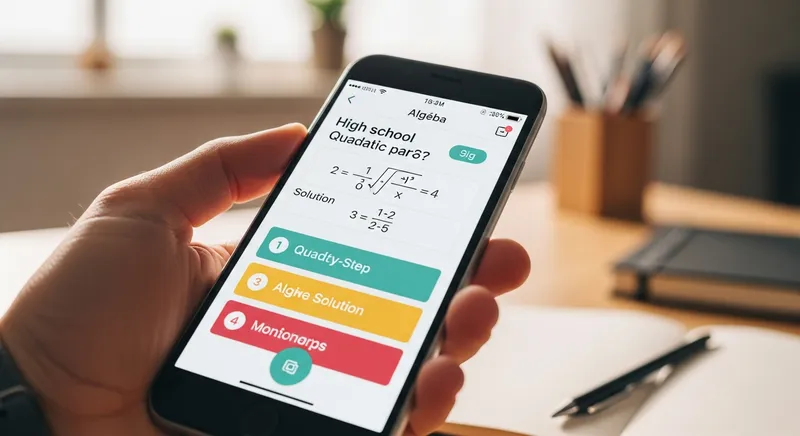
For parents who aren't math experts, an AI-powered tool can be the perfect 'co-pilot.' Instead of feeling helpless, you can use an AI Math Solver with your teen. When they're stuck, they can simply snap a photo of the problem and get a full, step-by-step explanation. You can review it together, turning a moment of frustration into a collaborative learning opportunity. Best of all, the 24/7 availability of a tool like TutorAI means that help is always there, even when it's 11 PM and you're both out of ideas.
How to Use an AI Homework Helper Without Cheating
Many parents worry that an AI homework app is just a high-tech way to cheat. It's a valid concern, but it all comes down to how you use the tool. When used correctly, it becomes a powerful teaching aid. For a deep dive into the ethics, check out our guide on whether AI is a homework helper or a cheating tool.
Here is a simple, 5-step process to ensure you're using TutorAI for learning, not just answers:
- Try First: Your teen must attempt the problem on their own first. This is non-negotiable.
- Snap When Stuck: If they are truly stuck, they can use TutorAI to snap a photo of the problem.
- Review Together: This is the coaching moment. Go through the step-by-step explanation together. Ask questions like, "Ah, I see. Can you explain to me why they did that step?"
- Teach It Back: Have your teen explain the process back to you in their own words. This solidifies their understanding.
- Try Another: Find a similar problem in their textbook and have them solve it on their own to prove they've mastered the concept.
You're Not Just Helping with Math, You're Building Confidence
Supporting your teen through their high school math struggles is about so much more than quadratic equations and geometric proofs. It's about teaching them resilience, problem-solving skills, and the confidence to face challenges head-on. By shifting your role from solver to coach, focusing on the process over the answer, and using modern tools wisely, you can turn homework battles into moments of connection and empowerment.
You have what it takes to be your child's best advocate, no matter how long it's been since you took algebra. You're not just helping with homework; you're shaping a confident, capable learner.
Ready to become your teen's homework co-pilot? Explore TutorAI's features and see how you can transform math stress into a learning opportunity, together.
Disclaimer: The advice provided in this blog post is for informational and educational purposes only. It is not a substitute for professional academic or mental health advice. Please consult with a qualified professional for guidance on your child's specific needs.
Frequently Asked Questions
What do I do if my child is failing high school math?
First, take a deep breath and open a calm line of communication with both your child and their teacher. The goal is to identify the root cause—is it a specific concept, anxiety, or something else? From there, create a support plan that includes dedicated study time, using resources for practice, and celebrating small wins to rebuild their confidence.
How can I help my teenager with math anxiety?
Acknowledge their feelings without judgment. Saying "I know this is frustrating" is more helpful than "It's not that hard." Focus on praising their effort and persistence rather than just the final grade. Break down overwhelming assignments into smaller, manageable chunks and use tools that provide clear, non-intimidating explanations. Lastly, be mindful of your own words and try not to express your personal anxiety about math.
How much help with homework is too much?
The goal is to guide, not give. If you find yourself explaining every step or doing the calculations, it's too much. Use the 'coach' method by asking questions that prompt their thinking. A good rule of thumb is to spend more time listening to their process than talking. Your role is to ask questions that nudge them toward the next step, not to carry them there.
Are there free resources for parents to help with high school math?
Absolutely. Many schools offer free after-school tutoring, and websites like Khan Academy have extensive libraries of free video lessons. Additionally, apps like TutorAI offer a free version that provides step-by-step help for a limited number of problems, making it a fantastic, no-cost way to get started.
What if my child refuses help or gets angry when I try to talk about math?
This reaction is often a sign of deep frustration or anxiety. Instead of escalating the conflict, back off from being the 'teacher.' Position yourself as an ally by saying, "I can see how frustrating this is. Let's find a different approach." This opens the door to introducing a neutral third party, like a study app, which can remove the parent-child tension from the equation and provide help without the emotional baggage.