
Aiming for a high study score in VCE Mathematical Methods can feel like preparing to climb a mountain. You know the peak is a 40+ score, but the path is shrouded in fog. You might have tools to solve a single equation, but you lack a cohesive strategy to conquer the entire year.
This is not just another list of generic study tips. This is your comprehensive roadmap for 2026. We will break down the entire year, demystify the VCE system, and give you actionable strategies for every component of the course. While various tools can help you get unstuck, this guide provides the overarching game plan you need. See how Tutor AI compares to other tools in our breakdown of the 12 best AI solvers for 2026.
Key Takeaways for Skimmers
- Year-Long Plan: Success comes from consistent effort spread across four terms, not last-minute cramming.
- Master the Study Design: Use the official VCAA document as your ultimate checklist to ensure no knowledge gaps.
- Practice Smarter: Prioritize official VCAA past papers and use the examiner reports to learn from common mistakes.
- Build Your Tools: Create a high-quality, personalized bound reference and become an expert with your CAS calculator.
The Game Plan: Your Year-Long Timeline to a 40+ Study Score
Achieving a top score isn't about last-minute cramming; it's about consistent, strategic effort. Think of it like a marathon, not a sprint. Here is a term-by-term breakdown to keep you on track.
Term 1: Building Unshakeable Foundations
Your goal this term is mastery of the fundamentals. The topics you cover now are the building blocks for everything that follows. According to high-achieving students on platforms like ATAR Notes, a strong start is crucial. Focus on understanding concepts deeply, not just memorizing formulas.
Start a 'mistake book' to log questions you get wrong and why. This is where Tutor AI's Snap. Solve. Learn. workflow becomes invaluable. When you get stuck, just snap a picture of the problem. You won't just get an answer; you'll get a step-by-step explanation to understand the process. Use it to build daily study habits and track your learning streaks to stay motivated from day one.
Terms 2 & 3: Mastering Content and Dominating SACs
This is the heart of the VCE year. You'll be learning new content at a rapid pace while also being assessed through your School-Assessed Coursework (SACs).
- Stay Ahead: Aim to be one or two weeks ahead of your class. This turns class time into a revision session rather than a first-time learning experience.
- Consistent Practice: Dedicate time every single day to Maths Methods. Even 30-45 minutes of focused practice is more effective than one long session per week.
- Prepare for SACs Early: Start preparing for SACs at least two weeks in advance. Tutor AI's personalized learning can identify your weak spots, so you can focus your SAC preparation on areas that actually need work.
Term 4 & Holidays: Exam Domination
This is where your hard work pays off. Your focus should shift entirely from learning new content to targeted revision and exam practice.
- Practice Exams: Start doing timed, closed-book practice exams. Begin with commercial papers and save the official VCAA past exams for the final few weeks.
- Refine Your Bound Reference: As you do practice exams, you'll discover what's truly useful. Continuously add to and refine your bound reference (more on this below).
- Wellbeing: Do not underestimate the power of rest. As educational experts emphasize, managing stress and getting enough sleep is critical. Reduce late-night homework panic with 24/7 access to help; Tutor AI works on your schedule, not a tutor's availability.
Pro-Tip from VCAA Examiners: Pay close attention to notation, especially in probability questions. Year after year, students lose marks for using incorrect symbols for unions, intersections, and conditional probability. Practice writing these out perfectly.
Understanding the Rulebook: The VCE Study Design Explained
The single most important document for your success is the official VCE Mathematical Methods Study Design from VCAA. This is the rulebook for the entire course. It tells you, your teacher, and the exam setters exactly what you need to know. The 2023-2027 curriculum is built around four key areas:
- Functions, relations and graphs: The foundation of Methods, covering everything from polynomials to exponentials and logarithms.
- Algebra, number and structure: The rules and techniques that underpin all your calculations.
- Calculus: The study of change, including differentiation and integration, which forms a huge part of the exams.
- Data analysis, probability and statistics: Applying your skills to scenarios involving probability and data.
Actionable Tip: Print the study design. Use it as a checklist. As you master a dot point, highlight it. This ensures you cover every single base.
Mastering Your SACs: A Practical Guide
SACs typically make up a significant portion of your final study score. Treating them seriously is non-negotiable.
- Understand the Format: Know whether your SAC is a short test, an extended application task, or a modeling problem.
- Practice Application: Methods SACs often involve multi-part application tasks. The best way to prepare is by practicing similar problems from your textbook or commercial practice SACs.
- Show Your Thinking: Marks are often awarded for showing the correct process, even if your final answer is wrong. For complex problems, clearly lay out your steps, just as you would when learning to balance chemical equations.
The VCE Scaling Secret: How Your Methods Score is Calculated
Scaling can be a source of confusion. Here's a simple breakdown. The Victorian Tertiary Admissions Centre, or VTAC, handles scaling to ensure that a 30 in one subject represents the same level of achievement as a 30 in any other.
Because Maths Methods is a challenging subject, it is consistently scaled up. This means your scaled score is likely to be higher than your raw study score. This is not 'free points'; it's a recognition of your hard work in a difficult subject.
Creating the Ultimate Bound Reference (Your Exam Best Friend)
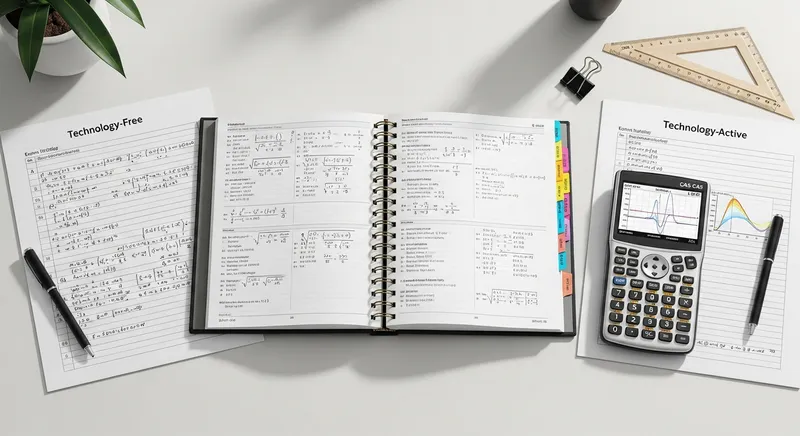
For Exam 2, your bound reference is your most powerful tool. A great one is concise, well-organized, and personal.
What to Include:
- Key Formulas and Definitions: The absolute essentials for each topic.
- Annotated Examples: Choose 1-2 difficult questions for each topic and include a perfectly worked solution with notes explaining each step.
- Common Mistakes: A dedicated section for errors you've made in practice exams.
- Calculator Steps: Exact syntax and steps for complex CAS calculator functions.
Actionable Tip: Use tabs and a color-coding system for different topics. Make it instantly navigable so you don't waste precious time during the exam.
Exam Strategy: Conquering Exam 1 and Exam 2
Success requires two different mindsets for the two different exams.
Exam 1: Tech-Free Speed and Accuracy
This 1-hour exam tests your fundamental skills. With no calculator allowed, your by-hand arithmetic must be sharp.
- Time Management: Allocate roughly one minute per mark. If a question is worth 3 marks, don't spend 5 minutes on it. Move on and come back.
- Show All Working: A correct answer with no working may not receive full marks.
- Don't Erase Mistakes: Put a single line through errors. Sometimes your initial thinking is on the right track and might earn partial marks.
Exam 2: Mastering Your CAS Calculator
This 2-hour, tech-active exam is a test of problem-solving and calculator efficiency.
Unlike answer-only apps, Tutor AI shows you the complete solving process, so you learn the method, not just the solution. This is crucial for earning marks for 'showing your working'.
- Know Your Tool: You should be a master of your CAS. Practice is the only way to get fast.
- 'Tech-Active' vs 'Tech-Required': Learn to recognize when it's faster to solve by hand versus when to use the CAS. This is a key skill that separates good students from great ones.
- Use It to Check: If you solve a question by hand, use the CAS to quickly verify your answer.
Learning from the Past: Using VCAA Resources Effectively
The most under-utilized resource for VCE students is the archive of VCAA past papers and examination reports. Doing past papers is good. Marking them with the official examiner reports is game-changing.
These reports highlight:
- Common student mistakes.
- What high-scoring answers included.
- Misinterpretations of questions.
By studying these reports, you are essentially getting feedback directly from the source. You start to 'think like VCAA', understanding how they phrase questions and what they look for in a response.
A Guide for Parents and Tutors: How to Support Your Student
Watching a student navigate the pressures of VCE can be challenging. Your role is not to be a math expert, but a support system. For parents struggling to help, it's important to know the difference between helpful tools and less reliable ones, as a comparison between Photomath vs. Chegg might show.
- Create a Conducive Environment: Provide a quiet, organized space for study.
- Focus on Wellbeing: Encourage breaks, healthy eating, and regular sleep. Research shows that wellbeing is directly linked to academic success.
- Provide Resources, Not Answers: Instead of trying to teach a concept you haven't seen in 20 years, empower them with tools. The Tutor AI parental dashboard shows you exactly where your child is improving and which topics need more focus, reducing homework battles and allowing you to support their journey without hovering.
Frequently Asked Questions
How do I get a 40+ in VCE Maths Methods?
Achieving a 40+ requires a combination of deep conceptual understanding, strategic preparation, and consistent effort. Top students focus on: 1) Mastering the VCAA Study Design. 2) Using official VCAA Examination Reports to learn from common mistakes. 3) Creating a high-quality, organized bound reference. 4) Maintaining a consistent study schedule throughout the year.
What is a good study score in Maths Methods?
A 'good' score is subjective, but a raw study score of 30 is the state average. A score of 40 or above places you in the top 9% of a very competitive cohort. Because Maths Methods is scaled up by VTAC, these scores will be adjusted upwards, making any score above 30 a strong achievement.
How many practice exams should I do for Methods?
Quality trumps quantity. Most high-achieving students complete between 15 and 25 full practice exams. The most critical part is reviewing your exam. For every mistake, you must understand why you made it and update your bound reference and mistake log.
What are the most common mistakes in the Methods exam?
The official VCAA Examination Reports are the best source for this. Common mistakes include: not showing sufficient working, misreading the question, incorrect calculator use, and not stating the domain and range of functions. A frequent error is failing to relate the mathematical answer back to the context of the problem.
What calculator is best for VCE Maths Methods Exam 2?
The two most common permitted CAS calculators are the TI-Nspire CX II CAS and the Casio ClassPad II. The best one is the one you know how to use most efficiently. Check the official VCAA approved calculator list to ensure your model is permitted.
How do I make a good bound reference for Methods?
A good bound reference is a personal tool, not a textbook. It should be concise and instantly usable. Start with key formulas, but the most valuable content is what you add from your own experience: difficult example questions with annotations, a list of common mistakes you make, and step-by-step instructions for complex calculator procedures. Use color-coded tabs for fast navigation.
Ready to Conquer VCE Maths Methods?
Your journey to a 40+ study score starts now. Stop struggling with confusing problems and start building real understanding with a tutor that's available 24/7.
Download Tutor AI for free and get the step-by-step help you need to succeed.
[Download on the App Store] | [Get it on Google Play]


