It's 10 PM. Your calculus homework is spread across your desk, and you're stuck on question three. Sound familiar? You're one of thousands of NSW students facing the new 2026 HSC Maths Advanced syllabus, and the pressure is real.
Facing this course can feel like standing at the bottom of a huge mountain. There's excitement for the challenge, but also a wave of anxiety about the climb ahead, especially for students tackling the updated curriculum for the first time. You might be wondering: Where do I even begin? How do I structure my study? What happens when I get stuck?
This is your roadmap. This guide provides a comprehensive, step-by-step strategy for students, parents, and tutors. We will break down the new syllabus, provide an actionable study plan, and reveal the exam techniques that top students use. When you hit an inevitable roadblock, TutorAI is here to help you get unstuck with instant, step-by-step explanations, ensuring you not only find the answer but truly learn the concept.
What You'll Learn in This Guide:
- Key changes in the new 2026 HSC Maths Advanced syllabus.
- A term-by-term study plan for Year 12 to target a Band 6.
- How to master 'Working Mathematically' for top marks.
- Effective exam techniques using past papers and the reference sheet.
- A cheat sheet for parents and tutors to provide the best support.
What's New? Understanding the 2026 HSC Maths Advanced Syllabus
First, let's address the biggest source of uncertainty: the new syllabus. The NSW Education Standards Authority (NESA) has updated the course for students starting Year 11 in 2025, who will sit their HSC in 2026. The goal is to create a more logical flow and better prepare students for university-level mathematics.
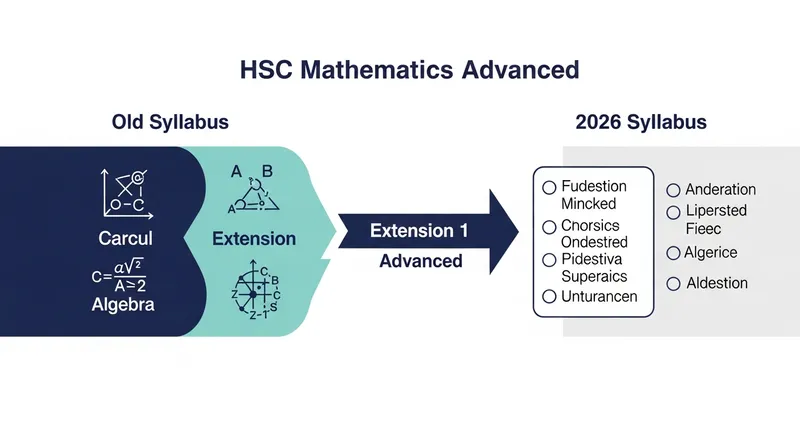
So, what's actually different?
- New Content Cascading Down: Some topics previously in the Mathematics Extension 1 course have been moved into the Advanced course. This includes introductions to permutations and combinations.
- Increased Focus on 'Working Mathematically': This is a major shift. According to insights from professional development bodies like the Mathematical Association of NSW (MANSW), the new syllabus places a much stronger emphasis on problem-solving, reasoning, and communicating your mathematical thinking. It's no longer enough to just get the right answer; you need to show how you got there.
- Streamlined Topics: The new syllabus is now structured into seven core areas: Functions, Trigonometric functions, Sequences and series, Calculus, Exponential and logarithmic functions, Statistical analysis, and Financial mathematics.
Actionable Tip: Download the official syllabus document from the NESA website. Go through it with a highlighter and create a personal checklist of every dot point. This will demystify the course and turn it into a series of manageable tasks.
Your Band 6 Blueprint: A Year 12 Study Plan That Works
A Band 6 doesn't happen by accident; it's the result of consistent effort guided by a smart plan. Here is a sample structure you can adapt.
-
Term 4 (Year 11): This is your head start. Solidify all Year 11 concepts, especially Functions, Trigonometry, and introductory Calculus. These are the foundations for everything in Year 12. Spend time reviewing weak areas identified in your Year 11 exams.
-
Term 1 (Year 12): The pace picks up. You'll likely be covering advanced Calculus (integration) and its applications. Create a regular study routine of 4-5 hours per week for Maths Advanced. Start doing practice questions from topic-specific textbooks and resources.
-
Term 2 (Year 12): This term often includes Logarithmic and Exponential Functions and Statistical Analysis. Your half-yearly exams will happen now. Begin incorporating full past papers into your routine, starting with one per fortnight. For more tips on building a solid routine, check out our guide on how to build effective study habits.
-
Term 3 (Year 12): This is for your Trial HSC exams and finishing any remaining topics. Your study should be almost entirely focused on past papers. Aim for 2-3 papers per week. After each paper, use the marking guidelines to identify mistakes and add them to a 'mistake journal'.
-
Term 4 (HSC Exam Period): This is revision and refinement. Re-do questions you got wrong in your mistake journal. Taper off doing full papers a few days before the exam to avoid burnout. Focus on reviewing key concepts and formulas.
Actionable Tip: Create a digital or physical wall calendar. Map out your school assessment dates, and then work backward to schedule your study and practice paper sessions. This visual plan makes the workload feel much more manageable.
Beyond the Answer: A Guide to 'Working Mathematically'
The biggest trap students fall into is believing that the final answer is all that matters. NESA's official exam feedback consistently shows that top-scoring students are the ones who can clearly communicate their reasoning. 'Working Mathematically' involves:
- Communicating: Using correct notation, structuring your response logically, and explaining your steps.
- Problem Solving: Applying your knowledge to unfamiliar problems and breaking them down into smaller, manageable parts.
- Reasoning: Justifying your conclusions and showing why your chosen method is valid.
Actionable Tip: For every multi-mark question you practice, pretend you're explaining the solution to someone else. Write down every single step, even the ones that seem 'obvious'. When you get stuck on the reasoning, you can use TutorAI's photo feature to scan your handwritten work. The app won't just give you an answer; it will show you the logical steps, helping you learn how to structure your work for maximum marks.
The Ultimate Exam Technique: Past Papers and the Reference Sheet
Talent gets you so far, but exam technique gets you across the finish line. Your two most powerful tools are past papers and the reference sheet.
Using Past Papers Effectively
Don't just do past papers; analyze them. The NESA website hosts a library of past HSC papers, marking guidelines, and notes from the marking centre. This is gold.
- Timed Conditions: Do the paper in the allocated time to simulate exam pressure.
- Mark Ruthlessly: Use the official marking guidelines to mark your own work. Be honest.
- Create a Mistake Journal: For every mark lost, write down the question, your mistake, and the correct process. Categorize mistakes: silly error, concept gap, or misinterpretation.
When you get stuck on a practice question, TutorAI's photo-solving feature can give you an instant, step-by-step breakdown to help you understand the method you missed.
Mastering the Reference Sheet
The official NESA reference sheet is a gift, but only if you know how to use it. It contains formulas for Advanced, Extension 1, and Extension 2.
Actionable Tip: Print a clean copy of the reference sheet. Go through it and highlight every single formula that is relevant to the Mathematics Advanced course. By doing this beforehand, you won't waste precious seconds during the exam searching for the right formula.
The Parent & Tutor Cheat Sheet: How to Be the Best Support System
For parents and tutors, watching a student struggle with HSC Maths can be difficult. You want to help, but how do you do it without just giving them the answers? Here's how you can be their best guide.
-
Be the Guide, Not the Hero: When a student is stuck, your role is to ask guiding questions. "What have you tried so far?" "What topic is this related to?" "What does the reference sheet say?" This builds their problem-solving skills.
-
Understand the 'Why': Remind them that this subject is crucial. As noted by top universities like the University of Sydney, Mathematics Advanced is assumed knowledge for many STEM, commerce, and health science degrees. Success in this course opens doors.
-
Embrace Productive Struggle: Learning happens when the brain is working hard. Don't immediately jump in to save them. Let them wrestle with a problem. If they're truly stuck, use a tool like TutorAI together. Let the app provide the step-by-step solution, and then your role is to discuss the method with them, asking, "Does that process make sense?"
-
Focus on Concepts, Not Just Marks: Ask about their confidence with different topics. A low mark on a test is a symptom; the cause is often a gap in foundational knowledge. As experts at UNSW's School of Mathematics point out, maths is hierarchical. A weak foundation will cause issues later on.
Frequently Asked Questions
What are the most common mistakes in the Maths Advanced exam?
Based on NESA's official marking feedback, common mistakes go beyond simple miscalculations. Key errors include:
- Not showing enough working for multi-mark questions.
- Incorrectly using or copying formulas from the reference sheet.
- Rounding too early in the question, causing inaccuracies.
- Failing to correctly interpret what the question is asking.
- Poor calculator use, like being in the wrong mode (degrees vs. radians) for trigonometry questions.
Should I make a 'mistake book' for maths?
Absolutely. This is one of the most powerful study techniques. A 'mistake book' is a notebook where you log every question you get wrong. For each entry, write down the full question, explain why you made the mistake (e.g., 'conceptual gap in integration' or 'silly arithmetic error'), and then write out the correct, fully-worked solution. Regularly reviewing this book turns your errors into your greatest learning opportunities.
How is the HSC Maths Advanced exam structured?
The exam is a single 3-hour paper worth 100 marks. It is divided into two sections:
- Section I: 10 multiple-choice questions (10 marks total).
- Section II: A series of short and extended response questions (90 marks total).
These questions test your knowledge across all syllabus topics and your ability to 'Work Mathematically'.
Is it harder to get a Band 6 in Maths Advanced if you don't do Extension 1?
Not inherently. Many students achieve a Band 6 in Advanced without taking Extension 1. However, Extension 1 students often find the Advanced course more manageable because they cover concepts at a faster pace and in greater depth. The key for non-Extension students is disciplined and focused study on the Advanced content alone to ensure complete mastery.
What's the real difference between a Band 5 and a Band 6 answer?
A Band 5 answer correctly solves the problem. A Band 6 answer does that and also demonstrates a high level of mathematical elegance and communication. It involves showing clear, logical steps, using correct notation, and justifying the process. A Band 6 student can often identify the most efficient method and apply their knowledge to non-routine questions they haven't seen before. It's the difference between doing the math and communicating the math.
Your Path to a Band 6 Starts Now
The journey to a Band 6 in HSC Maths Advanced is a marathon, not a sprint. It requires a smart strategy, consistent effort, and the right tools to help you when you get stuck. By understanding the syllabus, following a structured plan, and focusing on clear communication, you can turn anxiety into achievement.
Ready to tackle HSC Maths Advanced with confidence? Download TutorAI today and get instant, step-by-step help whenever you need it.


