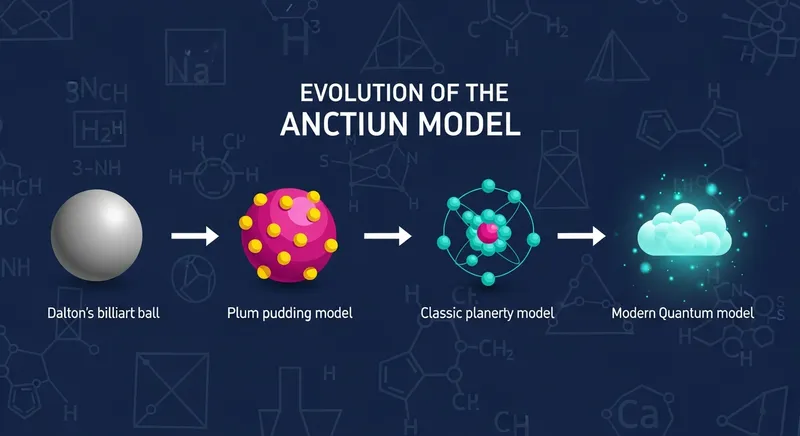
Ever sat in science class, learned about a theory from the 1800s, and thought, "Why do I need this if it's not completely right?" It's a fair question. But what if science isn't a list of facts but a thrilling detective story, with each discovery building on the last? In this story, John Dalton is a key character who took the atom from a philosophical guess to a real scientific theory.
Understanding his work is the first step to seeing the whole picture. This guide will break down Dalton's atomic model, show why it was so important, and connect it to the chemistry you're learning today. Let's make this story make sense so you can ace your next science test.
From Philosophy to Science: Why An Old Theory Matters
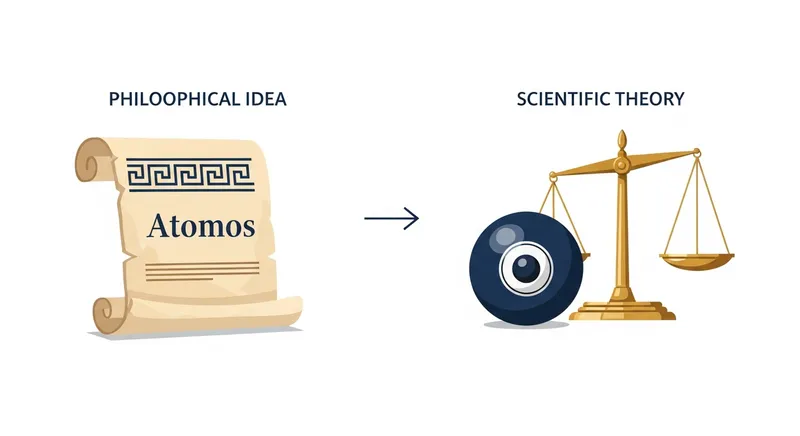
To understand why Dalton's theory was a game-changer, we need to rewind 2,000 years to ancient Greece, where the idea of atoms first emerged not as science, but as philosophy. For centuries, the concept of atoms was just that: an idea people couldn't prove. Then, Dalton came along and changed everything by using experimental evidence to build the first truly scientific model of the atom.
Before the Science: Democritus and 'Atomos'
Long before chemistry labs existed, ancient Greek thinkers were pondering what the world was made of. Around 400 B.C., a philosopher named Democritus suggested that if you kept cutting matter in half, you would eventually reach a point where you couldn't cut it anymore. He called these tiny, uncuttable particles 'atomos,' which means 'indivisible.'
According to the Stanford Encyclopedia of Philosophy, Democritus believed these atoms were eternal, unchangeable, and moved through empty space. It was a brilliant philosophical concept based on logic, but with no way to test it, it remained just an interesting thought for centuries.
John Dalton's Atomic Theory: The First Scientific Model
Fast forward to the early 1800s. Scientists were now using experiments to understand the world. John Dalton, an English chemist, meteorologist, and physicist, was a key figure in this new era. He wasn't just thinking; he was measuring, observing, and drawing conclusions based on evidence.
Who Was John Dalton?
As detailed by the Science History Institute, Dalton's fascination with the weather led him to study gases. He conducted countless experiments on their properties, which led to his famous Law of Partial Pressures. This deep work with how gases mixed pushed him to wonder about the fundamental nature of matter, ultimately leading to his groundbreaking atomic theory.
The 5 Postulates of Dalton's Atomic Theory
Dalton's theory, based on his experimental observations, can be broken down into five main points, or postulates. According to Purdue University's Department of Chemistry, these are the core assumptions that formed his model.
- All matter is made of tiny, indivisible particles called atoms. (He kept Democritus's name for the particle.)
- Atoms of a specific element are identical in mass, size, and other properties. (In his view, every atom of gold is exactly like every other atom of gold.)
- Atoms cannot be created, destroyed, or subdivided. (This supported the Law of Conservation of Mass.)
- Atoms of different elements combine in simple, whole-number ratios to form chemical compounds. (For example, water is always two hydrogen atoms for one oxygen atom, H₂O.)
- In chemical reactions, atoms are combined, separated, or rearranged. (The atoms themselves don't change, they just switch partners.)
An easy way to remember this is to think of atoms like LEGO bricks. You can't cut a LEGO brick in half (it's 'indivisible'). All red 2x4 bricks are identical. You can click them together in simple ratios (one red, one blue) to build different things (compounds). When you take your creation apart to build something new, you still have the same original bricks. This analogy can help you conquer any science word problem involving chemical reactions.
The 'Billiard Ball' Model
Based on his postulates, Dalton imagined atoms as tiny, solid, uniform spheres with no internal parts. Because they were seen as featureless, solid objects, his concept is often called the 'Billiard Ball Model.'
As the Royal Society of Chemistry explains, this model was powerful because it was the first to propose atoms as physical realities that could explain chemical phenomena. It was a simple, solid starting point for all atomic discoveries to follow.
Visualizing atoms can be tricky. Apps like Tutor AI provide step-by-step explanations that help you see how abstract concepts connect to real chemistry problems. Try it free today!
What Was Dalton Wrong About? A Quick Review
Dalton's theory was revolutionary, but science is all about progress. As new evidence emerged, scientists realized some of his postulates weren't quite right. This doesn't make his theory a failure; it shows science in action! As Khan Academy points out, later discoveries didn't erase his work, they refined it. Here's a quick comparison for your next test.
| Dalton's Postulate | The Modern Scientific View |
|---|---|
| 1. Atoms are indivisible. | Atoms are divisible. The discovery of subatomic particles (protons, neutrons, electrons) by J.J. Thomson and others proved atoms have an internal structure. |
| 2. All atoms of an element are identical. | Atoms of an element can have different masses. The discovery of isotopes (atoms with the same number of protons but different neutrons) showed that atoms of the same element are not always identical. |
Think of isotopes like two identical car models. They look and drive the same (same element), but one has a heavier engine, so it weighs more (different mass). This discovery explained observations that didn't fit Dalton's idea, including a mistake he made assuming the formula for water was HO, as noted by Britannica.
From Dalton to Today: A Timeline of the Atom
Understanding how the atomic model evolved is key to seeing the big picture. The history of atomic science, as the U.S. Department of Energy traces it, is built upon these foundational discoveries.
- John Dalton (~1803) - The Solid Sphere Model: Proposed that atoms are indivisible, solid spheres. This was the first scientific model based on evidence.
- J.J. Thomson (1897) - The Plum Pudding Model: Discovered the electron. He proposed the atom was a sphere of positive charge with negative electrons dotted throughout.
- Ernest Rutherford (1911) - The Nuclear Model: His gold foil experiment revealed the atom is mostly empty space with a tiny, dense, positively charged nucleus.
- Niels Bohr (1913) - The Planetary Model: Proposed that electrons orbit the nucleus in specific energy levels or shells. Understanding these energy levels is essential for grasping advanced topics like the photoelectric effect, where light energy ejects electrons from atoms.
If you're trying to spot the differences between Rutherford's and Bohr's models, it can be helpful to see them side-by-side. You can even snap a photo of diagrams in your textbook, and Tutor AI will give you an instant breakdown of how each model works.
Dalton's Legacy: The Foundation of Modern Chemistry
So, was Dalton wrong? In some ways, yes. But his theory was also more right and more important than any that came before it. The American Chemical Society even recognized his work as a National Historic Chemical Landmark.
Remember: Dalton gave chemistry its foundation. Thomson showed atoms have parts. Rutherford found the nucleus. Bohr explained electron orbits. Each discovery built on the last, and that's how science works.
Dalton's atomic theory was the first to give chemistry a solid, quantitative foundation. It explained fundamental laws and laid the groundwork for understanding chemical reactions. By understanding his model, you're not just learning old science; you're learning the first chapter in the story of modern chemistry.
Ready to tackle chemistry with confidence? Download Tutor AI for instant, step-by-step help with any science problem, available 24/7 on iOS and Android.
Frequently Asked Questions
What are the 5 main points of Dalton's atomic theory?
Dalton's theory is built on five core ideas, or postulates, that were revolutionary for their time:
- All matter is made of atoms. These are incredibly small, indivisible particles.
- All atoms of a given element are identical. They have the same mass, size, and properties.
- Atoms cannot be created or destroyed. They simply get rearranged during chemical reactions.
- Atoms combine in simple whole-number ratios. This is why we have formulas like H₂O.
- Chemical reactions involve the rearrangement of atoms. The atoms themselves don't change, but their combinations do.
Why is Dalton's model called the 'billiard ball model'?
It earned this nickname because the model describes atoms as simple, solid spheres with no internal structure. Just like a billiard ball, Dalton's atom was seen as an indestructible, uniform particle. This simple analogy was a powerful way to visualize the first scientific concept of an atom before we knew about protons, neutrons, or electrons.
Which part of Dalton's theory was wrong?
Two key parts of Dalton's theory were later proven to be incorrect as science advanced:
- Atoms are not indivisible. The discovery of the electron, proton, and neutron showed that atoms are made of even smaller, subatomic particles.
- Atoms of the same element are not always identical. The existence of isotopes proved that atoms of the same element can have different numbers of neutrons and therefore different masses. Despite these inaccuracies, his theory was a critical step forward.
What was Dalton's most important contribution to chemistry?
Dalton's single most important contribution was moving the concept of the atom from a philosophical idea to a testable scientific theory. By using experimental evidence from his work with gases to define the properties of atoms, he gave chemists a practical framework to predict and explain chemical reactions. This transformed chemistry into a quantitative science and laid the foundation for virtually all modern chemistry.
How is Dalton's atomic theory different from modern atomic theory?
The biggest difference is complexity and detail. Dalton saw the atom as a solid, indivisible ball. Modern atomic theory describes a far more intricate structure: a dense central nucleus containing protons and neutrons, surrounded by a 'cloud' of electrons moving in complex orbitals, not fixed paths. Our modern understanding also includes concepts Dalton couldn't have imagined, like isotopes, nuclear reactions, and quantum mechanics.
Struggling to keep the different models straight? For parents and students exploring learning tools, our guide to AI homework helpers can be a great place to start.


