
Staring at a science word problem can feel like trying to read a different language. The sentences are long, numbers are mixed with concepts, and it's hard to know where to even begin. If you've ever felt a wave of panic, thinking the words are more confusing than the actual science or math, you are not alone. And whether it's 3 PM or 11 PM, having a reliable strategy makes all the difference.
The secret that top students know is that solving these problems is rarely about being a math genius or a science whiz. It's about having a reliable strategy to translate confusing words into a clear, solvable plan. Most homework apps and answer-finders skip this crucial step, giving you an answer but leaving you just as confused for the next problem. They give you a fish, but they don't teach you how to fish.
This guide does. Whether you're a student feeling stuck, a parent trying to help without just giving the answer, or a tutor looking for a better framework, this universal 5-step method will empower you to break down any science word problem-from physics and chemistry to biology-and build lasting problem-solving confidence.
Why Science Word Problems Seem So Hard (Hint: It's Not Just You)
First, let's validate that feeling of frustration. Science word problems are intentionally designed to be challenging because they test multiple skills at once:
- Reading Comprehension: Can you understand the scenario and pull out key information?
- Conceptual Knowledge: Do you know the underlying scientific principles or formulas?
- Strategic Planning: Can you create a step-by-step plan to get from the information you have to the information you need?
- Mathematical Execution: Can you perform the necessary calculations accurately?
When you're juggling all of that, it's easy to feel overwhelmed by homework. The good news is that you can master this process. It starts by resisting the urge to immediately start calculating.
Stop Calculating, Start Deconstructing: The 'Before You Calculate' Checklist
The biggest mistake students make is grabbing their calculator the moment they see numbers. The most critical work happens before any math begins. To solve a problem like a detective, you must first understand the case.
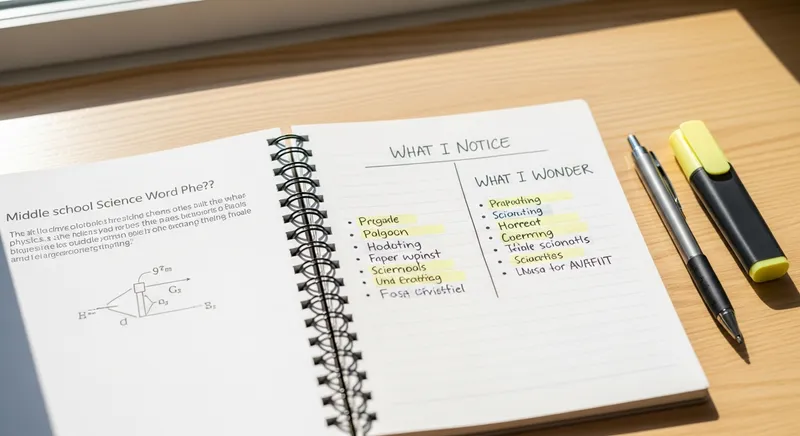
The 'Notice and Wonder' Protocol
A powerful technique recommended by educators at the National Science Teaching Association (NSTA) is to perform a 'Notice and Wonder' review. This simple action shifts your brain from panic mode to analysis mode.
Here's how to do it:
- Read the problem once from beginning to end without writing anything. Just get a sense of the scenario.
- Read it a second time, but this time with a pencil, and make two columns on a separate sheet of paper: "What I Notice" and "What I Wonder."
- In the "Notice" column, list all the concrete pieces of information: every number with its units (e.g., 10 kg, 3.2 m/s), key terms (e.g., "at rest," "constant velocity," "molar mass"), and any given constants.
- In the "Wonder" column, rephrase the core question. What are you actually being asked to find? (e.g., "I wonder what the final velocity will be," or "I wonder how many grams are needed.")
This simple exercise forces you to engage with the text and is the foundation of a structured approach to problem-solving.
The Universal 5-Step Method for Science Problem Solving
Once you've surveyed the scene, you can apply this repeatable 5-step method. This framework is grounded in educational research on how to build critical thinking skills, like the multi-phase model identified by the Journal of Learning Analytics, which was shown to improve student outcomes.
Step 1: Deconstruct the Problem (The Detective's Briefing)
This step formalizes your 'Notice and Wonder' work. Your goal is to create a clear inventory of your information.
- Actionable Tip: Use different colored highlighters. Use one color for all the "knowns" (the data the problem gives you), another for the "unknown" (what you need to find), and a third for words that hint at the concepts involved (like "acceleration," "reaction," or "photosynthesis").
Step 2: Formulate a Plan (Choosing Your Tools)
Now, look at your inventory. What's the relationship between your knowns and your unknown? This is where you strategize.
- Is it a calculation problem? Write down the formula or formulas that connect your knowns and unknown. If you're not sure which formula to use, look at the units! This is a huge clue.
- Is it a conceptual problem? Identify the core scientific principle at play (e.g., Newton's Third Law, conservation of mass, natural selection).
- Is it a conversion problem? Your plan might involve dimensional analysis. Research from the Journal of Chemical Education emphasizes that providing this kind of structured support, or "scaffolding," is crucial for developing these skills.
Pro-Tip: What is Dimensional Analysis? Dimensional analysis is a powerful way to check your work by treating units like algebraic variables. The goal is to make sure your units cancel out correctly to leave you with the unit you need for your final answer. For example, if you are solving for speed (in m/s) and your setup results in units of (m/s²), you know you've used the wrong formula or setup before you even finish the calculation!
Step 3: Execute the Plan (Solving the Case)
This is the step everyone wants to jump to first, but it's only effective now that you've done the prep work. Now, you can confidently plug your knowns into the formula, perform the calculation, or write out your conceptual explanation.
Show every single step of your work. This is non-negotiable. It helps you catch errors and allows teachers to give you partial credit. If you get stuck on the calculation itself, don't give up. This is the perfect moment to use a learning tool for support. Instead of searching for a simple answer-finder, use a tool like Tutor AI that explains the process. You can snap a photo of your work, and it will provide step-by-step explanations to guide you through the calculation, reinforcing the method without just giving away the solution.
Step 4: Check Your Work (The Reality Check)
Before you circle your answer and move on, stop and ask: Does this answer make sense?
- Unit Check: As explained in guides on dimensional analysis in chemistry education, you can ensure your setup is correct by making sure your units cancel out properly to give you the expected unit for the answer. A brilliant tip is to "work backwards from the unit of your answer" to set up the problem correctly from the start.
- Sanity Check: If you calculated the speed of a thrown baseball to be 5,000 m/s, you've likely made a mistake. If you calculated a negative mass, something went wrong. This quick mental check is invaluable.
Step 5: Communicate Your Answer (Presenting Your Findings)
In science, a number is rarely the complete answer. You need to present it with the correct units and, often, in the context of the question. This is where the CER method becomes your best friend.
Your 5-Step Method Checklist
For a quick reference, here is the process summarized. Screenshot this list!
- 1. Deconstruct: List all knowns (with units) and the final unknown you need to find.
- 2. Plan: Identify the core concept and choose the right formula or strategy.
- 3. Execute: Show your work as you plug in the numbers and solve the problem.
- 4. Check: Make sure your units canceled correctly and do a quick sanity check of the answer.
- 5. Communicate: Write your final answer clearly with the correct units.
Putting It All Together: A Worked Example
Let's apply the 5-step method to a simple chemistry problem.
Problem: A block of aluminum has a mass of 540 grams and a volume of 200 cm³. What is the density of the aluminum?
- Deconstruct:
- Knowns: Mass (m) = 540 g, Volume (V) = 200 cm³
- Unknown: Density (d) = ? g/cm³
- Plan:
- The relationship connecting mass, volume, and density is the formula:
Density = Mass / Volume.
- The relationship connecting mass, volume, and density is the formula:
- Execute:
d = 540 g / 200 cm³d = 2.7 g/cm³
- Check:
- Unit Check: The units are grams divided by cm³, which gives g/cm³. This is the correct unit for density. The setup is correct.
- Sanity Check: 2.7 g/cm³ is a reasonable density for a metal. (A quick search confirms this is the accepted density of aluminum).
- Communicate:
- The density of the aluminum block is 2.7 g/cm³.
Going Beyond the Math: Using the CER Method
Many science questions don't involve math at all. The Claim-Evidence-Reasoning (CER) method is the perfect tool for structuring a logical, scientific answer. As educators explain, CER is a framework for constructing scientific explanations.
- Claim: A direct, one-sentence answer to the question.
- Evidence: The data, observations, or facts from the problem (or your knowledge base) that support your claim.
- Reasoning: The scientific principle, rule, or definition that explains how your evidence proves your claim.
Example (Non-Math):
- Question: Why do plants in a dark closet grow tall and spindly?
- Claim: The plants are growing tall and spindly due to a lack of light, a phenomenon known as etiolation.
- Evidence: The problem states the plants are in a dark closet and are described as "tall and spindly."
- Reasoning: Plants require light for photosynthesis to produce energy. In the absence of light, they redirect their energy from leaf production to rapid stem elongation, trying to grow quickly towards any potential light source. This results in a pale, weak, and spindly structure.
Practicing this framework will dramatically improve your short-answer responses on any science test. For more tips on studying, check out these 12 proven study strategies to ace your science test.
Specific Strategies for Tough Subjects
While our 5-step method is universal, certain subjects benefit from specific tactics.
Physics Problem Solving Strategies
Physics is notorious for its word problems. The key is to visualize. Always start by drawing a diagram (a free-body diagram for force problems, a simple sketch for kinematics). Label all your knowns and unknowns on the diagram. This visual representation makes it much easier to select the right formula and apply it correctly.
Chemistry Problem Solving Steps
Chemistry problems often revolve around the mole and stoichiometry. Dimensional analysis is your most powerful tool here. Practice setting up conversion chains to go from grams to moles, moles to molecules, etc. Before you do anything else, make sure your chemical equation is balanced. A tool that helps you learn how to balance chemical equations can build a strong foundation.
A Guide for Parents and Tutors: How to Help Without Giving the Answer
It's painful to watch a child struggle. The instinct is to just show them the answer to ease their frustration. But this robs them of a crucial learning opportunity. Instead, use the 5-step method to guide them with questions.
- Instead of saying "Use this formula," ask: "What information does the problem give you? What are you trying to find? What formulas do you know that connect those things?"
- Instead of saying "Your answer is wrong," ask: "Does that answer seem reasonable to you? Let's check the units. Did they cancel out correctly?"
This Socratic approach builds their critical thinking and independence. You become a guide, not a crutch. Tools designed for learning can be a game-changer. With Tutor AI, the exclusive parent dashboard gives you visibility into your child's learning journey. You can see which concepts they're mastering and where they're getting stuck, turning "How was school?" into a specific, supportive conversation like, "I saw you were working on density problems-how's that going?" This data empowers you to support them more effectively. Comparing options in a parent's guide to homework apps can be very insightful.
Stop Guessing, Start Understanding
Feeling ready to tackle your next science problem with confidence? The 5-step method is your road map, and Tutor AI is the perfect guide for the journey. Snap a photo of any problem-from physics to chemistry-and get clear, step-by-step explanations 24/7.
Download Tutor AI for free on iOS and Android and turn homework frustration into learning moments.
Frequently Asked Questions
How do you break down a science word problem?
The best way to break down a science word problem is to use a systematic process before you start calculating. Read the problem twice. On the second read, create two lists: "Knowns" (all the numbers and data given to you, with their units) and "Unknowns" (what the question is asking you to find). Highlighting these elements directly in the text can also be very effective. This separates the crucial information from the story and gives you a clear inventory to work with.
What is the first step in solving any science problem?
The first and most important step is to understand the problem fully. This means resisting the urge to immediately search for a formula. Instead, read the problem to comprehend the scenario. The 'Notice and Wonder' protocol mentioned in this article is an excellent first step. By listing what you notice (the data) and what you wonder (the core question), you are forced to analyze the problem statement itself, which sets you up for success in all the following steps.
How can I get better at physics word problems?
Improvement in physics problems comes from visualization and strategy. For almost every physics problem, you should start by drawing a diagram. For motion, draw the path and label vectors. For forces, draw a free-body diagram. This act of translating words into a visual model helps you identify all the forces and variables at play. Consistently applying the 5-step method, especially the 'Deconstruct' and 'Plan' steps, will build the strategic thinking that physics problems demand.
How do you identify variables in a word problem?
Variables are the quantities in a problem. To identify them, look for numbers and the words that describe them. Pay close attention to units (like kg, m/s, J, or mol) as they are huge clues to what the variable represents (mass, velocity, energy, or moles). The 'unknown' variable is usually identified by phrases like "What is...?", "Find the...", or "Calculate the...". Assigning a symbol to each variable (e.g., m for mass, v for velocity) can help organize your thoughts.
Is there an app that solves science word problems and explains the steps?
Yes. While many apps simply provide a final answer, some are designed to teach the problem-solving process. Tools like Tutor AI are built for this purpose. You can take a picture of your problem, and the app will provide a detailed, step-by-step explanation showing how to get to the solution. This is more effective for learning than just seeing the answer because it helps you understand the method, which you can then apply to other problems.