
That sinking feeling. You're staring at a paragraph of text full of names, numbers, and questions, and your mind goes blank. It's not a math problem; it's a story problem, and it feels like you need to be a detective, not a math student. If this sounds familiar, you are not alone. Algebra word problems are consistently one of the biggest stumbling blocks in math, leaving students and parents feeling frustrated and stuck.
But what if there was a simple, reliable framework you could use to decode any word problem? A method that turns confusion into clarity and helps you translate those tricky sentences into solvable equations. There is. This guide will walk you through a simple 4-step process to confidently solve algebra word problems, with concrete examples to show you how it's done.
Why Do We Struggle With Algebra Word Problems?
Before we dive into the solution, it's helpful to understand why these problems are so tough. If you find them hard, you're not just "bad at math." In fact, your struggles might have more to do with reading than with numbers. Research published by the National Institutes of Health (NIH) shows a significant link between reading comprehension and a student's ability to solve math word problems. You have to understand the story before you can solve the equation hidden inside it.
For years, students were taught to look for "keywords," a strategy that often fails with more complex problems. As The Hechinger Report points out, this trick is a crutch that doesn't build true understanding. When a problem has multiple steps or complex language, simply grabbing keywords can lead you down the wrong path. These challenges are often some of the first academic red flags that a student might need a new strategy.
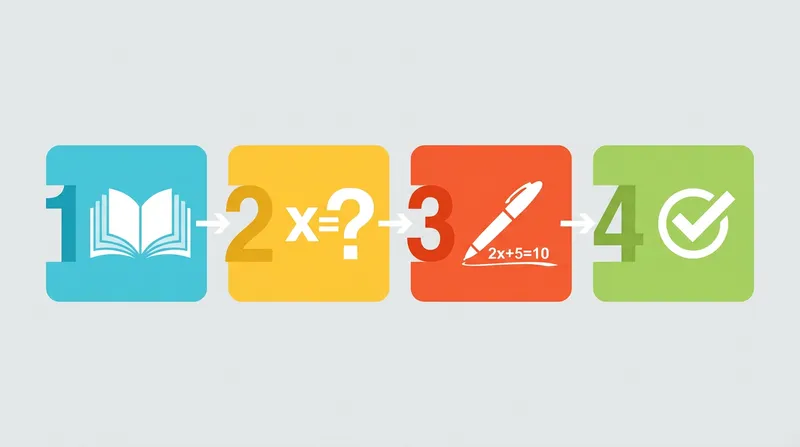
Your 4-Step Framework to Translate Word Problems Into Equations
Instead of looking for shortcuts, the key is to have a consistent process. The U.S. Department of Education's Institute of Education Sciences (IES) recommends that helping students learn to solve problems is a primary goal of mathematics instruction. A systematic approach is one of the most effective ways to do this. We've broken it down into four simple, memorable steps that work every time.
- Read & Understand: Figure out what the story is about and what you need to find.
- Define Variables: Give names to the unknown values.
- Write the Equation: Translate the words into the language of algebra.
- Solve & Check: Do the math and make sure your answer makes sense.
Let's break down each step.
Step 1: Read for Understanding (Not Just for Numbers)
Before you even think about your calculator, you need to understand the narrative. Try scanning the problem first to get a feel for it, then read it at least twice. The first time, just get a general idea of the situation. The second time, focus on the details.
As a guide from Edutopia suggests, the most important thing is to understand exactly what the problem is asking for. Ask yourself: What is my final goal? Are you looking for a distance, an age, a number of objects, or a price?
- Actionable Tip: Use a highlighter to mark the specific question being asked. Then, underline all the pieces of information (the numbers and facts) the problem gives you. Try rephrasing the entire problem in your own words. If you can explain it to someone else, you understand it.
Step 2: Define Your Variables (Give Names to Your Unknowns)
This step is where you start bridging the gap between words and math. A variable is simply a letter (like x or y) that holds the place of a number you don't know yet. According to guidance from Tacoma Community College, creating a clear 'dictionary' for your variables is a crucial organizational step.
Identify the primary unknown—the thing you are asked to find—and assign it a variable. A great practice is to write it down clearly.
- For example: If the problem asks, "How old is Tom?" you should write: Let t = Tom's age.
This simple step transforms confusing sentences into clear mathematical components, making complex problems manageable and less daunting. If there are other unknown quantities, try to define them using the same variable. If the problem also says, "Sarah is 5 years older than Tom," you would write:
- Let t = Tom's age
- Let t + 5 = Sarah's age
Now you have a name for every unknown piece of the puzzle.
Step 3: Write the Equation (Translate English to Math)
This is the heart of the process: translating the sentences of the problem into a single mathematical equation. The National Council of Teachers of Mathematics (NCTM) emphasizes that problem solving is an integral part of all mathematics learning, and this translation is a core skill. Use your variables from Step 2 and look for words and phrases that correspond to mathematical operations.
Here's a quick translation cheat sheet:
| English Phrase | Math Operation |
|---|---|
| is, are, was, will be, equals | = |
| sum, plus, more than, increased by | + |
| difference, minus, less than, decreased by | - |
| product, of, times, twice | × |
| quotient, per, divided by, ratio | ÷ |
💡 Pro-Tip: If you're struggling to translate a sentence, try rephrasing it in simpler English first. Then, translate each simplified piece into math.
Combine your variables with these operations to tell the story of the problem. If "The sum of Tom's age and Sarah's age is 35," you would translate that into:
t + (t + 5) = 35
You've successfully translated the word problem into an equation.
Step 4: Solve the Equation and Check Your Answer
Now it's time for the straightforward math. Use the rules of algebra to solve for your variable.
- t + (t + 5) = 35
- 2t + 5 = 35
- 2t = 30
- t = 15
So, Tom is 15 years old. But you're not done! The most critical part of this step is checking your answer. Don't just plug the number back into your equation; plug it into the original word problem.
Does it make sense? If Tom is 15, and Sarah is 5 years older, she is 20. Is the sum of their ages (15 + 20) equal to 35? Yes. Your answer is reasonable and correct.
Common Algebra Word Problem Examples (Using the 4-Step Method)
Let's put the framework into action. The more you practice, the more you'll see that this method works for all types of problems, making personalized learning paths for mastering them even more effective.
Example 1: Consecutive Integer Problem
Consecutive integer problems often seem tricky because they involve multiple unknown numbers. Here's how the framework makes them simple.
Problem: The sum of three consecutive integers is 147. What are the integers?
- Step 1: Read & Understand. I need to find three integers that are right next to each other (like 5, 6, 7) and add up to 147.
- Step 2: Define Variables. Let x = the first integer. Since the integers are consecutive, the next ones will be x + 1 and x + 2.
- Step 3: Write the Equation. The "sum" of the three integers "is" 147. So: x + (x + 1) + (x + 2) = 147
- Step 4: Solve & Check.
- 3x + 3 = 147
- 3x = 144
- x = 48
- The integers are 48, 49, and 50. Check: 48 + 49 + 50 = 147. It works!
Example 2: Age Problem
Age problems can be confusing because they often involve two different points in time. Let's break it down.
Problem: A father is 30 years older than his son. In 8 years, the father will be twice as old as his son. How old is the son now?
- Step 1: Read & Understand. This involves two points in time: now and 8 years from now. I need to find the son's current age.
- Step 2: Define Variables. Let s = the son's age now. The father is 30 years older, so his age now is s + 30.
- Step 3: Write the Equation. This is about the future. In 8 years, the son will be s + 8 and the father will be (s + 30) + 8. At that time, the father "will be" twice the son's age.
- (s + 30) + 8 = 2 * (s + 8)
- Step 4: Solve & Check.
- s + 38 = 2s + 16
- 22 = s
- The son is 22 years old now. Check: If the son is 22, the father is 52. In 8 years, the son will be 30 and the father will be 60. Is 60 twice 30? Yes. It works!
Stuck on the Algebra? How to Check Your Work and Learn the Steps
Following these steps helps you build the equation, but what happens if you get stuck on the solving part or want to quickly confirm your setup is correct? This is where modern learning tools can be incredibly helpful.
Instead of getting frustrated, you can use a study companion like TutorAI to reinforce your learning. After you've written your equation in Step 3, you can use the photo-solve feature to see the full, step-by-step solution. This doesn't just give you the answer; it models the correct process for you, helping you pinpoint exactly where you went wrong or confirming that you're on the right track. It's like having a tutor available 24/7 to check your work and explain the process, so you're not just solving one problem—you're learning how to solve all problems like it.
More Tips for Solving Algebra Word Problems
As you practice the 4-step framework, here are a few extra tips that educators and learning experts recommend:
- Draw a Picture: For problems involving geometry, distance, or physical objects, a quick sketch can make the relationships between the numbers much clearer.
- Talk it Through: As recommended by Edutopia, discussing the problem with someone else can help you process the information. This is a great opportunity for parent involvement in homework.
- Practice, Practice, Practice: The more word problems you attempt, the more familiar the patterns become. Start with easier problems to build confidence and work your way up.
You Can Solve This
Algebra word problems don't have to be a source of stress and anxiety. Remember that sinking feeling of staring at a problem with your mind going blank? That's behind you now. By trading guesswork for a reliable strategy, you have a system that turns confusion into clarity, every single time.
Remember the four steps: Read & Understand, Define Variables, Write the Equation, and Solve & Check.
Practice this method, and you'll build the skills and confidence to tackle any problem that comes your way. And for those moments when you need a little extra help, tools like TutorAI are there to provide instant, step-by-step explanations to keep you learning and moving forward. You've got this.
Frequently Asked Questions
What is the easiest way to solve algebra word problems?
The "easiest" way is to have a reliable plan! Think of it like a recipe instead of guessing ingredients. Our 4-step framework gives you the exact process to follow, which calms that initial panic and builds real confidence with every problem you solve.
How do you write an equation from a word problem?
Start by finding the goal of the problem. Then, give the main unknown value a simple name (like x). Now, act like a translator: look for keywords that mean math symbols (=, +, -, ×) and use your variable to build a sentence that tells the story of the problem mathematically.
What are the most common types of algebra word problems?
You'll often see problems about ages, consecutive numbers, mixtures, money, distance/rate/time, and geometry (like perimeter or area). The good news is, the more you practice these types, the faster you'll recognize their patterns!
Is there an app that can solve math word problems?
Yes, but the best apps are teachers, not just answer keys. A learning tool like TutorAI uses photo-solve technology to provide detailed, step-by-step explanations. The goal isn't just to get the answer for one problem, but to learn the process so you can solve the next one all on your own.
Why is reading comprehension so important for math word problems?
Authoritative research shows it's huge! You must first comprehend the 'story' in the problem before you can pull out the math. If you can't explain what the problem is asking for in your own words, you can't build the right equation. It's a reading challenge as much as a math one.
How can I get better at algebra word problems?
Consistent practice with a good strategy is everything. Use the 4-step framework on every problem, even the easy ones. Start simple to build momentum, and always check your work. Every mistake you find and fix is a lesson learned. You'll be amazed at how quickly your skills and confidence grow.