
That feeling of dread before a big science test is universal. You're facing a textbook full of complex terms, formulas you can't seem to remember, and abstract concepts that just won't click. It feels like you have to memorize an entire encyclopedia, and the pressure is on.
The core problem many students face is that generic study advice like "review your notes" or "read the chapter" simply doesn't work for the unique challenges of science. Biology, Chemistry, and Physics each demand a different approach, and trying to study for them all in the same way leads to frustration and burnout. Students are left feeling overwhelmed, with no clear roadmap to success.
This guide is different. We're going to give you a clear, actionable playbook with 12 proven strategies tailored for the sciences. You'll learn not just what to do, but how to do it for your specific class, transforming you from a passive reviewer into an active, confident learner.
The Foundational Strategies for Every Science
Before we dive into subject specifics, let's build a strong foundation. These core techniques are based on decades of cognitive science and are proven to help you study smarter, not harder.
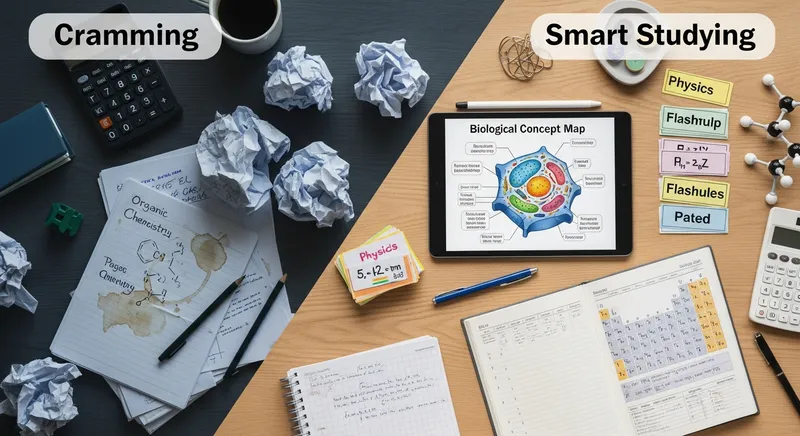
Strategy 1: Stop Cramming, Start Spacing
Your brain is a muscle, not a hard drive. You can't just download all the information the night before a test and expect it to stick. The most effective way to build strong, long-lasting knowledge is through spaced repetition.
What it is: Instead of one marathon 8-hour study session, you study in shorter bursts over several days or weeks. This technique works with your brain's natural "forgetting curve." By revisiting information just as you're about to forget it, you signal to your brain that this information is important and should be moved to long-term memory. Research published in journals like the Proceedings of the National Academy of Sciences (PNAS) and studies on physics students confirm that spacing out your study sessions dramatically improves long-term retention compared to cramming.
How to do it:
- Plan Ahead: After a lecture, schedule a quick 15-20 minute review for the next day.
- Weekly Review: Dedicate one hour each weekend to review the concepts from that week.
- Use Technology: Apps like Anki, Quizlet, or Tutor AI can automate a spaced repetition schedule and track your progress so you know which topics need more attention.
Strategy 2: Become an Active Learner with Active Recall
If spacing is when you study, active recall is how you study. Passively re-reading notes or highlighting a textbook is one of the least effective ways to learn. Your brain needs to work to retrieve information to strengthen neural connections. According to Birmingham City University, this retrieval practice is what truly cements learning.
What it is: Active recall (or retrieval practice) means actively trying to pull information out of your brain, rather than passively putting it in. It's the difference between reading a map and trying to draw it from memory.
How to do it:
- The Blurting Method: After reading a section in your textbook, close the book and write down everything you can remember on a blank sheet of paper. Then, open the book and fill in the gaps with a different colored pen.
- Teach a Friend: Try to explain a concept (like photosynthesis or Newton's Third Law) to a friend, family member, or even just to yourself. The act of organizing your thoughts to teach it will reveal what you truly understand.
- Practice Problems: Don't just look at solved problems. Start with a blank page and work through them yourself. This is especially critical for math-heavy subjects.
Strategy 3: Master the Language of Science
Science is full of complex vocabulary that can feel like learning a new language. Understanding the building blocks of scientific terms can help you decode their meaning.
How to do it:
- Break It Down: Many science words are made of Greek and Latin roots. For example, in Biology, knowing that "cyto" means cell unlocks cytoplasm and cytoskeleton. In Chemistry, understanding "hydro" (water) and "philic" (loving) makes the term "hydrophilic" instantly clear.
- Create Your Own Dictionary: Keep a running list of new terms. But don't just copy the textbook definition. Re-write the definition in your own words, as simply as possible.
- Connect to a Visual: Draw a picture or find a diagram that illustrates the term. For "endoplasmic reticulum," you might draw a network of tubes inside a cell.
Subject-Specific Game Plan
Now, let's apply these foundational skills to the unique challenges of each major science. Science requires a combination of different technical skills, so your study approach should be multifaceted.
Biology: Mastering Concepts and Memorization
Biology is often characterized by a vast amount of information, from cellular processes to entire ecosystems. The key is to see the connections, not just memorize a list of facts.
Strategy 4: Focus on Processes, Not Just Parts
Don't just memorize the parts of a cell. Understand the process of cellular respiration. Draw out the steps, explain what happens at each stage, and understand the overall purpose.
Strategy 5: Use Active Recall for Anatomy
For subjects like anatomy, which do require heavy memorization, active recall is your best friend. As explained by Kenhub, forcing yourself to recall names of bones or muscles without looking at a diagram is incredibly effective for building memory.
Strategy 6: Draw, Draw, Draw
Draw everything. The carbon cycle, the Krebs cycle, the process of mitosis. Drawing forces you to engage with the material on a deeper level and reveals what you truly understand.
Chemistry: Conquering Problems and Formulas
Chemistry combines abstract concepts with mathematical problem-solving. Success requires a methodical, step-by-step approach.
Strategy 7: Adopt a Problem-Solving Method
Don't just jump into the math. Follow a structured approach like the one recommended by Chemistry LibreTexts: Read the problem carefully, Plan your steps (identify knowns, unknowns, and formulas), Solve the math, and Check your answer (does it make sense?).
Strategy 8: Understand, Don't Just Memorize Formulas
For every formula, write down what each variable stands for, what units it uses, and when you would use it. Group formulas by concept. For example, when you're learning how to balance chemical equations, focus on the principle of conservation of mass rather than just memorizing steps.
Strategy 9: Practice Relentlessly and Get Unstuck Fast
The only way to get good at chemistry problems is to do them. Work through practice problems from your textbook, online resources, and past exams. When you get stuck, don't just look up the answer.
Tutor AI Pro-Tip: Getting stuck on a practice problem is a learning opportunity, not a dead end. Instead of searching for answers on forums like Brainly (check out our guide on Is Brainly Legit?), snap a photo of the problem with Tutor AI. You'll get an instant, step-by-step explanation that teaches you the process, so you can solve the next one on your own.
Physics: Building Conceptual Understanding
Physics is less about memorization and more about deep conceptual understanding. You need to understand the why behind the laws of the universe. As experts at the Stanford Center for Teaching and Learning advise, you must clarify foundational concepts before moving on to more advanced topics.
Strategy 10: Put Concepts Before Math
Before you plug numbers into an equation for Faraday's Law of Induction, can you explain what it means in simple terms? The math is just a tool to describe the concept. Grab a whiteboard, pretend you're the teacher, and explain a concept like inertia or torque from start to finish. If you get stuck, you've found a gap in your knowledge.
Strategy 11: Connect Physics to the Real World
Physics describes everything around you. Why does a curveball curve? How does your phone charger work? As research from the U.S. Department of Education's ERIC database highlights, learning is most effective when it's connected to real-world phenomena. Making these connections will make the concepts stick.
Test Day Success
How you manage the hours before and during the test is just as important as how you study.
Strategy 12: Master Your Pre-Test and Test-Day Ritual
- The Night Before: Do a final, light review. Don't try to learn new concepts. Pack your bag with everything you need: pencils, calculator (with fresh batteries!), and a watch.
- The Morning Of: Eat a balanced breakfast with protein and complex carbs, not just sugar. Avoid frantically reviewing notes right before you walk in; at this point, trust your preparation.
- During the Test: Do a quick brain dump of key formulas on your scratch paper as soon as you begin. Read the directions carefully. Tackle the questions you know first to build confidence and momentum.
Feeling anxious is normal, but if it's getting in the way of your performance, check out these proven strategies for reducing homework anxiety and procrastination.
What About Cramming? A Damage-Control Plan
Ideally, you use the strategies above and avoid cramming. But let's be realistic, sometimes it happens. If you have less than 24 hours, you need a triage plan, not a comprehensive review.
Warning: This is for emergencies only and will not lead to long-term learning. It is a last-resort attempt to maximize points.
- Triage Your Topics: You can't learn everything. Scan your notes and syllabus to identify the main themes. Focus on concepts that were emphasized in class or appeared in multiple lectures.
- Focus on Big Ideas: Forget tiny details. For each major topic, create a summary with key definitions, one or two major formulas, and a key example problem.
- Get Instant Help: In a cram session, every minute counts. You can't afford to be stuck. This is where AI homework solvers are invaluable. While some students use Photomath or Chegg (see our Photomath vs. Chegg comparison), Tutor AI's photo-based problem solving gives you instant, step-by-step solutions to get you moving again.
- Sleep: Get at least 6-7 hours of sleep. Pulling an all-nighter is counterproductive. Your brain consolidates memories during sleep, and showing up exhausted is a recipe for disaster.
Your Action Plan for Acing Science
Success in science isn't about being a genius; it's about having the right strategies. By moving from passive reviewing to active learning, you can conquer any subject. Remember the core principles: study in short, spaced-out sessions, actively recall what you've learned, and tailor your approach to the unique demands of Biology, Chemistry, and Physics.
Don't let a tough problem stop your progress. When you need help, it's just a snapshot away.
Ready to put these strategies into action? Download Tutor AI for instant, step-by-step explanations 24/7 and turn study time into learning time.
Frequently Asked Questions
How can I effectively memorize science concepts?
True memorization in science isn't about rote learning; it's about deep understanding. The best way to memorize concepts is to connect them to a larger picture. Use active recall methods like drawing diagrams from memory (e.g., the Krebs cycle), explaining a concept to someone else in simple terms, or using the blurting method described in Strategy 2. For vocabulary and formulas, create flashcards and use spaced repetition to review them over several days. This tells your brain the information is important and moves it from short-term to long-term memory.
What is the best way to create a science study guide?
Don't just copy your notes. A great study guide is a condensed, actively created resource. For each major unit, dedicate a page and divide it into sections: Key Vocabulary (defined in your own words), Core Concepts (a 1-2 sentence summary of each big idea), Key Diagrams/Processes (simplified drawings of things like mitosis or a circuit), and Practice Problems (write down 1-2 representative problems and solve them). Creating this guide is a form of active recall and is a powerful study method in itself.
How do you get an A on a science test?
Students who consistently get A's do more than just study before the test; they engage with the material all semester. They ask questions in class, do all the practice problems (not just the required ones), and review their notes briefly after each lecture. Crucially, they focus on understanding the 'why' behind concepts, not just the 'what'. They analyze their mistakes on homework and quizzes to find weak spots, then use active recall and practice to strengthen those areas. It's a process of consistent, active engagement, not last-minute cramming.
How can I study for a science test without reading the textbook?
While reading the textbook is highly recommended, you can still study effectively by focusing on other high-impact resources. Your class notes are the most important guide to what the teacher thinks is important. Supplement these by watching videos (like Khan Academy or Crash Course) that explain the concepts visually. Most importantly, focus your time on doing practice problems. Working through problems from worksheets, past quizzes, and online resources forces you to apply concepts, which is a far more active and effective study method than passive reading.
What is the difference between studying for a multiple-choice science test and a problem-solving test?
For multiple-choice tests, you need both broad knowledge and the ability to spot subtle differences. The distractors (wrong answers) are often designed to be partially correct. Practice identifying why the wrong answers are wrong. This deepens your conceptual understanding. For problem-solving tests (common in Chemistry and Physics), your focus must be on process and application. Spend the majority of your time practicing problems, following a consistent method like READ-PLAN-SOLVE-CHECK. The goal is to master the step-by-step process, not just memorize the final answers.


