
Free Digital SAT Practice Tests: The Ultimate Guide to Finding and Learning From Them
Preparing for the SAT can feel like a monumental task. With the average student spending dozens of hours on test prep, finding time and the right resources between school, extracurriculars, and life can be stressful for students and parents alike. You know that practice is key, but with so many options out there, how do you find the best free digital SAT practice tests? And more importantly, how do you use them to actually improve your score?
Here's the secret: simply taking test after test isn't the most effective strategy. The real magic happens when you learn how to review your results, understand your mistakes, and turn that knowledge into a targeted study plan. This guide is built to help you do exactly that. First, we'll show you where to find the highest-quality official practice tests. Then, we'll walk you through a powerful, step-by-step process to turn every practice test into an active learning session that builds your confidence and boosts your score.
Part 1: Where to Find the Best Free Digital SAT Practice Tests
To prepare effectively, you need practice materials that accurately reflect the real digital SAT. That means using questions and platforms created by the test-makers themselves or their official partners. Forget questionable online quizzes; sticking to these trusted sources will give you the most realistic and beneficial practice.
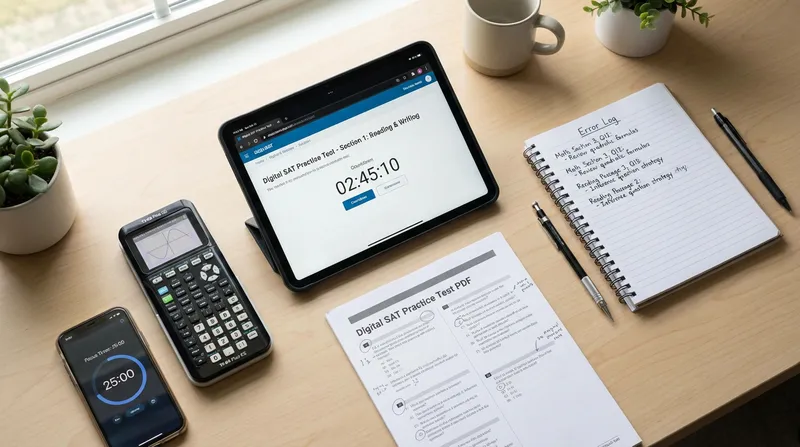
The Gold Standard: Official Bluebook™ Practice Tests
The absolute best resource for digital SAT practice comes directly from the source: the College Board. They offer their Bluebook™ app, which is the same application you'll use on test day. This is, without a doubt, the gold standard for practice.
According to the College Board's official site, using Bluebook is the best way to simulate the real testing experience. Here's why it's essential:
- It's Fully Adaptive: The digital SAT is an adaptive test, meaning the difficulty of the second module is determined by your performance on the first. Bluebook is the only free tool that perfectly replicates this adaptive format, giving you a true feel for the test's pacing and structure.
- It Mimics the Real Test: From the on-screen calculator to the question-flagging tools, everything in the app is identical to what you'll see on your official test day.
- You Get an Instant Score: Once you finish, you'll receive your score immediately, helping you track your progress over time.
For Pen-and-Paper Study: Official Digital SAT Practice Test PDFs
Sometimes, you just want to work with a physical copy. Whether you have accommodations that require a paper test or simply prefer to review questions away from a screen, the College Board has you covered. They provide official linear (non-adaptive) versions of the digital SAT that you can download and print.
These downloadable PDF practice tests are fantastic for deep-diving into individual questions. While they don't adapt, they contain the same types of questions you'll face on the digital exam, making them a valuable tool for your prep arsenal.
The Official Practice Partner: Khan Academy's Question Bank
Beyond full-length tests, you need a way to drill specific skills. For this, look no further than Khan Academy, the College Board's official practice partner. It's a completely free resource packed with thousands of official practice questions, articles, and instructional videos.
After taking a full-length practice test, Khan Academy is the perfect place to go for targeted practice. If you discover you're struggling with a specific type of math problem or grammar rule, you can find a wealth of exercises to help you master it. It's an essential part of any smart SAT study plan and a great way to build your general study skills.
Part 2: How to Review Your SAT Practice Test and Actually Improve
Finding the tests is the easy part. The secret to raising your score lies in what you do after the test is over. A low score isn't a failure; it's a diagnostic tool that tells you exactly what you need to work on. Let's transform your review process from a passive glance at your score into an active system for improvement.
Step 1: Understand Your Score Report
Your score report is more than just a number. As experts at The Princeton Review explain, the digital SAT report provides a total score, two section scores, and crucial performance indicators across different content areas. Don't just focus on the 400-1600 total. Look deeper.
Did you excel in "Craft and Structure" but struggle with "Standard English Conventions"? Were you strong in "Algebra" but weak in "Advanced Math"? Your score report is a treasure map pointing directly to your areas of opportunity. Use it to guide your focus.
Step 2: Create an Error Log and Identify Patterns
This is the most critical step for effective learning. An error log is a simple chart where you analyze every single question you got wrong. It helps you move past the frustration of a mistake and into the mindset of a detective. For each error, record:
- The Question #: So you can find it again.
- The Correct Answer: What the answer should have been.
- The Reason for the Error: Be honest! Why did you get it wrong?
Categorize your reasons into three main types:
- Careless Mistake: You knew the content but misread the question or made a simple slip-up.
- Time-Pressure Error: You rushed and made a mistake you wouldn't have otherwise.
- Content Gap: You genuinely didn't know the material or how to solve the problem.
Here's a simple template you can use:
| Question # | Correct Answer | My Answer | Reason for Error (Careless, Time, Content Gap) |
|---|---|---|---|
| Math M1, #12 | C | A | Content Gap: Forgot the formula for the area of a circle. |
| R&W M2, #5 | B | D | Careless Mistake: Misread the question; looked for the opposite. |
| Math M2, #21 | D | B | Time-Pressure Error: Rushed at the end and made a calculation error. |
After categorizing your errors from one test, you'll see clear patterns. Are most of your mistakes careless? You need to work on focus. Are they content gaps in geometry? You now know exactly what to study. As test prep leader Kaplan advises, you should even review questions you got right to see if there was a faster way to solve them. This is one of the best study tips for any test.
Step 3 (The Secret Weapon): Use TutorAI for Instant Explanations
Your error log is filled. You've identified your 'Content Gaps.' Now what? In the past, you might get stuck staring at a problem, unable to understand the official explanation. This is where modern learning tools can be a game-changer.
This is where the "Snap. Solve. Learn." power of TutorAI comes in. For every single question in your error log marked as a 'Content Gap,' simply open the TutorAI app and snap a picture of the problem.
Instantly, you'll get a clear, step-by-step explanation walking you through the exact process to get the right answer. It's like having a personal AI Tutor on call 24/7, ready to explain the 'why' behind every answer. This turns a frustrating review session into a powerful, one-on-one learning moment, ensuring you never have to move on from a problem without truly understanding it.
Step 4: Turn Insights into an Action Plan
Now it's time to put it all together. Your error log and TutorAI explanations have shown you exactly where your weaknesses are. Create a simple, targeted action plan.
- If you have lots of Algebra 'Content Gaps': Spend the next week doing targeted Algebra practice on Khan Academy. Use TutorAI to get detailed explanations for any questions that stump you and to practice similar problems to ensure mastery.
- If you have many 'Careless Mistakes': Practice mindfulness and double-checking your work on your next set of practice questions. Slow down to speed up.
- If 'Time-Pressure' is your issue: Use the timer on Bluebook or your phone to do short, timed practice sets to build your speed and confidence under pressure.
This focused approach is far more effective than just taking another full-length test. It's the essence of smart homework help and self-study.
Targeted Practice for Each SAT Section
Knowing the test's structure helps you tailor your practice. Here's what to focus on for each section.
Reading and Writing: The digital SAT features much shorter reading passages than the old paper test, with only one question per passage. Some watchdog groups like FairTest have noted that the passage complexity has also been reduced. This means you should focus on quickly identifying the main claim of a passage and mastering Standard English grammar rules. Pay special attention to subject-verb agreement, pronoun clarity, and proper punctuation like commas and semicolons.
Math: A huge change for the digital SAT is that you can use a calculator on the entire Math section! The test has a great built-in Desmos calculator, so get familiar with it. The majority of questions fall under Algebra and Advanced Math. Master key concepts like linear equations, systems of equations, and quadratic functions. If you struggle with turning text into equations, check out this guide to solving algebra word problems.
Your Path to a Better SAT Score Starts Now
Success on the digital SAT isn't about memorizing thousands of words or endlessly grinding through tests. It's about practicing with the right materials and, most importantly, having a smart strategy to learn from your mistakes. By combining official practice tests from the College Board with a powerful review process, you can study with confidence and purpose.
Ready to make every practice question count? Download TutorAI and turn your review sessions into powerful learning moments. Snap. Solve. Learn.
Frequently Asked Questions
Are the free digital SAT practice tests adaptive?
Yes, the official tests on the College Board's Bluebook™ app are fully adaptive, just like the real exam. This means your performance on the first section (or "module") determines the difficulty level of the second module. The printable PDF versions, however, are "linear" and do not adapt.
Can I get a full-length digital SAT practice test as a PDF?
Yes, you can. The College Board offers non-adaptive, full-length practice tests in a downloadable PDF format on their website. These are a great resource if you want to study offline, work on paper, or don't have consistent access to the Bluebook app.
Where can I find truly official SAT practice questions?
For the most authentic practice, you should only use materials from official sources. These include the College Board's Bluebook™ app, their downloadable PDFs, and their official free partner, Khan Academy. Using these ensures the questions match the style, difficulty, and content of the actual test.
How many practice tests should I take before the real SAT?
It's about quality, not quantity. Most experts recommend taking 3 to 5 full-length, official practice tests. The key is to thoroughly review each test using an error log before taking the next one. Taking a test without analyzing your mistakes is one of the biggest missed opportunities in test prep.
How many hours should I study for the digital SAT?
There's no magic number, as it depends on your starting score and your goal. However, a general guideline is to aim for consistent, focused study over several months. A common plan is 2-4 hours per week for 2-3 months. The most important factor is the quality of your study—a few hours of targeted review is more valuable than 10 hours of unfocused practice.
What is a good score on a digital SAT practice test?
A "good" score is relative and depends on your personal goals and the admission standards of the colleges you are interested in. For context, the national average score is around 1030. Instead of focusing on a single number, aim for personal progress and a score that makes you a competitive applicant for your target schools.


