
Introduction: Why Does Momentum Seem So Hard?
Does your physics homework ever feel like you're trying to read a different language? You stare at a word problem about a car crash or a billiard ball collision, and the words just blur together. A knot of anxiety tightens in your stomach because you know there's a test coming up, and you just don't know where to begin. That feeling of being completely stuck is frustrating, and it can make you feel like you're just "bad at physics."
But what if you aren't? What if you just need a better map? This guide is that map. We'll walk you through impulse and momentum, step-by-step, to turn that confusion into confidence. We'll start with the basics, build up to a reliable problem-solving method, and master not just the 'how,' but the 'why' behind the formulas.
Part 1: Understanding the Building Blocks
Before we can solve complex problems, we need to make sure our foundation is solid. Let's break down the two most important ideas: momentum and impulse. We'll use simple, real-world examples to make sure they stick.
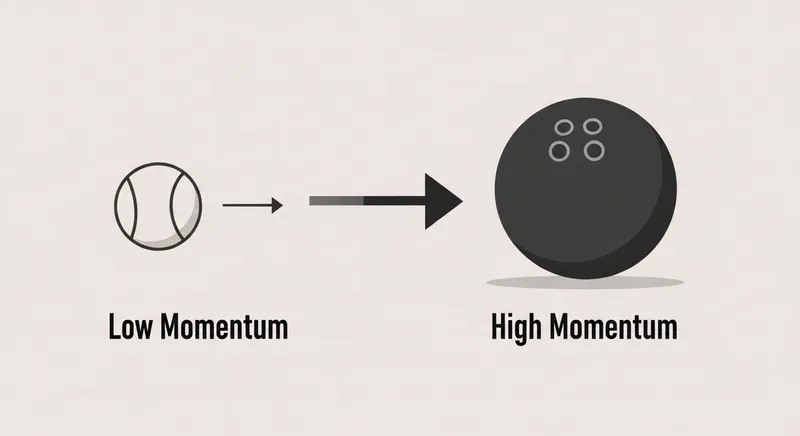
What is Momentum? (It's More Than Just Motion)
Momentum is often described as "mass in motion." It's a measure of how much 'oomph' a moving object has. According to Georgia State University's HyperPhysics, the formula is simple:
Momentum (p) = mass (m) × velocity (v)
- p: The symbol for momentum.
- m: The mass of the object (in kilograms, kg).
- v: The velocity of the object (in meters per second, m/s).
Think about it this way: imagine a bowling ball and a tennis ball are rolling toward you at the exact same speed. Which one would you rather try to stop? The bowling ball. Even though their velocities are the same, the bowling ball has much more mass and, therefore, much more momentum.
Actionable Tip: The most important thing to remember is that momentum is a vector. This means it has both a size (magnitude) and a direction. When solving problems, always decide which direction is positive (like 'to the right') and which is negative (like 'to the left'). Forgetting this is one of the most common mistakes!
What is Impulse? (The 'Push' That Changes Everything)
If momentum is an object's 'oomph', then impulse is the action that changes that 'oomph'. Impulse is the effect of a force acting over a period of time.
Impulse (J) = Force (F) × time interval (Δt)
- J: The symbol for impulse.
- F: The force applied (in Newtons, N).
- Δt: The time the force is applied for (in seconds, s).
Imagine you're pushing a friend on a swing. You can give them a huge, quick shove (a big force for a short time) or a gentle, steady push for a longer time. Both actions can get them swinging to the same height. They are different combinations of force and time, but they can produce the same impulse. As explained by Khan Academy, for a force that changes over time, the impulse is the total area under a Force-Time graph.
Part 2: The Core Concept - The Impulse-Momentum Theorem
Now, let's connect these two ideas. This is where the magic happens. The Impulse-Momentum Theorem is the master key that unlocks most of these problems. It states:
The impulse applied to an object is equal to the object's change in momentum.
J = Δp
Which we can expand to:
FΔt = mΔv (where Δv is the change in velocity, or v_final - v_initial)
This single equation connects force, time, mass, and velocity. It's the tool you'll use over and over again.
Real-World Examples: Seeing Impulse in Action
This isn't just textbook theory; it's all around you. Engineers use this theorem constantly.
- Car Safety: Airbags and crumple zones save lives by using the impulse-momentum theorem. They can't change your total change in momentum (you have to go from moving to a stop), but they can increase the time of the impact (Δt). By making Δt larger, they make the force (F) on you much, much smaller.
- Sports: When a baseball catcher catches a fastball, they let their mitt move backward. This increases the time of impact, reducing the force on their hand. A golfer's follow-through keeps the club in contact with the ball for longer, delivering a greater impulse for a bigger change in momentum (and a longer drive).
- Rocket Science: A rocket's movement is a perfect example of the conservation of momentum. As explained by NASA, the rocket pushes hot gas out (giving the gas momentum in one direction), and the gas pushes the rocket forward (giving the rocket equal and opposite momentum).
Part 3: Solving Problems Like a Pro - Your 4-Step Method
Okay, theory is great, but how do you actually solve that scary word problem? Students often struggle to apply formulas to real problems. You need a strategy. Here is a 4-step method that works every time. For a more general guide, check out our post on how to Conquer Any Science Word Problem.
Step 1: Understand the System & Draw a Diagram
This is the most important step! Before you write a single number, draw it out.
- Draw a 'Before' picture: Show all the objects and their velocities just before the collision or event.
- Draw an 'After' picture: Show all the objects and their velocities just after the event. (Pro tip: Use different colored pens for 'Before' and 'After' to make your diagram extra clear!)
- Establish a Coordinate System: Clearly label which direction is positive (+) and which is negative (-). Usually, right is positive and up is positive. Write this down. It will save you from countless sign errors.
Step 2: Identify What's Conserved (Momentum vs. Energy)
Next, you need to decide which physics principle to use. For collisions, momentum is the key.
- The Law of Conservation of Momentum: In a closed system (no external forces like friction), the total momentum before a collision is equal to the total momentum after the collision.
But what about energy? This is where we define collision types:
- Elastic Collisions: Both momentum AND kinetic energy are conserved. Think of two billiard balls colliding perfectly. They bounce off each other without losing energy to sound or heat. This is similar to the ideal particles in Dalton's Atomic Theory.
- Inelastic Collisions: Momentum is conserved, but kinetic energy is not. Some energy is converted into sound, heat, or deformation (crumpling). If the objects stick together after the collision, it's called a perfectly inelastic collision.
Step 3: Write Down Your Equations and Solve
Now you're ready for the math. For a two-object collision, the conservation of momentum equation is:
(m₁v₁ᵢ) + (m₂v₂ᵢ) = (m₁v₁f) + (m₂v₂f)
(Momentum of object 1 before + momentum of object 2 before) = (Momentum of object 1 after + momentum of object 2 after)
Carefully plug in all your known values from your diagram, paying close attention to the positive and negative signs you established in Step 1. Then, solve for the one variable you don't know.
Step 4: Check Your Answer - Does It Make Sense?
Don't just circle the number and move on. Do a quick 'gut check'. If a small car and a big truck collide, does your answer show the truck flying backward at 100 m/s? If so, you probably made a sign error. Check your units and the direction of your final velocity. Is it what you would expect?
This is a great place to use technology ethically. Once you've worked the problem, you can use an AI tool to verify your answer. With Tutor AI, you can even snap a photo of your handwritten work to get instant, step-by-step verification. This reinforces your learning without just giving you the solution. To learn more, see our Ultimate Guide to AI Math Solvers.
Part 4: Putting It All Together - Solved Problems
Ready to apply the 4-step method? Let's start with a foundational problem and then tackle a more advanced one.
Warm-Up Problem: A Perfectly Inelastic Collision
The Problem: A 10,000 kg railroad car moving at 2 m/s collides and sticks to an identical, stationary railroad car. What is the final speed of the coupled cars?
- Diagram: Draw car 1 (m₁) moving toward a stationary car 2 (m₂). The 'after' picture shows them stuck together (m₁ + m₂).
- Conserved Quantity: This is a perfectly inelastic collision, so momentum is conserved.
- Equation:
p_initial = p_final(m₁v₁ᵢ) + (m₂v₂ᵢ) = (m₁ + m₂)v_f(10000 kg * 2 m/s) + (10000 kg * 0 m/s) = (10000 kg + 10000 kg) * v_f20000 kg·m/s = (20000 kg) * v_fv_f = 1 m/s
- Check: The final speed is half the initial speed, which makes sense because the mass doubled. The answer is reasonable.
The Advanced Problem: A Ballistic Pendulum
This classic problem is challenging because it combines two different physics principles. Let's conquer it with our 4-step method. For another deep dive, you might enjoy Mastering the Photoelectric Effect.
The Problem: A 0.01 kg bullet is fired into a 2.5 kg block of wood hanging from a string. The block is initially at rest. The bullet embeds itself in the block, and together they swing up to a maximum height of 0.65 meters. What was the initial speed of the bullet?
Step 1: Diagram
- Before: Bullet (m, vᵢ) moving toward a stationary Block (M, V=0).
- After (Phase 1): Bullet+Block (m+M) moving together with a new velocity (v_f) right after impact.
- After (Phase 2): Bullet+Block (m+M) at rest at the peak of their swing (height 'h').
Step 2: Identify What's Conserved This problem has two parts:
- The Collision: The bullet hitting the block is a perfectly inelastic collision. Momentum is conserved, but kinetic energy is not (energy is lost to heat, sound, and splintering wood).
- The Swing: After the collision, the swing upwards is governed by the conservation of energy. The kinetic energy right after the collision is converted into gravitational potential energy at the peak of the swing.
Step 3: Write Equations and Solve (in two parts)
Part A: The Swing (Work Backward!) It's often easier to start from the end. We know the height (h), so we can find the velocity right after the collision (v_f).
- Conservation of Energy: KE_bottom = PE_top
- ½(m+M)v_f² = (m+M)gh
- The (m+M) cancels out! v_f = sqrt(2gh)
- v_f = sqrt(2 * 9.8 m/s² * 0.65 m) = sqrt(12.74) = 3.57 m/s. This is the speed of the block and bullet right after impact.
Part B: The Collision Now we use conservation of momentum for the collision itself.
- p_initial = p_final
- (m * vᵢ) + (M * Vᵢ) = (m+M) * v_f
- We know: m=0.01kg, M=2.5kg, Vᵢ=0 (block was at rest), and v_f=3.57 m/s (which we just found).
- (0.01 * vᵢ) + (2.5 * 0) = (0.01 + 2.5) * 3.57
- 0.01 * vᵢ = 2.51 * 3.57 = 8.96
- vᵢ = 8.96 / 0.01 = 896 m/s
Step 4: Gut Check The initial speed of the bullet is 896 m/s. This is very fast, but typical for a rifle bullet. The answer makes physical sense. By breaking a 'killer' problem into two smaller parts, we can solve it. Using visual aids like momentum bar charts can also be a huge help.
For Parents & Tutors: How to Support Your Student
Watching a student struggle with physics can be tough. Your instinct might be to just show them the answer, but this doesn't build long-term confidence. Instead, guide them through the 4-step process by asking supportive questions.
- Guide, don't tell: Ask questions like, "Can you walk me through your diagram?" or "What clues in the problem tell you if energy is conserved?"
- Focus on the setup: Many errors happen before the math. Ask, "What direction did you decide is positive, and why?" and "What are all your 'knowns' and 'unknowns'?"
- Encourage visual aids: If they're stuck, suggest drawing the problem or using different colors to track objects.
- Frame AI tools as a partner: Encourage them to try the problem first, then use a tool to check their work, not to cheat. For more on this, read The Parent's Guide to AI Homework Helpers.
Conclusion: You Can Conquer Physics!
We've covered a lot of ground, from the basic definitions of momentum and impulse to solving a complex, multi-step physics problem. The key takeaways are simple:
- Master the definitions: Know what momentum (p=mv) and impulse (J=FΔt) are.
- Use the Theorem: The Impulse-Momentum Theorem (J=Δp) is your master key.
- Follow the Method: The 4-step strategy (Diagram, Conserved Quantities, Equations, Check) provides a reliable path to the solution for any problem.
Physics doesn't have to be a source of anxiety. It's a skill, and like any skill, it can be learned and mastered with the right strategy and practice. The next time you face a tough problem, take a deep breath, pull out this guide, and start with Step 1. You've got this.
And for those moments when you're truly stuck, a 24/7 helper can make all the difference. Tutor AI provides instant, step-by-step explanations for problems exactly like these, so you can get unstuck and keep learning, even late at night. To see how AI is changing science homework, read The Ultimate Guide to AI for Science Homework.
A quick note: Every student learns differently. The methods in this guide are a powerful starting point, but feel free to adapt them to what works best for you. The goal is understanding, not just memorization.
Frequently Asked Questions
Are impulse and momentum the same thing?
No, they are related but distinct concepts. Think of it like this: Momentum is a property an object has when it's moving (its "mass in motion"). Impulse is the action that causes a change in that momentum. An impulse applied to an object causes its momentum to change. You can't have an impulse without a change in momentum, and you can't change momentum without applying an impulse.
What is the unit of impulse?
The standard unit for impulse is the Newton-second (N·s). This comes directly from its formula, J = Force × time. However, because impulse is equal to the change in momentum (Δp), its units are also equivalent to the units of momentum, which are kilogram-meters per second (kg·m/s). Both are correct and used interchangeably.
When is momentum not conserved?
Momentum is not conserved in a system when there is a net external force acting on it. The law of conservation of momentum only applies to isolated systems where all the forces are internal (like the forces between two colliding objects). Common external forces that break momentum conservation include:
- Friction acting on a rolling or sliding object.
- Air resistance acting on a moving object.
- A person pushing or pulling on an object from outside the system.
What is the difference between an elastic and inelastic collision?
The key similarity is that momentum is conserved in both types of collisions (as long as they are in an isolated system). The difference is what happens to the kinetic energy (the energy of motion):
- In an elastic collision, kinetic energy is also conserved. The objects bounce off each other perfectly, with no energy lost to heat or sound. This is an ideal case, like two perfect billiard balls colliding.
- In an inelastic collision, kinetic energy is not conserved. Some of it is transformed into other forms of energy, such as heat, sound, or deformation (crumpling). A car crash is a classic example of an inelastic collision. A special type is a perfectly inelastic collision, where the objects stick together after impact.
How do you find impulse on a graph?
On a Force vs. Time graph, the impulse delivered to an object is equal to the area under the curve. This is a very useful concept for problems with variable forces.
- If the force is constant, the area will be a simple rectangle (Area = Force × Time).
- If the force increases or decreases linearly, the area will be a triangle (Area = ½ × base × height) or a trapezoid.
For more tools to help with homework, check out our list of the 12 Best Free AI Homework Helpers for 2026.