Are you staring at a physics problem about the photoelectric effect and feeling completely stuck? You've probably searched online, only to find fragmented answers on Q&A sites, confusing textbook definitions, or solutions hidden behind a paywall. It's frustrating when you just need one clear, complete resource to guide you through it.
This is a common hurdle, and if you're feeling a bit overwhelmed by homework, you are not alone. Even the world's greatest scientists were stumped by this concept at first!
That's why we created this guide. This is your one-stop resource for mastering the photoelectric effect. Whether you're a student needing extra help, a parent trying to support your child, or a tutor looking for the best way to explain a tricky topic, you've come to the right place. We will walk you through everything, from the basic concept to solving complex problems step-by-step.
What is the Photoelectric Effect in Simple Terms?
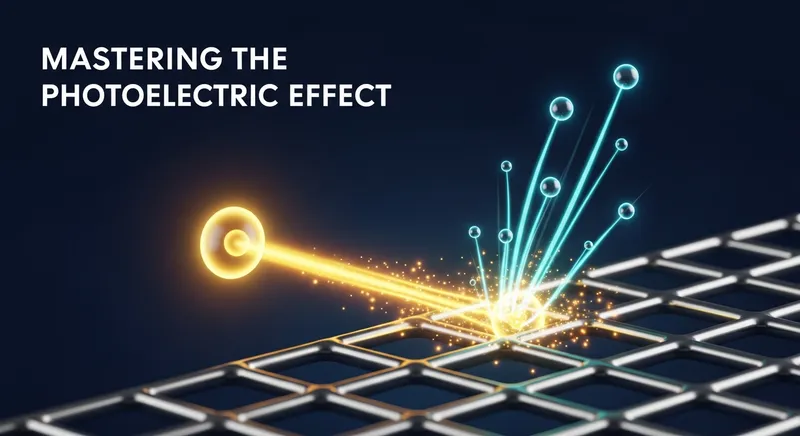
Imagine a special vending machine. But instead of money, it only accepts specific coins made of light, and instead of snacks, it dispenses tiny particles called electrons. This is the core idea behind the photoelectric effect.
In more scientific terms, the photoelectric effect is the emission of electrons when light shines on a material. These ejected electrons are called photoelectrons.
Here's the simple version:
- A beam of light is made of tiny energy packets called photons.
- When these photons hit the surface of a metal, they transfer their energy to the electrons in the metal.
- If a photon has enough energy, it can knock an electron completely out of the metal.
This phenomenon was a huge puzzle for scientists, and understanding why it was so puzzling is the key to truly getting it.
From Theory to Practice: Why the Wave Theory of Light Failed
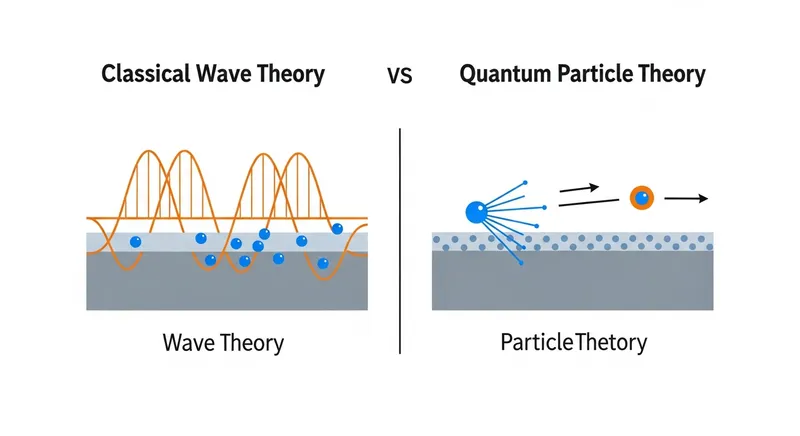
Before the 20th century, scientists were confident that light behaved like a wave. But when they looked closely at the photoelectric effect, the wave theory just didn't add up. The historical work of physicists like Heinrich Hertz and Philipp Lenard laid the groundwork for this scientific revolution.
Here's what the old wave theory predicted versus what experiments actually showed-a conflict that baffled the physics community:
-
Prediction 1: Brighter light should mean higher energy electrons. The wave theory said a brighter (more intense) light wave has more energy, so it should eject electrons with more kinetic energy.
- Observation: The brightness of the light only changed how many electrons were ejected, not their individual energy. A dim, high-frequency light could eject high-energy electrons while a bright, low-frequency light might eject none at all.
-
Prediction 2: Any color of light should work if it's bright enough. Wave theory suggested that a very bright red light should have enough total energy to eventually knock an electron loose.
- Observation: For each metal, there was a specific threshold frequency (a minimum color or frequency) of light. Any light below that frequency, no matter how bright, would not eject a single electron.
-
Prediction 3: There should be a time delay. A weak light wave would need time to transfer enough energy to an electron to eject it.
- Observation: Electrons were ejected the instant the light hit the surface, with no measurable delay. According to the American Physical Society, this immediate response was one of the key mysteries that couldn't be explained by waves.
These inconsistencies were a major problem. The rules of physics as they were known simply couldn't explain what was happening.
Einstein to the Rescue: The Birth of the Photon
In 1905, a revolutionary paper by Albert Einstein changed everything. As detailed by Physics World, he proposed that light isn't a continuous wave but is actually made of discrete, particle-like packets of energy. He called these packets "light quanta," which we now know as photons.
This idea perfectly explained all the confusing observations. For his groundbreaking work on this, Einstein was awarded the Nobel Prize in Physics in 1921.
Here's how Einstein's photon model solved the puzzle:
- Energy depends on frequency, not intensity. The energy of a single photon is determined by its frequency (its color), not the brightness of the light. Brighter light just means more photons.
- The All-or-Nothing Interaction. One photon gives all its energy to one electron. If the photon's energy is less than the energy holding the electron in the metal (the work function), the electron can't escape. This explains the threshold frequency.
- Instant Ejection. Since it's a one-to-one collision, there's no need for energy to build up over time. If the photon has enough energy, the electron is ejected instantly.
This led to one of the most important equations in modern physics.
Mastering the Formulas: Your Photoelectric Effect Toolkit
Understanding the formulas is crucial, but it's more than just memorizing them. It's about knowing what each part means. Think of it like a recipe: once you know what each ingredient does, you can cook anything.
Key Ingredients & Constants:
- E: Energy of a single photon (in Joules, J, or electron-volts, eV).
- K_max: The maximum kinetic energy of an ejected photoelectron (in J or eV).
- Φ (Phi): The Work Function of the metal. This is the minimum energy required to remove an electron from the surface (in J or eV).
- f: Frequency of the incident light (in Hertz, Hz).
- f₀: Threshold frequency of the metal (in Hz).
- λ (lambda): Wavelength of the light (in meters, m).
- h: Planck's Constant. The National Institute of Standards and Technology (NIST) provides its value as 6.626 x 10⁻³⁴ J·s or 4.136 x 10⁻¹⁵ eV·s.
- c: The speed of light, 3.00 x 10⁸ m/s.
- e: The elementary charge of an electron, 1.602 x 10⁻¹⁹ C.
Quick Reference: Core Equations
| Equation | What it Calculates |
|---|---|
E = hf |
The energy of a single photon. |
K_max = hf - Φ |
The maximum kinetic energy of an ejected electron. |
Φ = hf₀ |
The work function (minimum energy to eject an electron). |
c = λf |
The relationship between speed, wavelength, and frequency. |
K_max = e * V₀ |
Kinetic energy in terms of stopping potential (V₀). |
As explained by Khan Academy, the photon's energy (hf) is split between freeing the electron (Φ) and giving it kinetic energy (K_max).
Step-by-Step Guide to Solving Photoelectric Effect Problems
This is where the theory meets the road. Let's break down how to solve for the most common variables. For a general approach to any physics calculation, check out our guide to conquering science word problems.
How to Calculate Maximum Kinetic Energy (K_max)
Goal: Find how fast the electrons are moving after they are ejected.
Formula: K_max = hf - Φ
Worked Example: Light with a frequency of 7.5 x 10¹⁴ Hz is shone on a metal with a work function of 2.3 eV. What is the maximum kinetic energy of the photoelectrons in eV?
-
Find the photon energy (E) in eV. Use Planck's constant in eV·s.
E = h * fE = (4.136 x 10⁻¹⁵ eV·s) * (7.5 x 10¹⁴ Hz)E = 3.10 eV -
Use Einstein's equation.
K_max = E - ΦK_max = 3.10 eV - 2.3 eVK_max = 0.80 eV
Action Step: Grab your calculator and verify the calculation. Doing it yourself is the best way to learn!
How to Calculate Work Function (Φ) and Threshold Frequency (f₀)
Goal: Find the minimum energy and frequency needed to eject an electron from a specific metal.
Formulas: Φ = hf₀ and K_max = hf - Φ
Worked Example: The threshold wavelength for sodium metal is 683 nm, as noted by Georgia State University's HyperPhysics project. What is its work function in eV?
-
Convert wavelength (λ₀) to threshold frequency (f₀). First, convert 683 nm to meters: 683 x 10⁻⁹ m.
f₀ = c / λ₀f₀ = (3.00 x 10⁸ m/s) / (683 x 10⁻⁹ m)f₀ = 4.39 x 10¹⁴ Hz -
Calculate the work function (Φ) in eV.
Φ = h * f₀Φ = (4.136 x 10⁻¹⁵ eV·s) * (4.39 x 10¹⁴ Hz)Φ = 1.82 eV
Action Step: Find a table of work functions online for different metals. Pick one and calculate its threshold frequency.
Stuck on a Problem? Snap a Photo!
If you're working on a problem with different numbers or a tricky setup, don't get frustrated. With the TutorAI app, you can just snap a photo of your question. Our AI will break it down and give you a step-by-step explanation just like the ones above, helping you learn the process, not just get the answer.
A Note on Units: Converting eV to Joules
Physicists often use the electron-volt (eV) because the numbers are smaller and easier to manage than Joules. It's essential you know how to convert between them.
1 eV = 1.602 x 10⁻¹⁹ Joules (J)
- To convert eV to Joules, multiply by 1.602 x 10⁻¹⁹.
- To convert Joules to eV, divide by 1.602 x 10⁻¹⁹.
Action Step: In our first example, we found K_max was 0.80 eV. Convert this value to Joules. (Answer: 1.28 x 10⁻¹⁹ J).
Visualize the Concept: Interactive Learning
Reading about the photoelectric effect is one thing, but seeing it in action is another. The University of Colorado Boulder's PhET Interactive Simulations offers an amazing, free tool for this.
Action Step: Go to the PhET simulation and try this:
- Choose sodium as the metal.
- Set the light intensity to 50% and start with red light.
- Slowly increase the frequency by dragging the slider towards the ultraviolet. Watch for the exact moment electrons start to pop off. That's your threshold frequency!
- Now, increase the intensity (brightness). You'll see more electrons, but their speed won't change.
- Increase the frequency into the UV range. The ejected electrons will move much faster (higher kinetic energy).
Playing with this simulation for 10 minutes will give you a more intuitive feel for the concept than hours of reading.
Common Mistakes to Avoid
When working through problems, a few common trip-ups can lead you down the wrong path. Here are the big ones to watch out for:
- Confusing Intensity and Frequency: This is the #1 mistake. Remember: Intensity (brightness) affects the number of photoelectrons. Frequency (color) affects the energy of each photoelectron.
- Unit Mismatches: Always check your units! If your work function is in eV, your photon energy should be in eV. If you're using Planck's constant in J·s, convert your final answer if needed.
- Forgetting the Work Function: Don't assume the photon's energy is equal to the electron's kinetic energy. The electron has to pay an "exit fee" (the work function) first.
K_maxis the leftover energy.
Putting It All Together: A Real-World Application
The photoelectric effect isn't just a weird concept for physics class; it has amazing real-world applications. As highlighted by NASA research, it even helps explain the behavior of moon dust! When sunlight (a source of high-frequency UV photons) hits the lunar surface, it knocks electrons out of the dust particles. This gives the dust a net positive charge, causing it to float and creating a temporary "atmosphere" of dust near the ground.
Frequently Asked Questions
What is the difference between work function and threshold frequency?
The work function (Φ) and threshold frequency (f₀) are two sides of the same coin. The work function is the minimum amount of energy required to free an electron. The threshold frequency is the minimum frequency of light that has enough energy to do this. They are directly related by the formula Φ = hf₀.
What is stopping potential in the photoelectric effect?
Stopping potential (V₀) is the minimum negative voltage needed to stop the most energetic photoelectrons in an experiment. It's a practical way to measure the maximum kinetic energy (K_max) of the ejected electrons. The relationship is K_max = e * V₀, where 'e' is the elementary charge of an electron.
How do you calculate the maximum kinetic energy of a photoelectron?
You use Einstein's photoelectric equation: K_max = hf - Φ. First, calculate the energy of the incoming photon (E = hf). Then, subtract the work function (Φ) of the metal. The result is the maximum kinetic energy of the photoelectron.
Does the intensity of light affect the kinetic energy of photoelectrons?
No. The intensity (brightness) of the light only affects the number of photons hitting the metal per second. A brighter light will eject more photoelectrons, but the maximum kinetic energy of any single electron remains the same. Kinetic energy is determined only by the frequency (color) of the light.
Your Physics Homework, Solved.
Feeling more confident? You've got this! Working through complex topics like the photoelectric effect step-by-step is the best way to build lasting knowledge.
When you need that extra bit of help, TutorAI is here for you 24/7. Get instant, step-by-step solutions for any homework problem, from physics and chemistry to math and biology.
Download TutorAI today and see how easy learning can be!
Download on the App Store | Get it on Google Play
Disclaimer: This article is for educational purposes. While we strive for accuracy, always consult your teacher or academic materials for official course requirements.


