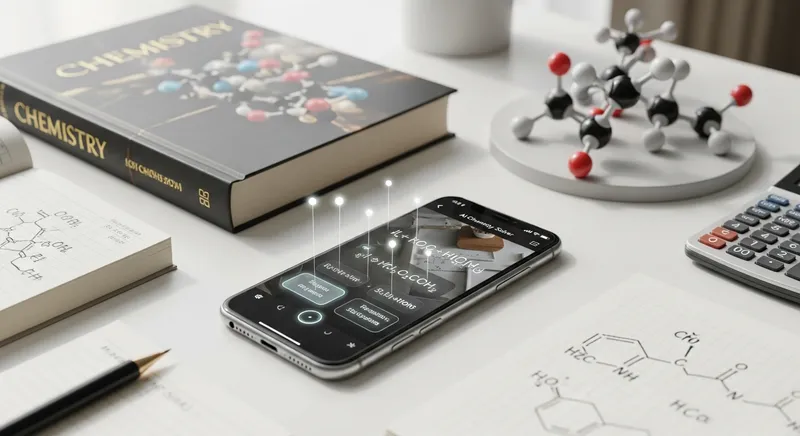
It's 10 PM, and you're staring at a chemistry worksheet that might as well be written in a different language. You see terms like 'stoichiometric coefficients' and 'molar mass,' and the frustration builds. You don't just want the answer; you desperately want to understand how to get the answer so you can handle the next problem on your own.
This is the core challenge for so many students and parents: finding help that doesn't just give a solution, but actually explains the 'how' and 'why' in a way that makes sense. Textbooks can be dense, and private tutors are expensive. That's where AI chemistry solvers come in.
These powerful apps use your phone's camera to scan a problem and provide instant, step-by-step guidance. But not all solvers are created equal. The best ones are designed to be your personal tutor, available 24/7. In this guide, we've tested the top AI chemistry solvers for 2026 to help you find the perfect tool that truly teaches.
Why Use an AI Chemistry Solver? The 'Teach Me, Don't Just Tell Me' Approach
The goal of homework isn't just to get it done; it's to practice and master the concepts you learned in class. The right AI tool can transform this process from a frustrating chore into a powerful learning opportunity. Instead of just giving you the final answer, a good AI chemistry solver acts as a patient tutor, breaking down complex processes into simple, manageable steps.
This method is incredibly effective. A groundbreaking study from Harvard University published in Scientific Reports found that students using a well-designed AI tutor achieved nearly double the learning gains compared to those in a traditional classroom setting. The AI's ability to provide immediate, personalized feedback helps you pinpoint exactly where you went wrong. It's a key component of achieving Science Homework Mastery: Your Guide to Real Learning in 2026 | Tutor AI Blog.
Actionable Tip: To use a solver for learning, not cheating, follow this three-step process:
- Attempt First: Always try to solve the problem on your own first. Grappling with the question is a critical part of the learning process.
- Check Your Steps: Use the AI solver to check your work step-by-step. Don't just look at the final answer. Identify the exact point where your process differed.
- Explain It Back: After reviewing the solution, try to explain the steps back to yourself or a friend in your own words. This solidifies your understanding.

How We Tested & Key Features to Look For
To find the best AI chemistry solvers, we didn't just look at app store ratings. We put these tools to the test with real-world chemistry problems, from balancing chemical equations and stoichiometry to identifying organic compounds. We focused on the features that matter most to students, parents, and educators.
Here are the key features to look for in a top-tier chemistry helper:
- Photo & Manual Input: The ability to snap a picture of a handwritten or textbook problem is a must-have for speed and convenience.
- True Step-by-Step Explanations: The app must show its work, explaining the 'why' behind each step with clear, easy-to-understand language.
- Subject-Specific Accuracy: Chemistry isn't one-size-fits-all. The app must accurately interpret chemical formulas (like H₂O), equations, and structures.
- Visual Learning Aids: Features like an interactive periodic table or a 3D molecular viewer can make abstract concepts much easier to grasp.
- Accuracy and Reliability: The solutions must be consistently correct. Inaccurate answers are worse than no answers at all.
- Educational Value: The app's core design should focus on teaching concepts, not just providing a shortcut to the answer.
The 7 Best AI Chemistry Solver Apps for 2026
After extensive testing, here are our top picks for AI chemistry solvers that excel in accuracy, ease of use, and most importantly, educational value.
1. TutorAI: Best for Overall Learning & Step-by-Step Understanding
⭐ Editor's Choice
TutorAI is our top pick because it was built from the ground up with a 'teach me, don't just tell me' philosophy. It helps students go from a C to an A- in chemistry, by turning homework panic into confident learning. Its photo solver is fast and accurate, but its real strength is the clarity of its step-by-step explanations. It breaks down everything from basic stoichiometry to complex redox reactions into digestible chunks, so you finally get those 'aha!' moments.
Key Features:
- Instant Photo Solver: Snap a picture of any problem for immediate, detailed solutions. Its OCR is specifically tuned to read complex chemical symbols and subscripts (e.g., H₂O, C₆H₁₂O₆) with high accuracy.
- True Learning Focus: Each step is explained with simple definitions and context, so you learn the concepts behind the calculation.
- Personalized Learning Paths: The app identifies where you struggle and offers targeted practice to help you improve.
- Works Anywhere: Full offline capabilities mean you can study on the bus, in the library, or anywhere else, even without an internet connection.
For Parents: End the Homework Battles TutorAI's unique Parent Dashboard is a game-changer. It allows you to track your child's progress and see which concepts they need help with, all without having to become a chemistry expert yourself. It provides peace of mind and empowers you to support their learning journey effectively.
It's the most comprehensive tool on our list for turning homework frustration into genuine understanding, making it one of The 7 Best AI Science Photo Solvers for 2026 (Physics & Chemistry) | Tutor AI Blog.
Ready to master chemistry? Download TutorAI for Free and Get Step-by-Step Help Tonight!
2. Mathway: Best for Integrated Math & Chemistry Problems
Mathway, a service by Chegg, is a powerhouse for math and has a surprisingly robust, dedicated chemistry section. You can type in problems or use its photo feature to tackle chemical equations, stoichiometry, and more. It's clean and easy to use.
- Key Feature: Its dedicated chemistry keyboard makes it easy to type in complex formulas and equations.
- Weakness: While it provides the final answer for free, the detailed, step-by-step explanations that are crucial for learning require a premium subscription.
3. KingDraw Chemical Structure Editor: Best for Organic Chemistry
Organic chemistry is highly visual, and KingDraw excels here. It's less of a problem solver and more of a professional-grade molecular drawing tool. For o-chem students, it's an invaluable free resource for visualizing molecules, predicting properties, and converting IUPAC names to structures.
- Key Feature: Powerful drawing tools let you easily create complex molecules and reaction pathways, which you can then view in 3D.
- Weakness: It's a specialized tool for drawing and visualization, not for solving multi-step problems like stoichiometry.
4. Chegg: Best for Textbook-Specific Problem Sets
Chegg's main strength is its massive database of expert-answered questions and solutions for specific textbooks. If your homework comes directly from end-of-chapter problems, there's a good chance Chegg has a detailed explanation ready to go.
- Key Feature: Its library is unmatched for official textbook problems from major publishers.
- Weakness: It's a premium service, and the reliance on a pre-existing library or human experts means it may not be as 'instant' as a true AI solver for unique problems.
5. Brainly: Best for Community-Sourced Explanations
Brainly takes a hybrid approach, combining a massive community of students and experts with an AI-powered solver. You can scan a problem and see if it has been answered before by the community or get an instant solution from its AI.
- Key Feature: With millions of answered questions, your problem might already be solved and explained by multiple people.
- Weakness: The quality of community-generated answers can be inconsistent, and the free version is heavily supported by ads.
6. Chemistry & Homework: Best for Quick Reference
This app is more of a digital chemistry toolkit than a dedicated problem solver. It's perfect for quick lookups and supporting your problem-solving process. It features an interactive periodic table, a molar mass calculator, and solubility tables.
- Key Feature: The interactive periodic table is excellent for quickly finding element properties on the fly.
- Weakness: It won't solve a multi-step problem for you, but it provides the tools you need to solve it yourself.
7. Photomath: A Note on Math Solvers
While Photomath is brilliant for solving the mathematical calculations within a chemistry problem (like algebra or unit conversions), it is not designed to understand chemical concepts. Use it as a supporting tool, not your primary chemistry solver. It's one of The Best Math Solver Apps for 2026, but not a chemistry specialist.
Accuracy Showdown: Head-to-Head Comparison
We put the top contenders to the test on core chemistry tasks. Here's how they stacked up:
| Feature | TutorAI | Mathway | Chegg | KingDraw | Brainly |
|---|---|---|---|---|---|
| Photo Input Accuracy | Excellent | Very Good | N/A | N/A | Good |
| Balancing Equations | Excellent | Very Good | Good | N/A | Fair-Good |
| Stoichiometry Steps | Excellent | Good (Paywalled) | Good (Varies) | N/A | Fair (Varies) |
| Organic Chemistry | Good (Identifies) | Fair (Basic) | Good (Textbook) | Excellent (Drawing) | Fair |
| Free Step-by-Step | Yes (Full) | No (Answer Only) | No | Yes (For Drawing) | Limited |
| Educational Focus | Excellent | Good | Good | Good | Fair |
The Limitations & Ethics of AI Chemistry Solvers
Can using an AI solver be considered cheating? The answer depends on how you use it. If you simply copy the answer, you're only cheating yourself out of a learning opportunity. However, when used as a learning aid, these tools are invaluable.
It's also important to recognize their limitations. As one expert noted in an EdSurge article, general AI is not a perfect 'robot tutor,' and accuracy can be a concern. Research on AI in chemistry education has confirmed that while AI improves performance, students have valid concerns about accuracy and over-reliance. The best tools, like TutorAI, are specifically tuned for educational subjects to maximize accuracy.
This is a key difference between AI vs. Human Math Tutors, where AI offers instant availability but must be used responsibly.
Actionable Tip: How to Use AI Solvers Ethically
- Do use it to check your work after an honest attempt.
- Don't use it to copy answers for a graded assignment.
- Do focus on understanding the step-by-step process.
- Don't become so reliant that you can't solve problems without it.
Frequently Asked Questions
Is TutorAI free? What about pricing?
Yes, TutorAI has a robust free version that provides full, step-by-step solutions for a limited number of problems each day. This is perfect for getting unstuck on nightly homework. For users who need unlimited help, personalized learning paths, and access to the Parent Dashboard, there is a premium subscription available. The goal is to make core learning accessible to everyone.
Can using an AI chemistry solver be considered cheating?
It depends on your intent. If you use an app to simply copy answers to submit for a grade, then yes, it's cheating. However, if you use it as a learning tool to understand how to arrive at a solution after you've already attempted the problem yourself, it's one of the most effective study aids available.
Which app is best for balancing chemical equations step-by-step?
TutorAI excels at this. It not only provides the balanced equation but breaks down the method used, showing you how to track the atom count on each side. Mathway also handles this well, but its step-by-step explanations require a subscription.
Are these apps accurate for complex topics like organic chemistry?
Accuracy varies. For drawing molecules, KingDraw is professional grade. For solving reaction mechanisms, AI is still developing. Solvers like TutorAI can accurately identify common functional groups and predict products for well-known reactions, but always cross-reference with your textbook for complex organic chemistry.
Can an AI solver help with my lab report calculations?
Absolutely. This is a great use case. AI solvers are excellent at handling the mathematical parts of a lab report, such as calculating percent yield, determining molarity, and performing titration calculations. You can use a photo solver like TutorAI to quickly check your calculations and ensure your final results are accurate.
Don't Let Chemistry Frustration Win
Another night of homework stress doesn't have to be your reality. The right tool can transform that frustration into a breakthrough moment of understanding. Instead of just searching for an answer, you can finally learn the process and build the confidence to solve the next problem all on your own.
Ready to turn confusion into confidence?
Download TutorAI for Free and Start Learning for Real