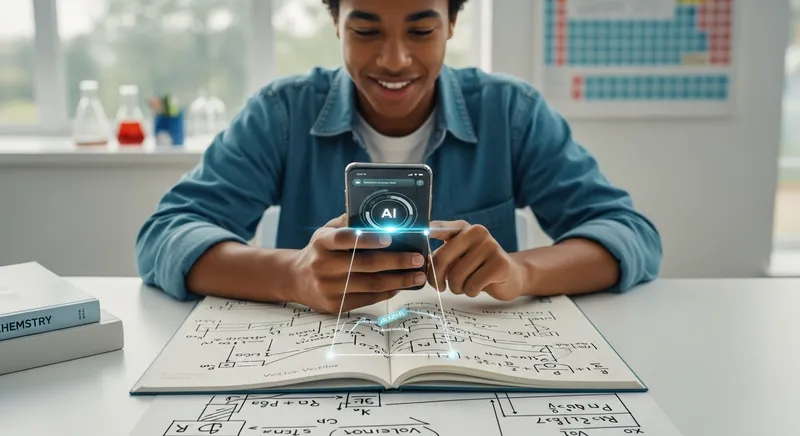
It's 10 PM. The textbook is open, the notebook is covered in scribbles, and a single, stubborn science problem is the only thing standing between your child and a good night's sleep.
Whether it's a physics diagram that looks like modern art or a chemistry equation that defies balancing, you've probably had this thought: "I wish there was a Photomath for science."
That specific frustration is why we created this guide. For years, students and parents have searched for a tool that can handle the unique challenges of science homework. While math solvers are fantastic with numbers, science is a different beast. It's visual, conceptual, and requires understanding the why behind the numbers. The good news? In 2026, AI has finally caught up, with multi-modal models that can see, read, and reason about scientific problems like never before. The right app can be a powerful learning partner, a concept affirmed by global organizations like UNESCO who are guiding the integration of AI into education.
This guide will walk you through the very best AI science photo solvers available today. We'll show you which tools can actually interpret a free-body diagram, solve a handwritten word problem, and provide the step-by-step explanations that turn homework frustration into genuine understanding.
Why You Need a Science-Specific AI Solver
If you've ever tried a math-focused app for a complex science problem, you know the disappointment. The app might solve the calculation part, but it completely misses the context. This is the "Photomath for science" problem: the need for a tool that understands scientific principles, not just mathematical operations. For a deeper dive on this, check out our Photomath vs. TutorAI: A Parent's Guide to Math Apps That Actually Teach.
Science solvers need to master three areas where math solvers often fail:
- Complex Diagrams: Physics is filled with free-body diagrams, electrical circuits, and vector arrows. Chemistry relies on molecular structures. A true science solver needs computer vision that can identify these components and understand their relationships.
- Conceptual Word Problems: Science problems often come disguised as paragraphs of text. An AI needs to read the problem, identify the knowns and unknowns, choose the correct formula, and then solve. It's a language and logic challenge, not just a math one.
- Multi-Step Formulas & Equations: From stoichiometry to kinematics, science problems often require multiple steps and formulas. A great AI tutor guides you through the entire process, not just the final calculation.
How We Tested: The Ultimate Science Problem Showdown
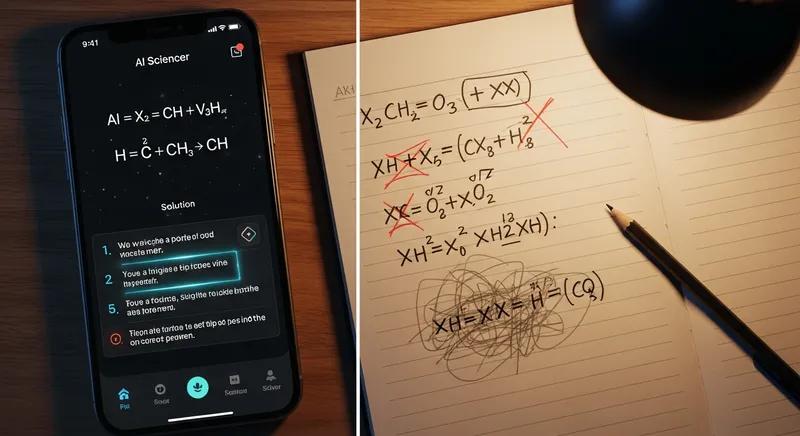
To find the best of the best, we didn't just read marketing pages. We put these apps to the test with three notoriously difficult, real-world homework problems:
- The Physics Diagram: A hand-drawn free-body diagram of a block on an inclined plane with friction.
- The Chemistry Equation: A photo of a complex, unbalanced redox reaction from a worksheet.
- The Handwritten Word Problem: A messy, handwritten multi-step physics word problem involving momentum.
We graded each app not just on whether it got the right answer, but on the quality of its step-by-step explanation, its ability to read handwriting, and its user-friendliness. This approach ensures our recommendations are for tools that actually help students learn, a core component of The Ultimate Guide to AI for Science Homework.
Pro-Tip: For the best results with any photo solver, use a dark pen on light paper and take your picture in a well-lit area without shadows. A clear photo is the first step to an accurate answer!
AI Science Solver Comparison
Here's a quick look at how our top contenders stack up on the features that matter most for science homework.
| Feature | TutorAI | Socratic | Brainly | Photomath |
|---|---|---|---|---|
| Physics Diagrams | ✅ Excellent | 🟨 Hit or Miss | 🟨 Hit or Miss | ❌ No |
| Word Problems | ✅ Excellent | ✅ Good | ✅ Good | 🟨 Limited |
| Step-by-Step Explanations | ✅ Excellent | ✅ Good | 🟨 Varies | ✅ Excellent |
| Parent Dashboard | ✅ Yes | ❌ No | ❌ No | ❌ No |
| Offline Mode | ✅ Yes | ❌ No | ❌ No | ✅ Yes |
| Primary Focus | Science Learning | Web Research | Community Q&A | Math Calculation |
The 7 Best AI Science Photo Solvers for 2026
After rigorous testing, here are the top AI science solvers that stand out from the crowd.
1. TutorAI: The Best All-Around Science Learning Partner
Naturally, we're proud of what we've built. TutorAI was designed from the ground up to solve the core pain points of science homework. It excels where others fail, particularly with visual and conceptual problems.
- What it does best: TutorAI's biggest strength is combining a powerful AI solver with a true learning focus. It doesn't just give you the answer; it shows you how to get there with clear, step-by-step explanations for everything from physics diagrams to chemistry equations. Its advanced AI can even interpret messy handwriting and works offline, so learning never has to stop.
- Key Features:
- Parent Dashboard: See where your child is excelling and where they need more practice. Get peace of mind that homework help is actually working.
- Offline Mode: Unlike most competitors, TutorAI works without an internet connection, making it perfect for studying on the bus, at the library, or during travel.
- Generous Free Version: The free tier offers several problem solves per day with full step-by-step explanations, making it a powerful tool for daily homework support.
- Best for: Students who want to truly understand science, parents looking for a reliable and transparent homework helper, and anyone who needs an instant, 24/7 tutor for physics and chemistry.
2. Socratic by Google: Best for Finding Online Resources
As an app backed by a tech giant, Socratic by Google is a powerful and completely free option. It uses your phone's camera to identify a problem and then scours the web to find the best online resources to help you learn the concept.
- What it does best: Socratic excels at connecting your specific question to high-quality explainers, videos (often from Khan Academy), and Q&A from the web. It's less of a direct solver and more of an intelligent search engine for learning.
- Weakness: Because it relies on finding existing resources, the quality of the explanation can vary. It may not provide a direct, step-by-step solution for your exact problem, sometimes requiring you to piece together information.
- Best for: Students who want to explore a concept from multiple angles and are looking for a powerful, free tool to supplement their learning.
3. Brainly: The AI and Community Hybrid
Brainly takes a different approach by combining an AI-powered solver with a massive community of students and experts. If the AI can't solve your problem, you can post it for the community to answer.
- What it does best: Brainly offers a safety net. If your problem is particularly unique or requires human creativity, there's a good chance someone in the community can help. It covers a vast range of subjects beyond just science.
- Weakness: The reliance on the community means answers aren't always instant or verified by experts. The quality can be inconsistent, which is a key difference from a dedicated AI tool. For a full comparison, see our Brainly vs. TutorAI: Which App is More Accurate and Safer? analysis.
- Best for: Students looking for help on a very wide range of subjects who don't mind waiting for a community-driven answer.
4. Symbolab: The Powerful Math & Physics Engine
Symbolab is a heavyweight in the equation-solving world, and its capabilities extend well into physics. While it started with a focus on higher-level math, it has become a go-to for college and high school students tackling complex physics problems.
- What it does best: Symbolab excels at solving complex equations and showing the intermediate steps. Its calculator can handle everything from calculus-based physics to matrix algebra. Some of the most advanced solvers, like Symbolab and TutorAI, use methods that understand the rules of science, not just what a problem looks like. This leads to far more accurate and reliable solutions.
- Weakness: Its interface is more technical and less visually intuitive than apps designed for a younger audience. It's more of a calculator on steroids than a friendly tutor, and its diagram recognition is not its primary strength.
- Best for: High school and college students who need a powerful calculation engine for math and physics.
5. Microsoft Math Solver: The Word Problem Specialist
Backed by Microsoft's AI, this free app is surprisingly capable, especially when it comes to a common pain point: word problems. It uses powerful language processing to deconstruct text-based questions.
- What it does best: It reads a photo of a word problem, identifies the key values, figures out what the question is asking for, and sets up the equation. It turns a confusing paragraph into a clear, solvable math problem.
- Weakness: As the name implies, its strength is math. It can handle the calculations within a physics problem but struggles to interpret complex diagrams or chemistry-specific notations.
- Best for: Students who understand the science formulas but get stuck translating a word problem into an equation.
6. Chegg: The Expert Q&A Powerhouse
Chegg is a giant in the homework help space, known for its massive library of textbook solutions and expert Q&A. You can take a picture of your problem and search to see if an expert has already solved it.
- What it does best: Offers access to a huge database of step-by-step solutions for problems found in popular textbooks. If your problem isn't there, you can submit it and an expert will typically answer it within a few hours.
- Weakness: It's not an instant solver. You are searching a database or waiting for a human expert, which doesn't help during a late-night study crunch. It is also a subscription-based service.
- Best for: Students using common textbooks who want expert-verified solutions and can wait for an answer.
7. Photomath: The Gold Standard for Math (and a Baseline for Science)
Photomath is the app that started it all, and it's brilliant at what it does: solving math problems. We include it here because it's the benchmark everyone knows, and understanding its limitations is key to choosing the right science tool.
- What it does best: Unmatched at recognizing and solving handwritten math equations with clear, animated step-by-step instructions. Its user interface is simple and intuitive.
- Weakness: It is not a science solver. It cannot interpret free-body diagrams, circuits, or molecular structures. It may solve the final calculation in a physics problem if you type it in, but it won't help you set up the problem or understand the scientific concepts involved.
- Best for: All levels of math homework, from arithmetic to calculus. Use it for the math part of your science, but pair it with a true science solver.
Beyond the Answer: What Makes a GREAT AI Science Tutor?
Getting the right answer is only half the battle. A truly great AI solver is a great teacher. Research from institutions like Harvard's Graduate School of Education shows that AI tutors are most effective when they amplify learning, not just provide answers. A study they highlighted found that students using an AI tutor showed double the learning gains.
When choosing an app, use this checklist:
- ✅ Does it show step-by-step work? Avoid apps that just give a final number.
- ✅ Does it explain the why? The best apps define concepts and explain formula choices.
- ✅ Does it handle visual problems? Test it with a diagram or a graph.
- ✅ Does it offer practice? The ability to practice similar problems is crucial for mastery.
A Word of Caution: Using AI Solvers Responsibly
The rise of these powerful tools is exciting, but it's important to use them wisely. A RAND Corporation study found that while a majority of students now use AI for homework, 67% are also concerned it could harm their critical thinking skills.
- For Students: Use the app to check your work, not do it for you. When you get stuck, focus on the first few steps of the explanation to get you moving again, then try to finish the problem on your own.
- For Parents: Frame these apps as a "24/7 tutor," not a "cheat machine." The goal is understanding. The fact that the U.S. Department of Education supports AI tools for instruction shows their growing acceptance as a legitimate part of the learning ecosystem.
The Verdict: End the Homework Battles Tonight
Remember that 10 PM homework crisis? With the right tool, those nights are over. While each app on this list has its strengths, a generic math solver will only lead to frustration when tackling complex science.
For science students, parents, and educators, TutorAI is the clear choice. It directly addresses the "Photomath for science" problem by expertly handling diagrams, word problems, and complex equations. More importantly, it delivers the clear, step-by-step explanations and parent-focused features that lead to true learning and peace of mind.
Stop the late-night homework battles and empower your student with a tool that teaches, not just tells. Try TutorAI for free tonight and see the difference for yourself!
Frequently Asked Questions
Is there really a 'Photomath for science'?
Yes, absolutely. This is the exact problem that apps like TutorAI were built to solve. While Photomath excels at math, a true 'Photomath for science' needs to understand diagrams (like circuits and free-body diagrams), interpret word problems, and handle multi-step scientific formulas. The best apps in our 2026 guide do exactly that, moving beyond simple calculation to offer conceptual understanding.
How accurate are AI science solvers?
Accuracy has improved dramatically. The most advanced solvers, particularly those that understand the rules of physics and chemistry, are highly reliable for most high school and introductory college problems. However, accuracy always depends on the quality of the photo you provide. Always use the step-by-step explanation to double-check the logic, as this is the best way to catch potential errors and ensure you understand the process.
Can AI help with balancing chemistry equations from a photo?
Yes, this is a key feature of a good science solver. Top apps use advanced technology to read the chemical formulas, even if handwritten. The AI then applies the rules of stoichiometry to balance the equation and provide the correct coefficients. The best tools, like TutorAI, will also show you the step-by-step process so you learn how to do it yourself.
Do these apps just give answers or do they explain the steps?
Every app on our recommended list was chosen because it provides detailed, step-by-step explanations. An app that just gives the final answer is not a learning tool. A great AI science solver acts like a tutor, guiding you through the entire process. It will explain which formula was chosen and why, show the calculations for each step, and define key concepts along the way.
Can I use these apps for my college-level physics and chemistry courses?
Many of these apps are effective for introductory college-level courses (like Physics 101 or General Chemistry). They are excellent for checking homework, understanding foundational concepts, and getting unstuck on complex problems. However, for highly specialized or upper-level courses, the AI may struggle. It's always best to use them as a supplement to your professor's lectures, textbook, and study groups, not as a replacement.


