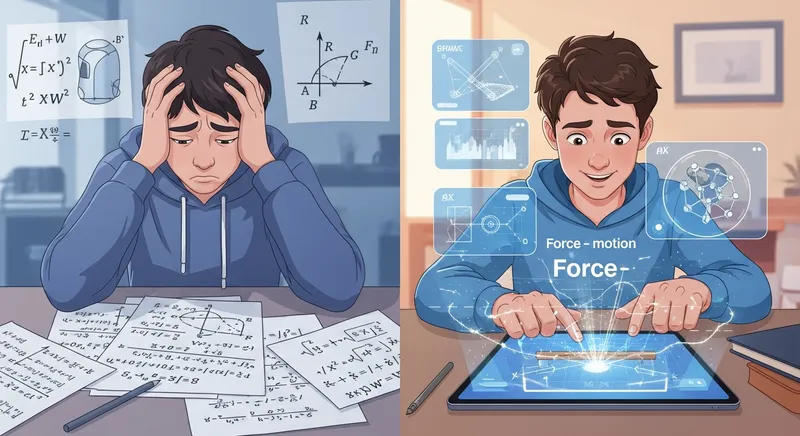
It's 10 PM. You're staring at a chemistry equation that feels like a foreign language, and the pressure is mounting. The temptation is real: just snap a picture, get an answer from an AI solver, and be done with it. For parents, this moment is just as stressful, watching a child struggle with homework anxiety and feeling helpless to guide them.
That quick fix solves the immediate problem, but it creates knowledge gaps and a nagging sense of impostor syndrome. This is the core pain point for so many families: the battle between short-term relief and the long-term goal of building real knowledge.
This guide is different. We're going beyond the answer. We'll show you- whether you're a student, parent, or tutor- how to build lasting science skills, use modern tools ethically, and develop a true conceptual understanding that will serve you long after the homework is submitted.
Why Conceptual Understanding is Your Most Valuable Skill in 2026
We hear the term "STEM" (Science, Technology, Engineering, and Math) all the time, but it's more than a collection of hard subjects. At its heart, science is a process of discovery. According to the education experts at Khan Academy, science isn't a list of facts to be memorized; it's a way of asking questions and testing ideas to understand the world.
This is why conceptual understanding is so much more powerful than memorization. Memorizing the steps to solve one physics problem won't help when the variables change. But understanding the concepts of force, mass, and acceleration allows you to tackle any problem that comes your way. Conceptual learning is about building a mental model of how things work.
As we head into 2026, AI makes answers a commodity. The most valuable academic skill is no longer finding the answer, but verifying it through critical thinking- a skill built on deep conceptual knowledge.
Using AI Smartly: A Guide to Ethical Learning
Let's be clear: AI tools are here to stay, and they can be incredibly powerful learning aids. The danger isn't the tool itself, but how it's used. Relying on AI for the final answer without engaging in the process is like eating dessert without the meal- satisfying for a moment but offering no real nourishment.
Instead of an "answer key," think of a good AI tool as your personal "study buddy." Here's how to use it to actually learn:
- Try First, Check Later: Always attempt the problem on your own. Grappling with the question is where real learning happens. That 10 PM stress is tough, but a tool like TutorAI offers 24/7 help, so you can get guidance even when teachers are unavailable. Use it to check your work and analyze the step-by-step solution to see where your logic went off track.
- Become the Interviewer: Don't just accept the explanation. Ask the AI follow-up questions. "Can you explain this concept in a simpler way?" or "What's a real-world example of this principle?"
- Generate Practice Problems: Once you understand a concept, ask your AI tool to generate a few similar practice problems. This is a fantastic way to test your knowledge and build confidence. You can find more ideas in our guide on how to use an AI math solver to actually learn.
- Focus on the 'Why': The best learning tools don't just give you the solution; they explain the process. Unlike answer-only apps, TutorAI's detailed, step-by-step solutions are designed to show you the logic behind each step, helping you build the skills to solve the next problem independently.
What Makes a Great AI Learning Tool?
Not all AI solvers are created equal. A true learning partner is designed to teach, not just to give answers. Look for tools that offer:
- Step-by-Step Explanations: To break down complex problems into understandable chunks.
- Progress Tracking: Features like achievement badges and learning streaks make practice engaging and help you see how far you've come.
- Parental Involvement: A parent dashboard, like the one in TutorAI, allows parents to see progress and offer encouragement, making them a partner in the learning journey.
- Accessibility: Support for both typed and handwritten problems means you can get help directly from your notes, and offline access ensures learning can happen anywhere.
Effective Science Study Methods for Deep Learning
Moving beyond memorization requires a different set of study skills. A study published in the Journal of STEM Education found that students who practiced metacognition- or "thinking about their own thinking"- developed much stronger and deeper learning skills.
Here are a few powerful, research-backed methods:
-
The Feynman Technique: Pick a concept and try to explain it in the simplest terms possible, as if you were teaching it to a 6th grader. When you get stuck or use complicated language, you've found a gap in your understanding. Go back to your notes, fill that gap, and try again.
-
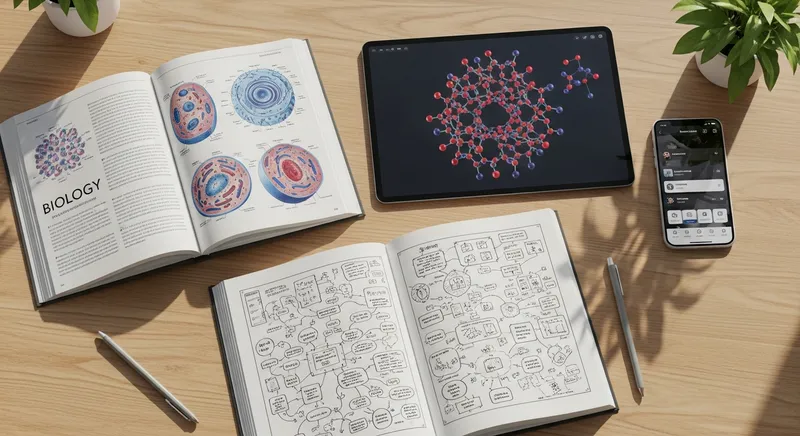
Concept Mapping: Instead of writing linear notes, create a concept map. Start with the main idea in the center (e.g., "Photosynthesis"). Then, branch out with key components (e.g., "Sunlight," "Chloroplasts," "Glucose"). Use lines to connect related ideas and write a short phrase on each line to explain the relationship. This visual method forces you to see how concepts are interconnected.
-
Active Recall: Don't just re-read your notes. Close the book and actively try to recall the information. Use flashcards or simply write down everything you remember about a topic. This act of retrieval strengthens the neural pathways in your brain, making the information easier to remember later.
Subject-Specific Strategies: From Biology to Physics
Science isn't a monolith. Generic study advice often fails because it doesn't account for these differences. Here's how to tailor your approach:
-
For Biology: Focus on Processes and Visualization Biology is the study of complex systems. Don't just memorize definitions. Actionable Tip: To learn mitosis, don't just read about it. Draw every stage from prophase to telophase. Label the chromosomes, spindle fibers, and cell membrane. Write one sentence describing what happens in each stage. This act of creation cements the process in your mind.
-
For Chemistry: Focus on Connections and Concepts Chemistry can feel abstract. Connect the symbols to the real-world story. Actionable Tip: Before balancing the equation
2H₂ + O₂ → 2H₂O, ask yourself: "What is actually happening?" You're combining hydrogen and oxygen atoms to form water molecules. Visualizing this exchange makes the abstract numbers and letters meaningful. -
For Physics: Focus on Problem-Solving Frameworks Physics is famous for its word problems. According to a problem-solving guide for university physics from Lumen Learning, the key is a structured approach. Actionable Tip: Use a three-step process for every problem:
- Strategy: Identify the principles (e.g., conservation of energy). A ball is dropped from 10m. What is its speed before it hits the ground? The principle is that potential energy is converted to kinetic energy.
- Solution: Now do the math (
mgh = ½mv²). - Significance: Does the answer make sense? If you get 5,000 m/s, you made a mistake. This final check builds intuition. For more help with math-heavy subjects, check out our guide to mastering calculus, statistics, and algebra.
Visualizing Science: Free Tools That Go Beyond Textbooks
Sometimes, you need to see and interact with a concept. Interactive simulations provide a play environment to explore science without fear of failure.
One of the best resources is PhET Interactive Simulations from the University of Colorado Boulder. This project offers hundreds of free, game-like simulations for physics, chemistry, and biology. You can build atoms, bend light, or see how gravity works by dragging planets around.
Another fantastic source is the National Science Teaching Association (NSTA). While aimed at teachers, their free resources are a goldmine for students and parents, offering activities and labs that encourage you to think like a scientist. For a comparison of different tools, see our ultimate student toolkit guide.
The Parent & Tutor's Playbook: How to Help Without Giving the Answer
For parents and tutors, it's hard to watch a student struggle. Your instinct is to help, but giving the answer short-circuits their learning. The U.S. Department of Education advises your role is to be a guide, not a source of answers. Here's a playbook to help effectively:
- Ask Guiding Questions: Resist the urge to explain. Instead, become a coach. Ask questions like: "What is the main goal here?" or "Where in your notes might we find a clue?"
- Praise the Process: When your child is working hard and trying different strategies, praise their effort. This builds resilience and reinforces that learning is a process of trial and error.
- Break Down Big Projects: Help your child break large tasks like lab reports into smaller chunks: research, outlining, drafting, and revising.
- Leverage Technology Together: You don't need to be a science expert. Sit with your child and explore a PhET simulation. If they use TutorAI, the parent dashboard can help you see where they're making progress and offer support, making you a partner in their learning. For more on this, explore our comparison of AI vs. Human Math Tutors.
Conclusion: Build Skills, Not Shortcuts
Mastering science is no longer about having all the answers. It's about knowing how to find them, understand them, and use that knowledge to solve new problems. By focusing on conceptual understanding, adopting effective study habits, and using technology as a learning partner, you build skills that last a lifetime.
Homework anxiety is real, but it doesn't have to end in a frustrating search for shortcuts. The next time you're stuck, remember to go beyond the answer. Embrace the process, ask questions, and build your confidence one concept at a time.
Ready to transform homework stress into confident learning? TutorAI provides instant, 24/7 help with step-by-step explanations designed to teach, not just solve. Join over 100,000 students building real science skills. Download free on iOS and Android - your first breakthrough is minutes away.
Frequently Asked Questions
How can I use AI for science homework without cheating?
The key is using AI as a "study partner," not an "answer key." Always try the problem on your own first. Then, use a tool like TutorAI to check your work. Analyze the step-by-step solution to understand the process, not just the result. Ask the AI follow-up questions to deepen your understanding.
What should I do when I'm truly stuck on a science problem?
First, take a short break to reset. When you return, try explaining the problem out loud. If still stuck, use a tool to find the solution, but only look at the very first step that confuses you. Understand that step completely before moving on. This incremental approach prevents overwhelm.
How do I know if I really understand a science concept or just memorized it?
Test yourself: 1. Can you explain it in simple words (The Feynman Technique)? 2. Can you solve a slightly different version of the problem? 3. Can you identify a real-world application? If you can do all three, you have a deep conceptual understanding.
How can I help my child with science homework when I don't understand it myself?
Your role is coach, not expert. Ask guiding questions: "What's the goal here?" or "What have you tried?" Praise their effort, not just correct answers. You can also be a co-learner by exploring tools like PhET simulations together or using the TutorAI parent dashboard to see their progress and offer encouragement.
How can I get better at word problems in chemistry and physics?
Adopt a three-stage approach: 1. Strategy: Before calculating, identify the core scientific principle needed. 2. Solution: With a clear plan, plug in the numbers and solve. 3. Significance: Look at your answer. Does the number seem reasonable in a real-world context? This final check catches errors and builds intuition.
Note: Every student learns differently. While these strategies are research-backed, results may vary. Adapt these techniques to fit your unique learning style and circumstances.


