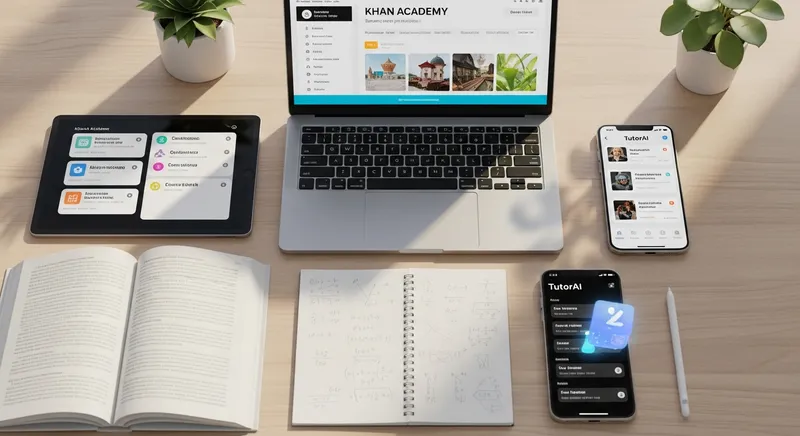
The Ultimate 2026 Student Toolkit: TutorAI vs. Quizlet vs. Khan Academy
It's 10 PM. You're staring at a wall of homework, with a dozen browser tabs open, a half-finished worksheet, and a growing sense of panic. You have three different study apps on your phone, but toggling between them feels more chaotic than helpful. Does this sound familiar?
If so, you're not alone. Students and parents are drowning in a sea of digital tools, all promising to be the magic bullet for academic success. Many of these tools position themselves as all-in-one solutions, but the reality is often disappointing. This guide offers a more honest and effective approach. Instead of searching for one app to rule them all, let's build a powerful 'Digital Toolkit' by using the right tool for the right job. We'll show you how to combine TutorAI, Quizlet, and Khan Academy to study smarter, reduce stress, and truly learn the material. For a broader look at the landscape, check out our guide to The Best AI Homework Helpers of 2026: A Guide for Students & Parents.
Why a 'Digital Toolkit' Beats Any Single 'All-in-One' App
Many popular homework help platforms market themselves as a complete solution for every academic need. However, this often leads to a jack-of-all-trades, master-of-none situation. True, effective learning isn't a single activity; it's a process with distinct stages.
Education experts often refer to a framework called Bloom's Taxonomy, which outlines different levels of learning. As explained by Vanderbilt University's Center for Teaching, these levels range from basic recall to complex creation. A successful student needs to master several of these stages, including:
- Remembering: Recalling facts, dates, and formulas.
- Understanding: Explaining ideas or concepts in your own words.
- Applying: Using information in new situations to solve problems.
No single app is perfectly optimized for all these tasks. By building a toolkit, you can use a specialized tool for each stage of your learning process. This strategy helps you learn more deeply and avoids the pitfalls of apps that might offer quick but shallow answers. It's a smarter approach than relying on platforms that can sometimes feel more like a gamble on accuracy and safety. For more on that, see our comparison: Brainly vs. TutorAI: Which App is More Accurate and Safer?.
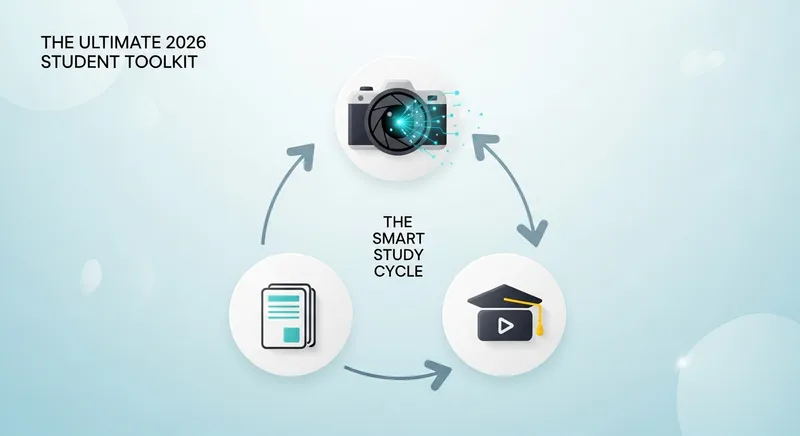
Your 2026 Toolkit, Explained: The Right Tool for Every Task
Let's break down the three essential components of your new digital toolkit and the specific job each one is built for.
Tool #1: TutorAI for Instant Problem-Solving & Understanding the 'Why'
This is your go-to tool for when you hit a wall. You're working on your math or science homework, and you get stuck on a specific problem. Instead of just giving you the final answer (which doesn't help you on a test), you can snap a photo with TutorAI to get detailed, step-by-step explanations.
This focus on process is crucial. The goal isn't just to get the homework done; it's to understand how it's done. As reported by education technology publication EdSurge, AI is becoming the new normal for homework, and the best tools are those that actively support the learning process.
- Key Feature: 24/7 Availability. That 10 PM panic is real. A tool like TutorAI provides help at any hour, day or night, whenever you actually study-unlike scheduling a human tutor.
Actionable Tip: First, always try to solve the problem on your own. Then, use TutorAI to check your work. If you got it wrong, don't just look at the right answer. Carefully walk through the provided steps to pinpoint exactly where your understanding went off track. This turns every mistake into a valuable learning opportunity. For a deeper dive into how this compares with other tools, read Photomath vs. TutorAI: A Parent's Guide to Math Apps That Actually Teach.
Tool #2: Quizlet for Memorization & Active Recall
This is your tool for the 'Remembering' stage of learning. Quizlet is the undisputed champion for mastering vocabulary, key dates, scientific terms, and mathematical formulas. It's built on a powerful, science-backed learning principle: spaced repetition.
Hundreds of academic studies, like those discussed in Policy Insights from the Behavioral and Brain Sciences, have proven that spacing out your practice over time is far more effective for long-term memory than cramming everything in one night. Quizlet's digital flashcards, practice tests, and learning games make this easy and engaging.
Actionable Tip: As soon as you finish a new chapter in your textbook, take 15 minutes to create a Quizlet flashcard deck of the most important terms and concepts. Then, use the app to review that deck for just 5-10 minutes every other day. This small, consistent effort will build a strong foundation of knowledge and make studying for the final exam infinitely less stressful.
Tool #3: Khan Academy for Structured, In-Depth Lessons
What if you're not just stuck on one problem, but on an entire concept? That's when you turn to Khan Academy. Think of it as your free, world-class library of master classes. If you need to learn (or re-learn) a topic from the ground up, there is no better place to start.
Khan Academy offers well-structured, comprehensive courses filled with video lessons, articles, and practice exercises. Its quality and commitment to free access for all have earned it consistent praise from education reviewers and users worldwide. It's the perfect tool for building deep, foundational understanding before you dive into specific homework problems.
Actionable Tip: Feeling lost in your physics class? Before you even attempt the homework, find the relevant module on Khan Academy. Spend an hour over the weekend watching the videos and doing the practice exercises. You'll walk into class on Monday feeling prepared and confident.
Quick Reference: Which Tool When?
- Feeling lost on a whole topic? Start with Khan Academy to build your foundational knowledge.
- Need to memorize facts, dates, or formulas? Use Quizlet for active recall and spaced repetition.
- Stuck on a specific homework problem? Snap a photo with TutorAI for a step-by-step guide.
Putting It All Together: A Weekly Study Scenario
Theory is great, but how does this work in practice? Let's use a common high school chemistry topic to imagine a student's week.
-
Monday: The teacher introduces Dalton's Atomic Theory in class. That evening, the student watches the 20-minute Khan Academy module on the topic. This builds a solid, big-picture understanding of the core concepts.
-
Wednesday: The student tackles their first homework assignment on the theory. They solve most problems on their own but get stuck on two tricky calculations. They use TutorAI to get a step-by-step walkthrough for those two problems, learning the correct process.
-
Friday: The student takes 10 minutes to create a Quizlet deck with the key principles of Dalton's theory and new vocabulary words. They run through the flashcards once.
-
Sunday: While planning for the week ahead, the student spends another 10 minutes reviewing their Quizlet deck and re-works the two problems they got stuck on earlier in the week, this time without help. They now feel confident and prepared for the next lesson.
This is how you turn a list of apps into a powerful, integrated learning system. For a deeper look at the theory itself, check out our guide, Dalton's Atomic Theory Explained: From Billiard Balls to Modern Chemistry.
A Parent's Guide to Homework Help Apps in 2026
For parents, the world of AI homework helpers can be intimidating. You want to provide support, but you worry about accuracy, and you definitely don't want your child to just cheat. These are valid concerns shared by educators. A recent NPR/Ipsos poll found that while many teachers see the benefits of AI, they also worry it could hinder the development of critical thinking skills.
The toolkit approach is the perfect antidote to this fear. By framing it this way, you can have a constructive conversation with your child about using technology responsibly:
- Khan Academy is for learning.
- Quizlet is for practicing.
- TutorAI is your tutor for when you get stuck, not an answer key.
This framework, which aligns with guidance on AI in education from institutions like the U.S. Department of Education, helps you and your child use these powerful tools to build real skills, not just to get grades. Plus, a parent dashboard can let you see which topics your child practices most and where they're improving, helping you stay involved without hovering. For more tips, explore The Best AI Homework Helpers of 2026: A Guide for Students & Parents.
Build Your Smart Study Toolkit Today
Stop searching for a single, magical app that will solve all your problems. The secret to studying effectively in 2026 is to be a smart consumer of technology. By building a digital toolkit, you empower yourself to learn more deeply, efficiently, and with far less stress.
Recap your new toolkit:
- Khan Academy: For deep, foundational learning.
- Quizlet: For fast memorization and active recall.
- TutorAI: For instant, step-by-step help when you get stuck.
Ready to add instant, step-by-step problem solving to your toolkit? Download TutorAI free and solve your first problem in under 60 seconds.
Frequently Asked Questions
Are AI homework helpers considered cheating?
It all depends on how you use them. Simply copying a final answer and submitting it as your own work is cheating, and it won't help you learn. However, using an AI tool to get a step-by-step explanation for a problem you're stuck on is a modern form of studying. The goal is to learn the process, not to bypass it. Leading organizations like the ISTE (International Society for Technology in Education) encourage teaching students AI literacy so they can use these tools ethically to enhance their learning.
What are the best free study tools for students?
Many of the best tools are accessible for free. Khan Academy is a non-profit and is 100% free. Quizlet offers a very robust free version that is more than enough for most students' flashcard and practice needs. Many AI homework helpers, including TutorAI, also provide free features or a set number of free solutions so you can get help when you need it most. For a full breakdown, see our guide on the 10 Best AI Homework Helpers: Truly Free & No Sign-Up Tools.
Which app is best for math homework?
No single app is 'best' for all math needs, which is why our toolkit approach is so effective. Use this two-step method: First, if you don't understand the core concept (like quadratic equations), go to Khan Academy to watch the video lessons and build your foundation. Second, when you are working on specific problems in your assignment and get stuck, use TutorAI to get an instant, step-by-step walkthrough to understand the application.
Is Quizlet or Anki better for flashcards?
For the vast majority of middle and high school students, Quizlet is the better choice. It is far more user-friendly, has a cleaner interface, and offers a variety of engaging study modes like games and practice tests. Anki is a powerful, open-source tool that is highly customizable, but it has a very steep learning curve. It is typically favored by niche groups like medical students or intense language learners who need to memorize thousands of items with a precise algorithm.
How can I trust the answers from an AI homework app?
This is a critical question. No AI is 100% perfect, and you shouldn't blindly trust any answer you get. The real value of a good AI homework helper like TutorAI is not the final answer-it's the step-by-step process. You should always review the explanation to see how the AI arrived at the solution. This helps you learn the correct method and allows you to spot any potential errors, whether they are in your own work or in the AI's explanation.
Note: Every student learns differently. While these strategies are research-backed, they are intended for informational purposes and should be adapted to individual learning needs. Results may vary, and this guide should not be considered a substitute for professional academic advice.


