Homework time can quickly turn into a stressful battleground. Picture this: it is 10 PM on a Tuesday. Your teenager is staring at a blank algebra worksheet, completely stuck. You want to help, but it has been years since you last factored a polynomial. You are not alone in this struggle. Millions of families face this exact scenario every week.
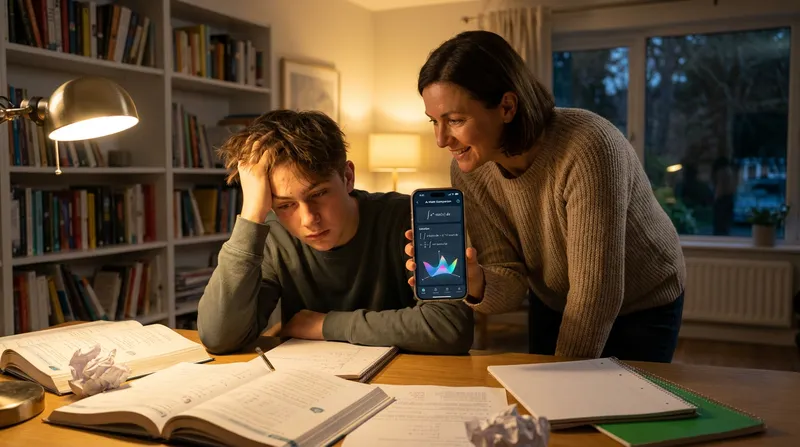
The core problem is simple but deeply frustrating. Students are memorizing math formulas using traditional flashcards, but they are failing their exams because they do not understand how to apply those steps in different contexts. Flashcards are fantastic for learning Spanish vocabulary or historical dates, but they fall short when it comes to the dynamic problem-solving required in STEM subjects. Meanwhile, parents are left exhausted, often feeling forced to pay for expensive private tutors just to help their kids survive late-night homework sessions.
If you have been relying on Quizlet or physical flashcards for math and science, it is time for an upgrade. Today, AI math solvers and smart study apps are rapidly being adopted by families. According to a recent survey by the Walton Family Foundation, a majority of students are now using AI tools to help with schoolwork, fundamentally shifting how they learn. They do not just give the final answer; they act as a 24/7 personalized tutor. In this guide, we will explore the top 7 Quizlet alternatives for math and science, explain why step-by-step AI solvers beat rote memorization, and show you how to reduce homework stress for good.
The core problem: Why traditional flashcards fail in STEM
Rote memorization is the enemy of mathematical fluency. When a student uses a flashcard to memorize the quadratic formula, they are only learning the "what." They are not learning the "how" or the "why."
When test day arrives, teachers rarely ask students to simply write down a formula. Instead, they present complex word problems that require critical thinking and multi-step logic. If a student only knows the formula by rote memory, they will freeze the moment a question looks slightly different from their flashcard.
Furthermore, cramming with flashcards does not create long-term retention. According to insights from Mathnasium, without reinforcement or spaced repetition, students forget about 50 percent of newly learned math information after just 24 hours. This phenomenon, known as the Ebbinghaus Forgetting Curve, explains why a student might ace a quiz on Friday but completely fail a cumulative exam at the end of the semester.
To truly master STEM subjects, students need dynamic problem-solving practice. They need a tool that can look at a specific problem, break it down into logical steps, and explain the reasoning behind each calculation. This is exactly where AI math solvers step in to save the day.
What is the best free alternative to Quizlet for math?
Let us break down the top tools on the market today, highlighting what they do well and where they fall short for students and parents.
1. Tutor AI (The ultimate snap, solve, learn platform)
Tutor AI is not just a calculator; it is a comprehensive learning ecosystem designed for both students and parents. While Quizlet forces you to manually type out complex equations to create flashcards, Tutor AI allows you to simply snap a photo of your homework. The advanced optical character recognition (OCR) instantly reads the problem and generates a detailed, step-by-step solution.
What truly sets Tutor AI apart is its focus on genuine comprehension. It adapts to the individual student, identifying weak spots and creating personalized learning paths. For parents, the platform offers a dedicated dashboard to track daily practice, monitor topic mastery, and celebrate improvements. If you want to know how this compares to other tools, check out our guide on the Best AI math solver apps: How AI tutors are replacing expensive math help.
2. Photomath
Photomath is one of the most popular camera-based scanning apps for instant math solutions. It is incredibly fast and provides animated steps for standard textbook algebra and calculus.
However, Photomath has some distinct weaknesses. It only handles math, completely ignoring science, chemistry, and biology. It also lacks features for parent or tutor monitoring, making it difficult for adults to know if a student is actually learning or just copying answers. Furthermore, it does not build a daily practice habit to ensure long-term retention.
3. Brainly
Brainly is a collaborative learning platform that combines community-driven answers with an AI-powered instant solver. It is highly gamified, using points and badges to keep students engaged.
The main issue with Brainly is that crowdsourced answers can sometimes be noisy or unreliable. While they have expert-verified answers, the free tier is heavily ad-supported, and the interface can feel cluttered. If you are a parent worried about accuracy, you might want to read our article: Is Crowdsourced Homework Help Reliable? What Parents Need to Know About Verified Answers and AI Tutors.
4. Mathway
Mathway provides a clean, straightforward calculator-like interface that covers a massive range of math, from basic arithmetic to advanced calculus. Its computational engine is highly accurate.
Unfortunately, Mathway locks its step-by-step explanations behind a premium paywall. The free version only gives you the final answer, which is useless for a student trying to understand the process. The user experience is also very dry, with zero integration for study guides or spaced repetition.
5. Chegg Study
Chegg is a massive online learning platform offering expert Q&A and textbook solutions. They have recently integrated AI tools for homework help across many subjects.
The downside? Chegg operates on a very expensive subscription model with strict device limits. Additionally, their transition to AI-generated answers has frustrated some users who preferred the certainty of traditional textbook solutions. Chegg also lacks the spaced repetition tools needed to help students memorize core concepts for exams.
6. Caktus AI
Caktus AI is an AI writing and study assistant that helps students generate content and solve problems across various subjects. It uses academic sources to prevent hallucinations and offers a specialized suite of tools, including text summarization.
However, the math solver is sometimes overshadowed by the essay writing features. The content can occasionally feel robotic, and the platform focuses less on the gamification and spaced repetition that often aids long-term mathematical memorization.
7. Socratic by Google
Socratic is a free app that uses AI to help students understand their school work. It provides visual explanations and pulls resources from the web.
While it is a solid free Quizlet alternative, Socratic is quite basic. It does not offer personalized learning paths, nor does it provide the detailed progress tracking that parents need to stay informed about their child's academic journey. Furthermore, Google has significantly reduced active development on the app, meaning it may not receive the latest AI advancements.
How AI math solvers work: Bridging the gap between answers and understanding
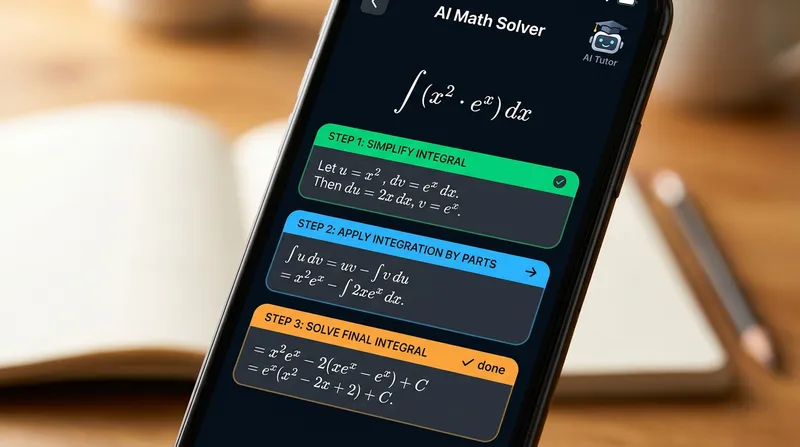
The best educational technology does not do the work for the student; it scaffolds the learning process. This is the fundamental difference between a basic calculator and an AI homework helper.
When a student uploads a photo to Tutor AI, the system uses natural language processing and computer vision to interpret the problem. It then breaks the complex equation down into logical, bite-sized steps. This methodology is rooted in proven educational frameworks. For instance, you can apply The AI Feynman technique: How to use an AI tutor to master complex STEM homework to ensure you truly grasp the material.
Research supports this interactive approach. According to a study from Stanford University, AI can scaffold student practice through adaptive hints and step-by-step reasoning support, acting as a highly effective supplement to traditional tutoring. Instead of staring at a flashcard and hoping for inspiration, the student is actively guided through the problem-solving journey.
Step-by-step explanations vs. traditional flashcards
Let us look at a practical example. Imagine a student studying AP Calculus. A flashcard might show the Power Rule on one side and its definition on the back. That is helpful for basic recall.
But what happens when the student faces a complex Free Response Question (FRQ) that combines the Power Rule with the Chain Rule? The flashcard is useless. A comprehensive AI math solver, on the other hand, will walk the student through the exact application of both rules in real-time. If you are preparing for advanced classes, check out our guide on AP Calculus AB vs BC: The 2026 Guide to GPA Weighting and AI Study Strategies.
This brings up the "anti-cheating" angle. Many parents and teachers worry that AI solvers are just tools for cheating. However, when used correctly, they are exactly the opposite. A tool like Tutor AI explains the "why" behind every step. It builds confidence and independence, ensuring the student can replicate the process during an in-class exam where no devices are allowed.
Spaced repetition for math: The ultimate hybrid approach
The most effective way to learn STEM subjects is to combine the step-by-step guidance of an AI solver with the memory-boosting power of spaced repetition.
Spaced repetition involves reviewing information at gradually increasing intervals. When you struggle with a concept, you review it frequently. As you master it, the reviews become less frequent.
Tutor AI integrates this philosophy into its personalized learning paths. If the AI notices that a student consistently struggles with quadratic equations, it will automatically recommend targeted practice problems in that specific area over the next few days. This hybrid approach ensures that the student not only understands the steps today but remembers them for the final exam next month. Experts at the Brookings Institution validate the use of AI as a scalable, cost-effective tutoring method that improves knowledge transfer and helps students solve novel problems.
Why AI solvers are a game changer for neurodivergent students
Traditional flashcards and crowded classroom environments can be particularly challenging for students with ADHD or Dyscalculia. Rote memorization often leads to cognitive overload, making math feel impossible.
AI solvers provide a distraction-free, endlessly patient tutoring experience. A student can ask the AI to re-explain a concept ten different times without fear of judgment. The visual breakdown of steps helps neurodivergent brains process mathematical logic at their own pace. To learn more about this specific benefit, read our deep dive on AI Math Help for ADHD & Dyscalculia: Why Traditional Solvers Fail (And What Actually Works).
Pricing and features comparison
When evaluating Quizlet alternatives, pricing is a major factor for families.
Traditional tutoring can cost anywhere from forty to one hundred dollars per hour. Over a semester, that adds up to thousands of dollars. Premium subscriptions to platforms like Chegg can also drain a student's budget quickly.
Tutor AI offers a highly accessible model. The free tier provides basic problem solving and a limited number of daily questions, allowing students to experience the core features without a commitment. The premium tier unlocks unlimited questions, an ad-free experience, advanced progress reports, and full access to the parent dashboard. For multi-child households, the Family Plan offers incredible value, ensuring all your students get the personalized help they need under one subscription.
Note: Pricing and features are subject to change - visit tutoraisolver.com for current plans.
Best math solver apps for high school students: Four actionable tips
Downloading an app is only the first step. To truly boost your grades, you need to use the technology actively. Here are four actionable tips for students and parents:
- Try the First Step Yourself: Before snapping a photo of the problem, write down your best guess for the first step. Use the AI solver to check your work, not to do the work for you.
- Read Every Explanation: Do not just scroll to the bottom to copy the final answer. Read the breakdown of each step. If you do not understand a specific calculation, ask the AI for further clarification.
- Generate Practice Problems: Once you solve a difficult homework question, use Tutor AI to generate a similar problem. Test yourself immediately to ensure the concept has actually clicked. For more advanced strategies, read How to Pass AP Statistics: Master Hypothesis Testing FRQs with an AI Math Solver.
- Build Stamina for Exams: Use the AI to check your work during long study sessions. If you are preparing for standardized tests, incorporate these tools into your routine by following The Weekend Digital SAT Mock Test Strategy: How to Build Stamina with Full Practice Tests.
Frequently asked questions
What is the best free Quizlet alternative for math?
While Quizlet is great for vocabulary, Tutor AI is the best free alternative for math because it focuses on step-by-step problem solving rather than rote memorization. It allows you to snap a photo of your homework and get instant, detailed explanations.
Can AI math solvers help with word problems?
Yes. Advanced AI solvers use natural language processing to understand the context of word problems. They can extract the relevant mathematical data, set up the equation, and guide you through the solution process seamlessly.
Is using an AI homework helper considered cheating?
It depends entirely on how you use it. If you simply copy the final answer to get your homework done quickly, you are cheating yourself out of an education. However, if you use the AI to read the step-by-step explanations and understand the underlying concepts, it functions as a highly effective 24/7 personal tutor.
How do AI solvers compare to traditional flashcards for STEM?
Traditional flashcards are static; they only test your ability to recall a formula or definition. AI solvers are dynamic. They show you exactly how to apply those formulas to unique, complex problems, which is critical for success in math and science.
Which math app gives step-by-step solutions for free?
Tutor AI provides step-by-step solutions for free through its basic tier. While some apps like Mathway lock their explanations behind a paywall, Tutor AI believes that understanding the process is the most important part of learning.
How can parents monitor their child's progress with AI study apps?
The best AI study apps include dedicated parent dashboards. For example, Tutor AI provides parents with detailed progress reports, highlighting which subjects their child is mastering and where they might need extra encouragement, all without hovering over their shoulder.
Are AI math solvers better than hiring a private tutor?
AI math solvers offer a highly cost-effective, 24/7 alternative to private tutoring. While a human tutor is great for weekly check-ins, an AI solver is available at 11 PM the night before a test, providing instant, step-by-step guidance exactly when the student needs it most.
Can AI homework helpers explain science concepts like physics and chemistry?
Yes. Unlike basic calculators that only handle algebra, comprehensive platforms like Tutor AI are designed to solve and explain multi-step problems in physics, chemistry, and biology by breaking down complex scientific formulas into easy-to-understand steps.
How does spaced repetition work for math formulas?
Spaced repetition involves reviewing a difficult math concept frequently at first, then gradually increasing the time between reviews as you master it. AI apps track your weak spots and automatically generate practice problems at the perfect intervals to lock formulas into your long-term memory.
What is the safest AI study app for middle school students?
Safety and accuracy are top priorities for younger students. Tutor AI is designed to be a closed, curriculum-aligned educational environment. It avoids the noisy, ad-heavy distractions of crowdsourced platforms like Brainly, ensuring middle schoolers stay focused on learning.
Conclusion
The days of staring blankly at a math textbook while flipping through unhelpful flashcards are over. For students in middle and high school, STEM subjects require dynamic, step-by-step guidance that rote memorization simply cannot provide.
By switching to a smart Quizlet alternative like Tutor AI, students gain access to a 24/7 tutor that explains the "why" behind every answer. Parents get the peace of mind that comes with progress tracking, and the entire family can finally say goodbye to late-night homework stress.
Ready to study smarter, not harder? Snap a photo, solve the problem, and learn for real. Download Tutor AI on the App Store or Google Play today.
Note: Every student learns differently. While these strategies are research-backed, results may vary. Adapt these techniques to fit your unique learning style and circumstances.


