It is 9:30 PM on a Tuesday, and you are stuck in the worst homework loop in high school science. You change the number in front of oxygen, and suddenly hydrogen is off. You fix hydrogen, and carbon falls out of sync. Five minutes later, your paper is covered in eraser smudges, and your parent trying to help across the kitchen table is just as frustrated as you are.
That endless guess-and-check ping-pong game happens for one simple reason: balancing "by inspection" can feel like guesswork without a clear order of operations. Without a clear system, balancing feels like solving a Rubik's Cube in the dark.
The good news is that balancing chemical equations is not about guessing. Once you learn the MINOH method, pair it with an atom inventory table, and know a few fast shortcuts for polyatomic ions and combustion reactions, you can solve most middle school, high school, and AP Chemistry equations quickly and confidently.
Why Chemical Equations Must Balance (The Law of Conservation of Mass)
Every chemical reaction is a rearrangement of existing atoms, never a magic trick. Matter cannot be created out of thin air or vanish into nothing. In chemistry, this rule is called the Law of Conservation of Mass, and applying the law of conservation of mass to balancing equations means every atom on the left side (the reactants) must also appear on the right side (the products).
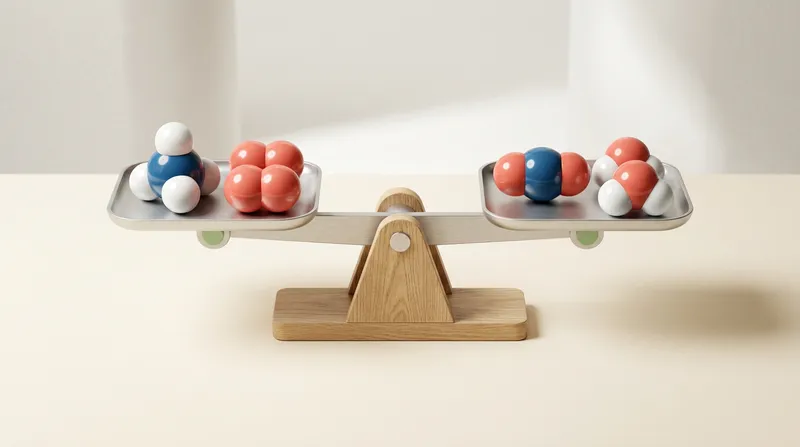
Think of the reaction arrow (→) like the center pivot of a playground seesaw. If you start with 4 iron atoms and 6 oxygen atoms before a reaction happens, you must end with 4 iron atoms and 6 oxygen atoms afterward. The atoms simply break old chemical bonds and form new partnerships.
By convention, balanced equations are written with the smallest whole-number coefficients. Writing 4 H2 + 2 O2 → 4 H2O has equal atoms on both sides, but because every coefficient divides cleanly by 2, the proper balanced equation is 2 H2 + O2 → 2 H2O.
Action Step: Before memorizing any steps, spend three minutes playing with the free PhET Interactive Simulations balancing lab from the University of Colorado Boulder. Turn on the "Balance Scales" tool so you can watch each element tip level in real time as you adjust numbers.
Coefficients vs. Subscripts in Chemistry: The One Rule You Cannot Break
Understanding coefficients vs. subscripts in chemistry is the single most important habit you can build before working a single problem. Both are numbers in a chemical equation, yet they do completely different jobs:
- Subscripts are the small numbers written below and to the right of an element symbol (like the 2 in H2O). They tell you the exact recipe inside one molecule. You may never change a subscript when balancing.
- Coefficients are the full-sized numbers written in front of a chemical formula (like the 2 in 2 H2O). They multiply the entire molecule and tell you how many copies of that substance participate in the reaction. Only coefficients can be changed.
Throughout this guide, coefficients are shown in bold so you can immediately spot which numbers you are allowed to adjust and which tiny subscripts must stay locked in place.
As explained in OpenStax Chemistry 2e, changing a subscript changes the actual chemical substance itself. Turning H2O (safe drinking water) into H2O2 turns it into hydrogen peroxide, a bleaching agent you would never pour into a glass. Yet a 2005 study published in the Journal of Chemical Education found that confusing subscripts with coefficients was one of the most common errors students made when writing balanced equations.
How to Count Atoms with Coefficients and Parentheses
Parentheses trip up middle and high schoolers more than almost anything else on quizzes. Whenever a formula has parentheses, the subscript outside the parentheses multiplies every element inside them, and the coefficient in front multiplies the entire result.
Look at 4 Al2(SO4)3:
- Aluminum (Al): 4 (coefficient) x 2 (subscript) = 8 Al atoms
- Sulfur (S): Inside the parentheses there is 1 S, multiplied by the outer subscript 3 (1 x 3 = 3), then multiplied by the coefficient 4 (3 x 4 = 12 S atoms)
- Oxygen (O): Inside the parentheses there are 4 O atoms, multiplied by the outer subscript 3 (4 x 3 = 12), then multiplied by the coefficient 4 (12 x 4 = 48 O atoms)
Action Step: Grab a pencil and draw a tiny box around every complete chemical formula in your homework problem before you begin. Remind yourself that nothing inside a box is allowed to be edited, and all your new numbers go strictly outside on the left.
The Inspection Method Made Easy: Use the MINOH Order + Atom Inventory Table
The classic balancing chemical equations inspection method works smoothly when you replace random guessing with a structured order. Many teachers and tutors use the MINOH method for balancing equations because it gives your brain a clear checklist from start to finish.
What MINOH Stands For
Balance elements in this exact order:
- M - Metals: Start with metals like Fe, Al, Mg, Ca, Na, or Cu.
- I - Ions (Polyatomic Ions): Next, balance intact polyatomic ions (such as SO4 or NO3) as single blocks.
- N - Non-metals: Balance non-metals other than hydrogen and oxygen, such as C, N, S, P, or Cl.
- O - Oxygen: Balance oxygen near the end, since it frequently appears in multiple formulas.
- H - Hydrogen: Balance hydrogen last (or swap O and H if hydrogen appears in fewer places).
Saving oxygen and hydrogen for last is not just a memory trick. Starting with elements that appear in only one formula on each side locks in the main structure first, preventing you from chasing oxygen back and forth.
Step-by-Step Example Using an Atom Inventory Table
An atom inventory table in chemistry (sometimes called a T-chart or RAP table) keeps your counts visible so you never lose track in your head. Let's balance a simplified version of the reaction used to extract iron from iron(III) oxide:
Fe2O3 + C → Fe + CO2
Step 1: Draw your initial Atom Inventory Table.
| Reactants (Left) | Element | Products (Right) |
|---|---|---|
| 2 | Fe (Metal) | 1 |
| 1 | C (Non-metal) | 1 |
| 3 | O (Oxygen) | 2 |
Step 2: Follow MINOH starting with Metals (Fe). The left has 2 Fe and the right has 1 Fe. Place a coefficient of 2 in front of Fe on the right:
Fe2O3 + C → 2 Fe + CO2
Update your table: Fe is now 2 on both sides.
Step 3: Check Non-metals (C). Carbon is currently 1 on both sides, so move on to Oxygen.
Step 4: Balance Oxygen (O) using the Least Common Multiple. The left has 3 oxygen atoms (inside Fe2O3) and the right has 2 oxygen atoms (inside CO2). Whenever you see a 3 vs. 2 mismatch, aim for their least common multiple, which is 6.
- Put a 2 in front of Fe2O3 (2 x 3 = 6 O).
- Put a 3 in front of CO2 (3 x 2 = 6 O).
Your equation now reads:
2 Fe2O3 + C → 2 Fe + 3 CO2
Step 5: Recount and repair Metals and Non-metals. Adding those coefficients changed Fe on the left to 4 (2 x 2) and C on the right to 3. Since Fe and C each sit completely alone as single elements, fixing them will not disturb oxygen at all:
- Change 2 Fe to 4 Fe on the right.
- Put a 3 in front of C on the left.
Final Balanced Equation:
2 Fe2O3 + 3 C → 4 Fe + 3 CO2
| Reactants (Left) | Element | Products (Right) |
|---|---|---|
| 4 | Fe | 4 |
| 3 | C | 3 |
| 6 | O | 6 |
Every element matches, and the coefficients (2, 3, 4, 3) cannot be divided by any common whole number greater than 1.
Action Step: On your next homework sheet, leave a two-inch column beside each problem for an Atom Inventory Table. Cross out old numbers with a single neat line as you update them rather than erasing, so you can trace your thinking if you need to back up.
How to Balance Chemical Equations with Polyatomic Ions (The Block Shortcut)
Long equations packed with parentheses look scary at first glance, yet balancing chemical equations with polyatomic ions is actually faster than regular balancing once you spot a pattern.
A polyatomic ion is a tightly bonded group of atoms that travels together like a locked Lego block, such as sulfate (SO4), nitrate (NO3), phosphate (PO4), carbonate (CO3), ammonium (NH4), or hydroxide (OH). If the exact same polyatomic ion appears unchanged on both sides of the arrow, do not split it into individual atoms. List the entire ion on one row of your Atom Inventory Table.
Worked Example: Double-Replacement with Two Polyatomic Ions
Balance:
Al2(SO4)3 + Ca(OH)2 → Al(OH)3 + CaSO4
Notice that both SO4 and OH stay completely intact on both sides. Build your table using whole blocks:
| Reactants (Left) | Element / Ion | Products (Right) |
|---|---|---|
| 2 | Al | 1 |
| 1 | Ca | 1 |
| 3 | SO4 | 1 |
| 2 | OH | 3 |
- Balance Metals (Al): Put a 2 in front of Al(OH)3. Now the right side has 2 Al and 2 x 3 = 6 OH blocks.
- Balance Ions (SO4): The left side has 3 SO4 blocks and the right has 1. Put a 3 in front of CaSO4. Now the right has 3 Ca and 3 SO4.
- Balance remaining Metal (Ca) and Ion (OH): Put a 3 in front of Ca(OH)2 on the left. That gives 3 Ca and 3 x 2 = 6 OH blocks.
Final Balanced Equation:
Al2(SO4)3 + 3 Ca(OH)2 → 2 Al(OH)3 + 3 CaSO4
Every single count matches (2 Al, 3 Ca, 3 SO4, 6 OH), and you never had to count 18 separate oxygen atoms!
The H-OH Water Trick for Acid-Base Reactions
Whenever an acid (starting with H) reacts with a hydroxide base (ending in OH) to make water (H2O), rewrite H2O as H-OH on scratch paper. Suddenly, the hydroxide group stays intact on both sides.
Look how fast H2SO4 + NaOH → Na2SO4 + H2O becomes when written as H2SO4 + NaOH → Na2SO4 + H-OH:
- Left has 2 H and 1 SO4. Right has 2 Na and 1 OH.
- Put 2 in front of NaOH (now 2 Na and 2 OH).
- Put 2 in front of H-OH (now 2 H and 2 OH).
- Rewrite cleanly as: H2SO4 + 2 NaOH → Na2SO4 + 2 H2O.
Action Step: Scan your equation for matching polyatomic groups before building your table. Highlight matching ions in the same color on both sides so your eyes immediately treat them as single units.
How to Balance Combustion Reactions Step-by-Step (The Temporary Fraction Trick)
Hydrocarbon combustion reactions burn a fuel made of carbon and hydrogen (sometimes with oxygen) in O2 gas to produce CO2 and H2O. Learning how to balance combustion reactions step by step takes just three letters: C, then H, then O.
The classic trap happens when your products end up with an odd number of oxygen atoms, while O2 on the left only supplies oxygen in pairs (even numbers). Instead of panicking, use the temporary half-fraction trick.
Worked Example: Butane Combustion (Lighter Fuel)
Balance:
C4H10 + O2 → CO2 + H2O
- Balance Carbon (C) first: There are 4 C atoms on the left, so place a 4 in front of CO2. C4H10 + O2 → 4 CO2 + H2O
- Balance Hydrogen (H) second: There are 10 H atoms on the left, and each H2O has 2 H atoms (10 / 2 = 5). Place a 5 in front of H2O. C4H10 + O2 → 4 CO2 + 5 H2O
- Count Oxygen (O) on the right:
- From 4 CO2: 4 x 2 = 8 O
- From 5 H2O: 5 x 1 = 5 O
- Total on right: 8 + 5 = 13 O
- Use a temporary fraction for O2: To get 13 oxygen atoms from O2 pairs, temporarily write 13/2 (which equals 6.5) in front of O2: C4H10 + (13/2) O2 → 4 CO2 + 5 H2O
- Multiply EVERY coefficient by 2 to clear the fraction:
2 C4H10 + 13 O2 → 8 CO2 + 10 H2O
Double-check the totals: Left has 8 C, 20 H, and 26 O. Right has 8 C, 20 H, and (8 x 2) + 10 = 26 O. Balanced on the very first try.
Action Step: Anytime a combustion equation gives you an odd oxygen total on the right side, do not restart from scratch. Write odd number / 2 in front of O2, then double every single coefficient across the whole equation.
When Inspection Fails: Advanced Tools for Honors & AP Chemistry (Algebraic & Redox)
Note for middle school and standard high school students: The two methods in this section are optional advanced tools mainly used in Honors, IB, and AP Chemistry. If your class is focused on basic reactions, polyatomic ions, and combustion, feel free to jump straight down to the practice worksheet and return here when your teacher introduces harder reactions.
MINOH handles most middle and high school chemistry equations. Still, in advanced courses, you will occasionally hit a stubborn reaction where one element appears in three or four compounds, or where electrical charges must balance alongside atoms.
Use this quick decision table to pick the fastest method in five seconds:
| Reaction Type | Best Method | How to Spot It |
|---|---|---|
| Standard synthesis, decomposition, single/double replacement, combustion | MINOH Inspection | Neutral molecules; elements appear in 1 or 2 formulas per side |
| Complex multi-product reactions that loop during inspection | Algebraic Method | One element splits across 3+ formulas with tricky ratios |
Aqueous ionic reactions with visible charges (+ or -) |
Redox Half-Reaction Method | Charges appear on ions, or H+/OH- acidic/basic conditions are stated |
Part 1: The Algebraic Method for Balancing Chemical Equations
When inspection feels stuck, the algebraic method turns chemistry into straightforward algebra that never relies on luck. You assign a variable letter (a, b, c, d) to each formula, write one short equation per element, set a = 1, and solve.
Let's try a notoriously tricky reaction used in fertilizer production:
NH3 + O2 → NO + H2O
- Assign letters to each compound: a NH3 + b O2 → c NO + d H2O
- Write an equation for each element:
- Nitrogen (N): a = c
- Hydrogen (H): 3a = 2d
- Oxygen (O): 2b = c + d
- Set a = 1 and solve step-by-step:
- Since a = c, c = 1.
- Substitute a = 1 into 3a = 2d: 3(1) = 2d, so d = 3/2.
- Substitute c = 1 and d = 3/2 into 2b = c + d: 2b = 1 + 3/2 = 5/2, so b = 5/4.
- Clear all fractions by multiplying by the largest denominator (4):
- a = 1 x 4 = 4
- b = (5/4) x 4 = 5
- c = 1 x 4 = 4
- d = (3/2) x 4 = 6
Final Balanced Equation:
4 NH3 + 5 O2 → 4 NO + 6 H2O
Quick check: 4 N on both sides, 12 H on both sides, and 10 O on both sides (4 + 6 = 10). If solving multiple linear equations together feels rusty, brush up with our walkthrough on How to Solve Systems of Equations Step-by-Step: Substitution vs. Elimination (Plus How to Check Your Work).
Part 2: Balancing Redox Reactions Step-by-Step (Mass AND Charge)
Now let's switch gears from neutral molecules to charged ions. In oxidation-reduction (redox) reactions, electrons transfer from one species to another. That means two things must match on both sides: total atoms AND total electrical charge.
Let's balance this classic AP Chemistry reaction in acidic solution:
Fe2+ + MnO4- → Fe3+ + Mn2+
- Split into two half-reactions (oxidation and reduction):
- Oxidation (loses electrons): Fe2+ → Fe3+
- Reduction (gains electrons): MnO4- → Mn2+
- Balance all atoms other than O and H: Fe and Mn are already 1 on each side.
- Balance Oxygen by adding H2O, then Hydrogen by adding H+:
- The reduction half has 4 oxygen atoms on the left, so add 4 H2O to the right: MnO4- → Mn2+ + 4 H2O.
- Now the right has 8 hydrogen atoms, so add 8 H+ to the left: MnO4- + 8 H+ → Mn2+ + 4 H2O.
- Balance electrical charge on each half by adding electrons (e-):
- Oxidation half: Left is +2, right is +3. Add 1 e- to the right: Fe2+ → Fe3+ + e-.
- Reduction half: Left is (-1) + 8(+1) = +7, right is +2. Add 5 e- to the left: MnO4- + 8 H+ + 5 e- → Mn2+ + 4 H2O.
- Make the electrons equal and add both halves together: Multiply the entire oxidation half by 5 so 5 e- cancels on both sides: 5 Fe2+ → 5 Fe3+ + 5 e-
Final Balanced Redox Equation:
5 Fe2+ + MnO4- + 8 H+ → 5 Fe3+ + Mn2+ + 4 H2O
Verify both mass and charge: 5 Fe, 1 Mn, 4 O, and 8 H on both sides. Total charge on the left is 5(+2) + (-1) + 8(+1) = +17, and total charge on the right is 5(+3) + (+2) + 0 = +17. (If a problem asks for basic solution, simply add the same number of OH- ions as H+ ions to both sides, combine H+ + OH- into H2O, and cancel extra water molecules.)
Action Step: Anytime you see ionic charges in an unbalanced equation, write a "Charge" row right at the bottom of your Atom Inventory Table so you never forget to check total charge before turning in your paper.
Balancing Chemical Equations Worksheet with Answers (10 Tiered Practice Problems)
Reading steps only takes you halfway; actually balancing equations builds muscle memory. Try this self-contained balancing chemical equations worksheet with answers on scrap paper first, covering up the solutions below until you finish each tier.
Level 1: Fundamentals (Use MINOH + Atom Inventory Table)
- Mg + O2 → MgO
- KClO3 → KCl + O2
- Fe + Cl2 → FeCl3
- N2 + H2 → NH3
Level 2: Polyatomic Ions and Combustion Reactions
- AgNO3 + MgCl2 → AgCl + Mg(NO3)2
- Na3PO4 + CaCl2 → NaCl + Ca3(PO4)2
- C3H8 + O2 → CO2 + H2O
- C2H6 + O2 → CO2 + H2O
Level 3: Algebraic and Redox Challenge
- Cu + HNO3 → Cu(NO3)2 + NO + H2O
- Zn + H+ → Zn2+ + H2 (balance both atoms and charge)
Step-by-Step Answer Key
- 2 Mg + O2 → 2 MgO How: Oxygen starts 2 vs. 1, so put 2 before MgO, then place 2 before Mg to match.
- 2 KClO3 → 2 KCl + 3 O2 How: Oxygen is 3 vs. 2 (LCM = 6), so place 2 before KClO3 and 3 before O2, then match K and Cl with 2 KCl.
- 2 Fe + 3 Cl2 → 2 FeCl3 How: Chlorine is 2 vs. 3 (LCM = 6), so use 3 Cl2 and 2 FeCl3, then put 2 in front of Fe.
- N2 + 3 H2 → 2 NH3 How: Balance N first with 2 NH3, which creates 6 H on the right, so place 3 before H2.
- 2 AgNO3 + MgCl2 → 2 AgCl + Mg(NO3)2 How: Keep NO3 as one block (1 vs. 2). Place 2 before AgNO3, then balance Ag and Cl together with 2 AgCl.
- 2 Na3PO4 + 3 CaCl2 → 6 NaCl + Ca3(PO4)2 How: Keep PO4 intact. Balance Ca with 3 CaCl2 and PO4 with 2 Na3PO4, then finish Na and Cl with 6 NaCl.
- C3H8 + 5 O2 → 3 CO2 + 4 H2O How: C first (3 CO2), H second (4 H2O), then count right oxygens (6 + 4 = 10 O), which needs 5 O2.
- 2 C2H6 + 7 O2 → 4 CO2 + 6 H2O How: Start with 2 CO2 and 3 H2O (total 7 O on right), use temporary (7/2) O2, then multiply every coefficient by 2.
- 3 Cu + 8 HNO3 → 3 Cu(NO3)2 + 2 NO + 4 H2O How: Assign a, b, c, d, e with a = 1: Cu gives c = 1, H gives b = 2e, N gives b = 2 + d, and O gives 3b = 6 + d + e. Solving yields b = 8/3, d = 2/3, e = 4/3; multiply all by 3.
- Zn + 2 H+ → Zn2+ + H2 How: Putting 2 in front of H+ balances both hydrogen atoms (2 on each side) and total electrical charge (+2 on each side).
Want even more randomized drills before a Friday quiz? Try the free Beginner, Intermediate, and Advanced interactive sets at the US Department of Energy's Jefferson Lab Balancing Act.
60-Second Homework Check for Students, Parents, and Tutors
You do not need to remember high school chemistry to help your teen avoid silly point deductions on a chemistry worksheet. Whether you are a student double-checking your own quiz or a busy parent lending a hand before bedtime, run through this 60-second check on every finished line:
- Subscript Check: Compare each formula against the original printed problem. Did any tiny bottom number accidentally change?
- Parentheses Check: If a formula has parentheses like 2 Ca(NO3)2, did the student multiply the outer subscript and the front coefficient?
- Lowest Ratio Check: Can all coefficients in the equation be divided by 2 or 3? If 2 H2 + 2 Cl2 → 4 HCl slipped through, divide every number by 2 to get H2 + Cl2 → 2 HCl.
- Final Count Check: Pick the trickiest element (usually oxygen) and recount it one last time on both sides.
Using a Chemistry Equation Solver from Photo Without Skipping the Learning
Sometimes you check all four points and your counts still refuse to line up at 10 PM. That is where a chemistry equation solver from photo can turn a stressful night into an "aha!" moment, as long as you use it to learn rather than just copy numbers.
With Tutor AI, students can snap a photo of a printed worksheet or handwritten chemistry problem and get a clear, step-by-step breakdown in seconds. Instead of handing over bare numbers with zero context, Tutor AI shows why each coefficient changes, works across math and science subjects 24/7, and, with Premium, gives parents progress reports that highlight weak spots.
If you want to see how photo-based feedback pinpoints the exact step where a student went off track, check out our guide on Can AI Check Handwritten Math Work? How to Find Your Exact Wrong Step, or see how science-capable tools stack up in MathGPT vs. StudyX vs. Tutor AI (2026): Best AI Math & Science Solvers for Word Problems & Diagrams.
Action Step: Try balancing each equation on paper with your Atom Inventory Table first, then snap a photo with Tutor AI only to verify your work or uncover which single element threw off your count.
Ready to Make Chemistry Homework Stress-Free?
Balancing chemical equations stops feeling intimidating the moment you replace guesswork with a repeatable plan: protect your subscripts, map out an Atom Inventory Table, follow MINOH, and keep polyatomic ions bundled together. Practice two or three equations a day for a week, and you will be surprised how quickly the patterns jump off the page.
Need a calm, 24/7 study partner the next time a stubborn combustion or redox problem pops up late at night? Snap. Solve. Learn. Download Tutor AI free on iOS or Android to snap a photo of handwritten or printed chemistry problems, follow clear step-by-step explanations, and build lasting confidence across STEM subjects.
Note: Every student learns differently. While these strategies are backed by classroom best practices and chemistry education research, adapt the tables and methods above to fit your teacher's guidelines and your personal study style.
Frequently Asked Questions
Do state symbols like (s), (l), (g), and (aq) affect how you balance a chemical equation?
No. State symbols simply tell you whether a substance is a solid (s), liquid (l), gas (g), or dissolved in water (aq). They never change the atom counts during balancing. However, you should still copy them neatly into your final answer, because you will need them later in chemistry to write net ionic equations and spot solid precipitates.
What are the 7 diatomic elements, and why do they matter when balancing word equations?
Seven non-metals always travel as bonded pairs (H2, N2, O2, F2, Cl2, Br2, and I2) whenever they appear alone in nature. Remember them with the acronym HOFBrINCl. When translating a word problem like "hydrogen gas reacts with oxygen gas," writing H + O instead of H2 + O2 produces wrong coefficients every time.
What if one element appears in two different compounds on the same side?
Save that "split" element for dead last, even if it is not oxygen or hydrogen. Focus first on elements that appear in only one formula on the left and one formula on the right. Once those coefficients are locked in, they automatically fix most of the split element's count, leaving only one coefficient left to adjust at the very end.
Can a chemical equation ever be impossible to balance?
Yes! If you try both MINOH and the algebraic method and keep hitting a dead end (or getting negative or zero coefficients), stop and check the original formulas. An equation cannot be balanced if there is a typo in a subscript, a missing product, or an element that appears on only one side of the arrow (for example, Mg + HCl → MgCl2 is missing H2 gas on the right).
Should I write the number 1 in front of a formula if its coefficient is one?
On paper tests and in standard chemistry notation, leave a coefficient of 1 blank because it is automatically understood (just like writing x instead of 1x in algebra). The one exception is certain online homework portals, which explicitly tell students to type 1 into every blank box so the computer knows you did not skip it.
Why can't Photomath balance chemical equations, and what can I use instead?
Photomath was designed strictly for mathematics (from arithmetic to calculus), and it is not designed to balance chemical equations. If you need a camera-based tool that handles chemistry worksheets alongside math and physics, compare options in our breakdown of Khanmigo vs. Photomath vs. Tutor AI (2026): Best AI Math Tutor for High School.