
It is 10 PM on a Tuesday, and you are staring at a six-sentence physics word problem with a tilted triangle diagram at the bottom of the worksheet. Most middle and high school students do not actually get stuck on adding fractions or multiplying decimals. They get stuck in the messy first two minutes: translating dense paragraphs and labeled diagrams into the right starting equations. Legacy camera calculators often choke on science diagrams or drop a paywalled final number with zero reasoning, leaving students completely unprepared when the closed-book unit test arrives on Friday.
If that scene feels familiar, your household is far from alone. According to The Nation's Report Card, only 28% of U.S. eighth graders and 22% of twelfth graders scored at or above Proficient in mathematics in the 2024 national assessment, leaving millions of families looking for reliable after-school help. Meanwhile, a February 2026 survey from Pew Research Center found that 54% of U.S. teens already use AI chatbots for schoolwork, even though there is a 13-percentage-point gap between how many teens use AI and how many parents realize it.
Choosing the right step-by-step AI homework helper matters more than ever in 2026. In this guide, we compare three of the biggest names parents, teachers, and students ask about: MathGPT, StudyX, and Tutor AI. We will clear up the widespread "TutorAI" name confusion, break down how each AI photo math and science solver approaches multi-step word problems and visual diagrams, and share a simple family verification routine so AI builds real exam confidence instead of shortcut habits.
Quick Comparison Table: Pricing, Free Tiers, and Best Use Cases (2026)
Before diving into detailed reviews, here is how MathGPT, StudyX, and Tutor AI (tutoraisolver.com) stack up across the features that actually decide whether a tool works on a busy weeknight.
| Feature | MathGPT (math-gpt.org) |
StudyX (studyx.ai) |
Tutor AI (tutoraisolver.com) |
|---|---|---|---|
| Primary Strength | On-demand AI animated video walkthroughs for STEM | Multi-LLM switcher (GPT-4o, Claude, Gemini) + study hub | Instant photo solving, personalized paths, and parent tracking |
| Word Problems & Diagrams | Strong focus on calculus, physics, and chemistry uploads | Broad prose parsing; vision accuracy varies by selected model | Fast photo OCR (<5 sec) built for worksheets, notes, and diagrams |
| Explanation Style | Step-by-step text plus narrated whiteboard-style videos | Conversational AI chat + 75M+ solved question bank | Curriculum-aligned step-by-step breakdowns with concept reasoning |
| Science Coverage | Math, Physics, Chemistry, Accounting | Broad STEM plus Humanities and lecture note summaries | Math (Pre-Algebra to Calculus/Stats), Physics, Chemistry, Biology |
| Parent & Progress Tools | Limited (individual student workspace) | Limited (student-centric study suite) | Built-in parent progress reports, weak-spot identification, and mastery trends |
| Offline Study Access | Cloud-dependent | Cloud-dependent | Offline access to saved solved problems and study history |
| 2026 Free Tier & Pricing | Free up to 15 questions & 5 videos/day; Unlimited ~$19.99/mo (about half that per month billed yearly; check current checkout price) | Credit-limited free tier; Plus |
Free tier with daily questions; Premium unlocks unlimited, ad-free & parent dashboard |
| Best Fit For | Visual learners tackling tough AP Calc or college STEM | High schoolers wanting one tab for STEM, essays, and notes | Middle & high school families wanting daily guided practice & parent peace of mind |
What to do right now: Do not commit to an annual subscription based on marketing claims alone. Run a 10-minute "Three-Problem Home Audit" using each tool's free tier tonight: pick one algebra word problem, one worksheet problem with a diagram, and one handwritten homework step from your child's current class. Compare which explanation your student can actually re-explain back to you in their own words.
How AI Solvers Actually Handle Word Problems and Diagrams
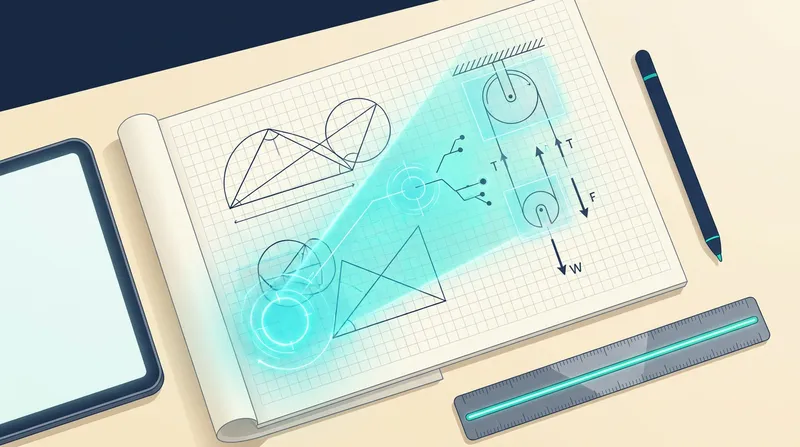
Most ads for an AI math solver with diagram recognition boast 98% or 99% accuracy. Those numbers usually come from clean, printed algebra equations like 3x + 7 = 22. Real middle and high school STEM homework is much harder because it requires a three-stage pipeline:
- Visual and Prose Parsing: Reading every exponent, negative sign, angle arc, force arrow, and unit without guessing.
- Model Selection: Deciding which theorem, conservation law, or chemical formula applies to the story.
- Symbolic Execution and Unit Checks: Running the algebra cleanly and checking whether the final units make physical sense.
Stage 1 is where modern vision-language AI still trips up most often. In the landmark MathVerse visual math benchmark, researchers tested leading multimodal AI models across 2,612 visual math problems reworked into 15,000 text-to-diagram variations. They discovered that AI systems frequently lean on redundant clues in the written text rather than genuinely "seeing" the diagram. When a critical measurement appears only on the drawing (such as a small perpendicular square on a geometry figure or a frictionless surface label on an incline), accuracy drops sharply.
Across real student worksheets, four diagram failure modes cause the vast majority of wrong AI answers:
- Sign and exponent slips: Misreading a handwritten minus sign as a stray dash or reading
x^2as2x. - Unlabeled angle confusion: Swapping sine and cosine on a physics ramp because the AI assumed the angle was at the base rather than the top corner.
- Graph scale misreads: Assuming every grid box on a coordinate plane equals 1 unit when the axis is actually scaled by 2s or 5s.
- Multi-part chemistry and circuit symbols: Missing a subscript in a chemical compound or miscounting resistors wired in parallel versus series.
Actionable habit to start today: Teach your student the "Crop and Confirm" rule before accepting any solution from a snap-and-solve homework app. Crop the camera frame tightly around a single problem (keep neighboring questions out of view), then read the AI's transcribed problem statement line by line. If the transcription missed a negative sign or angle label, edit it immediately before reading step 1. For a deeper look at catching subtle student or AI errors on paper, see our guide on Can AI Check Handwritten Math Work? How to Find Your Exact Wrong Step.
MathGPT Review: Animated Video Explanations, AP Prep, and Limitations
MathGPT (math-gpt.org) has carved out a distinct niche in 2026 by focusing squarely on STEM depth rather than trying to write English essays. Students can upload a screenshot, snap a photo, or paste a PDF covering algebra, geometry, calculus, physics, chemistry, or accounting.
Its standout feature is on-demand AI animated video explanations. Instead of handing a tired teenager a dense wall of LaTeX text, MathGPT generates a short, narrated, whiteboard-style clip that animates each algebraic move in real time. For visual and auditory learners who usually rely on searching YouTube for a matching example, watching a custom video tailored to their exact homework numbers can make an intimidating calculus integral click much faster. MathGPT also bundles a built-in graphing calculator and generates practice quizzes to reinforce the topic.
Its free tier is also refreshingly transparent compared to legacy paywalled calculators: free users can solve up to 15 questions and generate 5 animated video explanations per day, while MathGPT Unlimited runs about $19.99 per month, with the yearly plan cutting the monthly cost roughly in half (prices vary by platform; check checkout).
However, MathGPT has real trade-offs for middle and high school families:
- No parent visibility layer: Parents cannot log into a family dashboard to see which topics their child struggled with this week or whether homework time is actually closing knowledge gaps.
- Video generation friction: Waiting for an animated video to render feels great for a complex AP Calculus setup, but it can slow down quick nightly practice when a student just wants crisp, scannable feedback.
- Cloud-dependent workflow: Because MathGPT relies heavily on cloud processing and video streaming, its AI features are less convenient for quick offline review on a bus or in a low-signal classroom.
Actionable tip for MathGPT users: Treat animated videos as an interactive pause exercise, not a movie. Watch only until the video finishes translating the word problem into the starting equation, hit pause, and try solving the remaining algebra on scratch paper. Then press play to check your work.
StudyX Review: Multi-Model AI Solver, Note-Taking, and Science Coverage
When students compare StudyX vs. MathGPT, they are usually weighing a specialized STEM explainer against an all-in-one study dashboard. StudyX (studyx.ai) takes the Swiss-army-knife approach. Rather than relying on a single AI engine, StudyX lets students toggle between leading frontier models (such as GPT-4o, Claude, and Gemini) inside one homework workspace, paired with a searchable database of over 75 million previously solved academic questions.
For older high schoolers juggling five or six different classes, StudyX goes well beyond equations. It includes a Chrome browser extension for online homework portals, an AI lecture note-taker that turns class recordings and slides into structured study guides, flashcard generation, and broad subject coverage spanning math, physics, chemistry, biology, history, and literature. Free accounts get a limited daily credit allowance, while StudyX Plus costs about $9.99 per month or $69.99 per year (roughly $5.83 per month).
That breadth comes with a few catches that parents and teachers should notice:
- Decision fatigue and distraction: Giving a 7th or 9th grader model pickers, essay helpers, and a massive community Q&A bank can blur the line between learning and answer-hunting.
- Uneven community archive quality: While its frontier AI reasoning is strong, older crowdsourced answers pulled from the question bank vary in clarity and do not always match how U.S. teachers grade show-your-work steps.
- Limited adaptive mastery tracking: StudyX is built around getting through tonight's assignments and lecture notes rather than diagnosing long-term foundational gaps across middle and high school math.
Actionable tip for StudyX users: Take advantage of StudyX's multi-model setup on tricky science diagrams by running a Two-Model Cross-Check. Solve an AP Physics or Chemistry problem with one model, then ask a second model solely to check the starting formula and units. If the two models disagree on the setup, you have caught a potential hallucination before memorizing the wrong method.
Tutor AI Review: Clearing Up the Name Split, Step-by-Step Learning, and Parent Visibility
Before comparing MathGPT video explanations against Tutor AI, we need to clear up a major source of 2026 confusion that almost every review site misses. If you type "TutorAI" into a search engine today, you will bump into two completely different products:
- Browser-based AI course builders (such as
tutorai.me), which generate text-based mini-courses on general topics and bundle a browser homework tool. - Tutor AI (
tutoraisolver.com), a dedicated mobile-first (iOS and Android) and web snap-and-solve homework app and adaptive AI math practice platform built specifically around the "Snap. Solve. Learn." philosophy for middle school, high school, and family households.
In this Tutor AI math homework helper review, we are focusing on Tutor AI (tutoraisolver.com), because it is the tool designed directly for nightly math and science homework, exam prep, and parent oversight.
Where Tutor AI Stands Out for Families
Tutor AI is engineered to solve the exact late-night friction parents and teens run into:
- Fast, accurate photo OCR: Students snap a picture of printed textbooks, teacher worksheets, or handwritten notes and get structured recognition in under five seconds, covering pre-algebra through calculus and statistics, plus physics, chemistry, and biology.
- Comprehension-first step-by-step explanations: Instead of jumping to a bare number, Tutor AI breaks down why each formula or rule applies, using age-appropriate language and showing alternate methods when helpful.
- Personalized learning paths: As a student works through problems, Tutor AI identifies recurring weak spots (like factoring quadratics or balancing redox equations) and serves targeted, curriculum-aligned daily practice at an adaptive difficulty level.
- Built-in parent progress tracking: Unlike MathGPT or StudyX, Tutor AI treats parents as partners. Parents can review visual progress reports, topic mastery trends, and weak-spot identification so evening check-ins stay calm and productive instead of turning into kitchen-table arguments.
- 24/7 online and offline access: Students can review previously solved problems and saved study material even without Wi-Fi, making it practical for car rides, flights, and school commutes.
So how do MathGPT's video explanations compare with Tutor AI in practice? Think of the difference as one-off visual lecture versus daily personalized coaching. MathGPT is hard to beat when an AP Calculus student wants a 90-second narrated whiteboard video on a single messy integral. Tutor AI is the stronger everyday system for middle and high school families who want instant photo help across math and science, adaptive follow-up practice so the concept actually sticks, and transparent parent reporting. If you are weighing other popular apps or shopping for multiple kids, read our Question AI vs. Answer AI vs. Tutor AI (2026): Accuracy Guide & Hidden Subscription Traps and our roundup of 7 Best Tutoring Apps for Multiple Kids (Middle & High School): Affordable Family Plans & Kumon Alternatives (2026).
Actionable tip for Tutor AI families: Set a five-minute Sunday Night Dashboard Check. Sit down with your child, celebrate one mastery streak from the week, and pick one weak-spot topic from the progress report to practice for 10 minutes before the next quiz.
Head-to-Head Comparison: Calculus, Physics Diagrams, and Chemistry Word Problems
To figure out the best AI for calculus and physics word problems, it helps to look beyond simple algebra and examine how MathGPT, StudyX, and Tutor AI are designed to approach the three toughest homework archetypes in U.S. middle and high schools.
1. Multi-Step Calculus Word Problem (Related Rates)
Consider a classic AP Calculus problem: Water drains from a conical tank of radius 4 meters and height 10 meters at 2 cubic meters per minute; how fast is the water level dropping when the depth is 5 meters? A dependable multi-step math word problem solver must do three things cleanly: spot the similar-triangle ratio (r / h = 4 / 10), substitute r into the volume formula before differentiating, and preserve the negative sign on dV/dt = -2.
- MathGPT is well suited to this kind of visual setup because its animated videos are built to highlight how
rgets replaced in terms ofh, which can help prevent the #1 student mistake of applying the product rule unnecessarily. - StudyX gives students access to frontier models for multi-step calculus reasoning, though students may want to prompt it explicitly to show the similar-triangle justification rather than jumping straight to the simplified volume formula.
- Tutor AI is designed to lay out the setup step by step (given rates, geometric constraint, implicit differentiation, and sign check) and pair the walkthrough with follow-up practice so students can try the same structure on a ladder or balloon problem.
Building that habit of writing down constraints before computing starts early in algebra. If your student is still practicing equation setup, our guide on How to Solve Systems of Equations Step-by-Step: Substitution vs. Elimination (Plus How to Check Your Work) walks through a similar check-your-work habit. AP Statistics students can also apply a structured rubric using our State, Plan, Do, Conclude AP Stats FRQ Guide & AI Solver.
2. Physics Inclined-Plane Free-Body Diagram
Consider giving an AI chemistry and physics problem solver a photo of a 5 kg block sliding down a 30-degree ramp with a friction coefficient of 0.2, where the angle is drawn only inside the triangle. Here, visual reading and conceptual scaffolding matter equally.
Research shows how transformative scaffolded physics guidance can be when built right. In a randomized controlled trial of 194 Harvard introductory physics students published in Nature Scientific Reports, a custom AI tutor engineered with step-by-step scaffolding and cognitive-load pacing more than doubled median learning gains compared to an in-class active learning session, in less total study time.
- Tutor AI is designed to walk through cropped diagrams step by step, separating forces parallel to the ramp (
mg sin(30)) and perpendicular to the ramp (mg cos(30)) so students see why normal force is not simplymg. - MathGPT is an appealing choice when a student wants a narrated video illustrating rotated coordinate axes, though adding a brief text caption to hand-drawn pencil arrows helps avoid OCR guesswork.
- StudyX lets students pick stronger vision-capable models for printed textbook diagrams, though faint angle arcs on dimly lit worksheet photos still call for tight cropping and a quick transcription check.
3. Chemistry Stoichiometry & Limiting Reactant Word Problem
Take a two-paragraph honors chemistry prompt asking for the theoretical yield of water in grams when 12.0 g of hydrogen reacts with 64.0 g of oxygen, followed by percent yield. A solid solver needs to balance 2H2 + O2 -> 2H2O, convert grams to moles, flag oxygen as the limiting reactant, and keep intermediate rounding consistent.
- StudyX is convenient when students want molar-mass and stoichiometry help right next to their uploaded lecture notes and flashcards.
- MathGPT fits visual learners who want a narrated dimensional-analysis walkthrough showing how each unit cancels.
- Tutor AI is built to keep each calculation step and conceptual reason clear while logging ongoing chemistry practice into a student's science mastery tracker.
Actionable tip for every science problem: Run the "Unit Sanity Test." Copy just the units (such as m/s^2, kg, or mol/g) from each line of the AI's solution and cancel them like fractions. If the surviving unit at the bottom does not match what the question asked for, the setup has an error, even if the numbers look convincing.
Best Free Alternatives to MathGPT, StudyX, and Tutor AI in 2026
Many older "best free math solver" articles on the web are out of date. Several legacy camera apps have either retired or moved step-by-step explanations behind monthly paywalls, leaving only bare final answers for free users. If your family is searching for free MathGPT and StudyX alternatives in 2026, here is the honest, up-to-date toolkit:
- General AI Study Modes (Free): Both ChatGPT's Study Mode and Google Gemini's Guided Learning mode now offer free conversational Socratic coaching. They work well if a student types or uploads clear photos and wants hints instead of direct answers, though they lack dedicated K-12 parent progress dashboards and structured daily curriculum streaks.
- Desmos Graphing Calculator (100% Free): No AI text solver beats Desmos for visually checking functions, quadratic roots, trig waves, and calculus tangent lines. It is also built directly into the Digital SAT.
- Khan Academy & Khanmigo (Free / $4 per month): Khan Academy remains the gold standard for free, teacher-trusted concept videos and mastery exercises, while its Socratic AI tutor Khanmigo costs just $4 per month for individual U.S. learners.
- Smart Free-Tier Stacking: Budget-conscious families can combine Tutor AI's free daily snap-and-solve tier for quick nightly homework checks with Desmos for visual verification and our roundup of 7 Best Digital SAT Practice Websites for Targeted Math & R&W Modules (Free & Paid) when test season ramps up.
Actionable tip: Bookmark Desmos right beside whatever AI solver your child uses. Whenever an AI solves an equation for x, have your student plug both sides of the original equation into Desmos as y = (left side) and y = (right side) to visually confirm they intersect at that exact x-value.
How Parents and Teachers Can Turn AI Solvers Into Real Study Partners
Here is the honest truth every parent and teacher needs to hear before handing a middle or high schooler any AI homework app: how a student uses AI matters just as much as which app you pick.
A field experiment led by researchers at the University of Pennsylvania's Wharton School with nearly 1,000 high school math students in Turkey, published in Proceedings of the National Academy of Sciences (PNAS), showed this dramatically. Students who practiced with an unguarded AI chatbot scored 48% higher during homework practice, but once the AI was taken away, they scored 17% worse on a proctored exam than classmates who never used AI at all. By contrast, students who used a Socratic-safeguarded AI tutor that gave hints instead of instant copies scored 127% higher in practice and completely avoided the exam drop.
Broader K-12 evidence adds important nuance. A 2025 systematic review in npj Science of Learning analyzing 28 studies and nearly 4,600 K-12 students found that the effects of AI intelligent tutoring systems are generally positive, though the advantage shrinks when they are compared with non-intelligent tutoring systems, and the authors call for more rigorous research. That is why the National Council of Teachers of Mathematics (NCTM) encourages educators and families to build "healthy skepticism" toward AI and shift homework from solving alone to a blend of solving and verifying. The U.S. Department of Education's former Office of Educational Technology (eliminated in March 2025) had urged keeping humans in the loop so AI supports student agency rather than replacing critical thinking.
The 3-Step Parent & Teacher Audit Protocol
Whether your student chooses a Socratic AI tutor for high school, Tutor AI, MathGPT, or StudyX, put this simple house rule on the fridge:
- Attempt First (3-Minute Rule): Your child must write down the known values, sketch the diagram, and attempt step 1 on paper before opening the camera scanner. Even a messy guess activates memory.
- Verify the Setup, Not Just the Answer: Check the AI's transcribed problem, identify the governing formula it picked, and run the Unit Sanity Test.
- Close the App for a Twin Problem: Once your student understands the worked steps, close the phone or browser and have them solve the very next similar problem on the worksheet completely solo. If they can finish the twin problem unassisted, real learning happened.
Choosing the Right Next Step for Your Family
If your high schooler mainly wants on-demand whiteboard videos for tough AP Calculus or college STEM problems, MathGPT is an impressive visual specialist. If they want a multi-model browser hub for lecture notes, humanities, and STEM in one place, StudyX delivers broad versatility. And if you want a calm, distraction-free daily companion that combines instant photo solving across math and science, adaptive practice for weak spots, offline saved review, and parent progress dashboards, Tutor AI is built around how real families study.
Ready to turn tonight's 10 PM homework struggle into genuine confidence? Download Tutor AI free on iOS or Android (or visit tutoraisolver.com), run the Three-Problem Home Audit together tonight, and see how fast "Snap. Solve. Learn." takes the stress out of STEM.
Note: Every student learns differently. While these strategies and tools are grounded in current educational research, results vary by student. Adapt these study habits to match your child's learning style and classroom guidelines.
Frequently Asked Questions
Do AI homework apps handle messy cursive or slanted notebook handwriting?
Modern photo OCR handles neat print very well, but tight cursive, faint #2 pencil smudges, and slanted notebook lines still trigger misreads (especially confusing t with +, 5 with S, or z with 2). To get clean recognition in under five seconds, write equations with dark ink or a sharp pencil on a flat surface, hold the phone directly overhead rather than at an angle, and avoid casting a hand shadow across the page.
Do these tools work for international English curricula like IGCSE, IB, or Singapore, Malaysia, and Hong Kong syllabi?
Yes, though notation habits differ slightly from U.S. textbooks. For example, British-aligned and Asian English-medium curricula (such as Cambridge IGCSE, IB, HKDSE, or SPM) often say "gradient" instead of "slope," "trapezium" instead of "trapezoid," or expect "standard form" in scientific notation rather than Ax + By = C. Whenever an explanation uses unfamiliar terminology, simply add one short follow-up note specifying your syllabus (for example, "Show using IB HL notation" or "Use significant figures per IGCSE rules").
Can my child review solved math steps offline on the school bus or during travel?
It depends on the platform's architecture. Cloud-heavy platforms like MathGPT and StudyX rely on live servers for video streaming and multi-model chats, so their AI features generally need an internet connection. Mobile-first apps like Tutor AI allow students to open previously solved problems and saved study history offline, so saving tough problems at home makes it easy to review them before a morning quiz without burning cellular data.
Will using an AI math or science solver violate my school's academic integrity policy?
Most U.S. middle and high schools draw a clear line between copying AI-generated solutions onto graded work (which violates honor codes) and using AI as a tutor to check completed attempts or study practice problems. Always review the course syllabus at the start of the semester, ask the teacher whether step-checking apps are allowed for nightly homework, and make sure every submitted solution reflects work your student can explain aloud on the board.
What privacy checks should parents do before giving a middle schooler an AI study app?
Before creating an account for a student under 13 or in middle school, check three things in the app's privacy policy: whether the app avoids invasive ad trackers, whether uploaded photos of student worksheets are encrypted rather than used to train public models, and whether parents have clear visibility into account activity and subscription renewals. Dedicated family-friendly platforms with built-in parental controls and transparent data encryption are generally safer than ad-heavy crowdsourced homework sites.
When is an AI solver not enough, and when should a family hire a human tutor?
AI solvers shine at midnight equation help, step-by-step scaffolding, and unlimited targeted practice. However, consider bringing in a human tutor or school learning specialist if your child faces severe multi-year foundational gaps (such as struggling with basic multiplication in 9th grade), executive-function challenges like organizing long-term study schedules, or deep math anxiety that requires warm face-to-face emotional encouragement.