
Introduction: The Late-Night Biochemistry Struggle
We have all been there. It is 11 PM on a Tuesday, and you are staring at a textbook page filled with endless arrows, complex chemical structures, and acronyms that look like an alien language. Biochemistry is notoriously challenging because it demands a unique combination of skills. You have to memorize intricate biological pathways while simultaneously solving complex chemical equations.
For parents and private tutors, this subject often brings a profound sense of helplessness. You want to support your student, but unless you have a university degree in advanced sciences, helping them navigate the Krebs cycle or calculate enzyme turnover rates feels nearly impossible. The stress builds, confidence takes a hit, and homework time can start to feel like a battle for the whole family.
Fortunately, educational technology has evolved. A dedicated biochemistry AI homework help tool like Tutor AI can completely transform these late-night struggles. By acting as a personalized, 24/7 AI biochemistry tutor, these advanced platforms provide instant, step-by-step solutions that actually explain the "why" behind the science. This guide will show you exactly how to use AI to master pathways, visualize molecules, and crush your next lab report.
Actionable Tip: Before diving in, open your notes app and write down the one biochemistry topic that has confused you most this week. Keep it nearby as you read, because this guide will give you exact AI prompts to tackle it tonight.
Why Biochemistry is So Hard (And How Tutor AI Can Help)
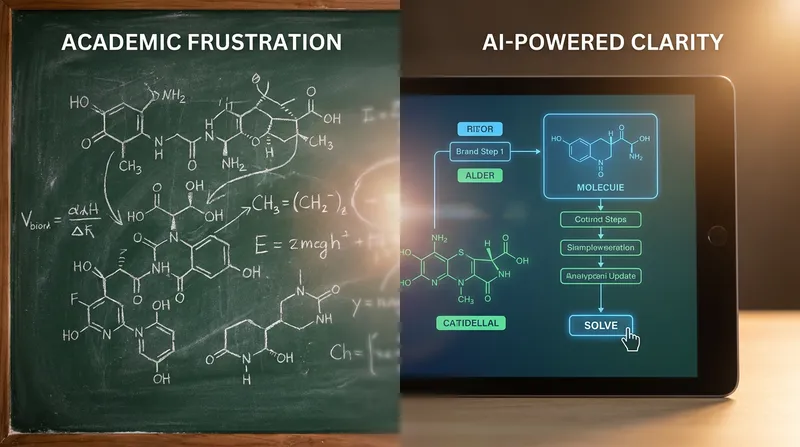
The Intersection of Biology and Math
Biochemistry is often the first class where students realize that simple memorization is no longer enough. The subject is a heavy collision of two distinct worlds. Biology requires you to understand massive, interconnected systems, while chemistry demands strict mathematical precision and an understanding of molecular forces.
When students try to use generic, text-based AI chatbots for this cross-disciplinary subject, they often run into trouble. Basic AI tools frequently "hallucinate" or make up chemical formulas, leading to incorrect homework answers and massive frustration. However, specialized AI for biochemistry students is built differently because it is trained specifically on scientific data and mathematical problem-solving logic.
In fact, specialized models are proving to be incredibly powerful in medical and advanced science education. A study published in the Journal of Medical Internet Research demonstrated that advanced AI models achieved passing scores on USMLE-style medical questions, highlighting their capability in complex subjects. If you are curious about how artificial intelligence can adapt to different learning needs, you can read more in our guide on The Ultimate Guide to AI for Differentiated Instruction in Math & Science.
Actionable Tip: Before you snap a photo of your homework and upload it to Tutor AI, take a breath and identify your specific weak point. Are you struggling to memorize the biological pathway, or are you confused by the math? Telling the AI exactly what you need (for example, "Explain the math steps only") will yield a much better result.
Mastering Metabolic Pathways with a Biochemistry Problem Solver
One of the biggest hurdles in biochemistry is memorizing metabolic pathways. Glycolysis, the Krebs Cycle (Citric Acid Cycle), and Oxidative Phosphorylation are massive chains of chemical reactions. Students are often expected to know every enzyme, every carbon molecule, and every energy transfer step by heart.
Staring at a static textbook diagram rarely helps this information stick. This is where a metabolic pathway AI tool becomes an invaluable study buddy. Instead of just giving you the final answer, Tutor AI interacts with you to break down the pathway into manageable chunks. It explains the logical flow of why a carbon atom moves from one molecule to another, helping you understand the big picture of cellular energy.
Visual Learning Strategies
Understanding how these pathways connect to broader biological concepts is crucial for long-term retention. Because Tutor AI adapts to different learning styles, visual learners can prompt the AI to generate text-based diagrams or step-by-step numbered pathway walkthroughs. For a great refresher on how energy systems work, check out our Photosynthesis vs. Cellular Respiration: Study Guide & Equations.
Actionable Tip: Do not just ask the AI to "explain glycolysis." Use this specific, copy-and-paste prompt template to get step-by-step biochemistry answers: "Act as an expert AI biochemistry tutor. Explain the regulatory steps of glycolysis to me like I am a high school student. Then, create a funny, easy-to-remember mnemonic device to help me memorize the three key regulatory enzymes."
Crushing Enzyme Kinetics: Your AI Math and Chemistry Helper
If metabolic pathways are the biology side of the course, enzyme kinetics represents the heavy chemistry and math side. Topics like Michaelis-Menten kinetics, Lineweaver-Burk plots, and calculating Vmax (maximum velocity) and Km (Michaelis constant) require intense algebraic manipulation.
Step-by-Step Algebraic Breakdowns
Analyzing raw data for these equations is mathematically complex and very time-consuming. A single math error in the first step will ruin the entire calculation. With Tutor AI's chemistry solver, you can snap a photo of your data table directly from your worksheet. The app's image recognition processes handwritten and printed tables instantly, so you skip the tedious step of retyping numbers while getting step-by-step math breakdowns.
Real-World Applications in Research
This is not just a homework shortcut, as professional scientists rely on these exact technologies every day. According to research published in Nature Communications, advanced AI frameworks have demonstrated a 20 percent higher performance in predicting enzyme turnover numbers compared to older models. Furthermore, the National Institutes of Health (NIH) validates that machine learning is actively used today to predict kinetic parameters, saving researchers thousands of hours in the lab. For more tips on tackling heavy calculations, explore The Best AI for Math and Physics: Top Problem Solvers for High School STEM Classes.
Actionable Tip: Take a clear photo of your raw kinetics data table from your worksheet. Upload it to Tutor AI and use this prompt: "Analyze this data table. Calculate the Vmax and Km using the Michaelis-Menten equation, and show me the step-by-step mathematical breakdown so I can understand how you got the answer."
Visualizing the Invisible: Using a Molecular Structure AI Visualizer
Biochemistry is a three-dimensional subject trapped in a two-dimensional textbook. To truly understand how proteins fold, how enzymes bind to substrates, and how amino acid side chains interact, you have to be able to visualize structures in space.
When a student cannot picture how a hydrophobic (water-repelling) amino acid folds inward away from water, the entire concept of protein structure falls apart. Artificial intelligence has completely revolutionized structural biology, with the gold standard coming from Google DeepMind. Their AlphaFold AI successfully predicted the 3D structures of over 200 million proteins, a monumental achievement that earned its developers the Nobel Prize in Chemistry.
Translating 3D Concepts into Plain English
While you might not need AlphaFold for your weekend homework, you can absolutely use Tutor AI's molecular visualization helper. The AI can describe exactly how molecules fit together, comparing their charges, polarities, and shapes in plain English to aid your mental visualization. For help with the organic chemistry side of molecular structures, you can review The Best AI Organic Chemistry Solvers (That Actually Work).
Actionable Tip: The next time you are confused about protein folding, ask your AI solver this question: "Compare the polarity and charge of the amino acids Valine and Glutamic Acid. Explain step-by-step how substituting one for the other would change the 3D folding structure of a protein in a water-based environment."
How to Write a Biochemistry Lab Report Using AI (Without Cheating)
Writing lab reports is one of the most tedious parts of any science class. After spending hours in the lab pipetting solutions and recording data, you still have to structure a massive document including an Introduction, Methods, Results, and Discussion section.
Many students wonder how to use a biochemistry lab report AI ethically. The goal is never to have the AI write the paper for you, as that bypasses the learning process completely and violates academic integrity. Instead, you should use the AI to solve complex biochemistry questions related to your data, structure your outline, and review your scientific reasoning.
Ethical AI Collaboration
Academic institutions are beginning to recognize the value of this integration. For example, Northeastern University highlights how artificial intelligence is being integrated into biochemistry research, preparing students to use machine learning to solve complex life science challenges. Using AI as a collaborative tool is becoming a standard industry skill. For a broader look at writing ethically with technology, read How to Use an AI English Solver for Homework & Essays (Without Cheating).
Actionable Tip: Write your own hypothesis and introductory paragraph first. Then, feed your text into the AI with this prompt: "Review my biochemistry lab report introduction. Check my hypothesis for scientific accuracy, suggest improvements for clarity, and tell me if my reasoning aligns with standard enzyme kinetics principles."
Tips for Parents and Tutors: Supporting Your Student in Advanced Science
It is incredibly tough to watch a student stress over a subject you do not fully understand yourself. If your child brings home AP Biology or university-level biochemistry, you might feel like you cannot help them at all.
Becoming a Partner in Learning
However, you do not need a science degree to be supportive when you have the right tools. Tutor AI acts as a co-pilot for parents and private tutors by providing the heavy scientific lifting while you provide the emotional support and structure. You can use Tutor AI to understand a concept well enough to ask your student guiding, Socratic questions. Instead of just handing them the answer, you can ask, "What do you think happens to the carbon molecule next?" to keep them engaged.
Tracking Progress and Offline Access
Tutor AI's parent dashboard lets you see exactly which topics your student has been working on. You can monitor how their accuracy is improving over time and where they still need support, without having to quiz them directly after a stressful study session. And because Tutor AI works offline, your student can access previously solved problems and saved explanations even without a Wi-Fi connection. This is perfect for study sessions at the library or during travel. If homework time is causing emotional distress in your household, you might find comfort and strategies in A Parent's Guide to Math Anxiety: How to Help a Child Struggling with Math and End Homework Tears.
Actionable Tip: Sit down with your student a few days before their big exam. Use the AI homework helper together by typing: "Generate a 10-question multiple-choice practice quiz on the Krebs Cycle at a high school AP level. Provide the answer key with detailed explanations for each correct answer."
Conclusion: Study Smarter, Not Harder
Biochemistry does not have to be a nightmare of endless memorization and impossible math. By leveraging a dedicated biochemistry AI homework help platform, you can break down terrifying metabolic pathways, easily calculate enzyme kinetics, and visualize complex molecular structures.
Remember that AI is a powerful tool designed to build true, lasting understanding, not just a shortcut to get to the final answer. When you use step-by-step biochemistry answers to learn the "why" behind the science, you build real academic confidence that will carry you through your final exams and beyond.
Ready to study smarter? Download Tutor AI today. Snap. Solve. Learn.
Note: Every student learns differently. The AI prompts and strategies in this guide are designed as starting points. Adapt them to fit your learning style, course level, and your teacher's specific requirements.
Frequently Asked Questions
Can AI accurately solve complex enzyme kinetics problems?
Yes. Advanced AI models can process data tables and apply complex mathematical formulas like the Michaelis-Menten equation to calculate Vmax and Km. However, students should always use tools that provide step-by-step math breakdowns to ensure they actually understand the algebraic process, rather than just copying a final number.
Is using an AI biochemistry tutor considered cheating?
Not if it is used correctly. Using AI to explain difficult concepts, visualize metabolic pathways, or check your math is a highly effective and ethical study strategy. Simply copying and pasting final answers onto your worksheet without understanding them is counterproductive and violates most academic integrity policies.
What is the best AI tool for visualizing molecular structures?
While high-level, professional tools like AlphaFold exist for working research scientists, students do not usually need that level of complexity. Instead, students can use specialized AI biology solvers to get detailed textual breakdowns of 3D structures, protein folding rules, and amino acid properties to aid their mental visualization and homework comprehension.
How can parents help with biochemistry homework if they do not know the subject?
Parents can act as study facilitators by using an AI homework helper alongside their child. The AI provides the specific scientific expertise, while the parent provides emotional support, helps set up healthy study schedules, and uses the AI to generate practice quizzes and review guides.
Will an AI solver help me memorize metabolic pathways like the Krebs Cycle?
Absolutely! You can prompt an AI biochemistry solver to create custom mnemonic devices, explain the logical flow of carbon molecules, and break down complex pathways into bite-sized, easy-to-remember steps. This interactive method is far more effective than just staring at a textbook diagram.


