
AP season is stressful enough without discovering your student's study tools are working against them. The 2026 AP exams are bringing significant changes to how students test, and many families are feeling the pressure. Imagine it is 10 PM and your child just realized their practice free-response question (FRQ) answer was correct but earned zero points. This is a frustrating reality for many families.
Here is what is actually changing in 2026, and how to prepare with confidence. Many students preparing for May are discovering a critical gap between their practice scores and their FRQ performance. They are getting the correct mathematical answers during practice using basic AI solvers, but they are still failing AP Calculus FRQs because they do not know how to write the conceptual justifications and theorem applications required by the strict College Board grading rubric.
Getting the right number is no longer enough. The shift to the 2026 AP exam hybrid format means students must navigate a brand new digital testing environment while still proving their mathematical reasoning on paper.
In this comprehensive guide, we will break down the new College Board digital AP exams, explain the updated AP exam calculator policy 2026, and show you exactly what to look for in a study tool instead to help your student build real academic confidence.
The 2026 AP Exam Hybrid Format Explained
If you have had a child take an AP exam in the past, you probably remember the classic setup of thick paper booklets and endless bubbling with a pencil. That era is officially over.
According to the official College Board digital AP exams overview, 12 specific AP subjects (including AP Calculus AB, AP Calculus BC, and AP Statistics) are now administered in a hybrid digital format.
What does this mean for test day?
First, students will use the Bluebook AP testing app on a school-approved device (like a Chromebook or laptop) to answer all multiple-choice questions.
Second, for the Free Response Questions (FRQs), students will read the complex word problems on their screen but handwrite their mathematical steps and justifications in a physical paper booklet.
This split-attention format requires a completely different type of practice. Students can no longer just scribble notes in the margins of a test booklet. They must look at a screen, process the information, and then translate their thoughts onto paper in a highly organized way.
If your child has been feeling the pressure of this transition, that is completely understandable. These are real changes, and preparation makes all the difference.
Actionable Tip for the Hybrid Format
Encourage your child not to wait until May to practice this workflow. When doing AP Calculus FRQ step-by-step help sessions at home, have your student prop up their laptop to read the question, and force themselves to write the complete solution in a blank notebook. This builds the exact muscle memory they will need on exam day.
The AP Exam Calculator Policy 2026: What You Need to Know
The tools students are allowed to use have also received a significant update. The AP exam calculator policy 2026 introduces new digital tools that students must master before test day.
For the first time, a Desmos scientific or graphing calculator is built directly into the Bluebook app for the calculator-allowed sections of the math exams. Students can still bring up to two permitted handheld calculators (like a TI-84), but many are choosing to rely on the digital Desmos tool because of its visual clarity.
However, there is a catch. The calculator is only available on specific sections. For AP Calculus, there is still a strict no-calculator section where students must rely entirely on their mental math and algebraic manipulation skills.
Actionable Tip for Calculator Practice
If your student plans to use the digital calculator, they must practice with the exact Desmos interface. Encourage them not to rely on their phone's basic calculator app during homework. Familiarizing themselves with how to quickly input integrals and derivatives into the Bluebook-style interface will save precious minutes during the exam.
The AP FRQ Grading Rubric 2026: Why Correct Answers Score Zero
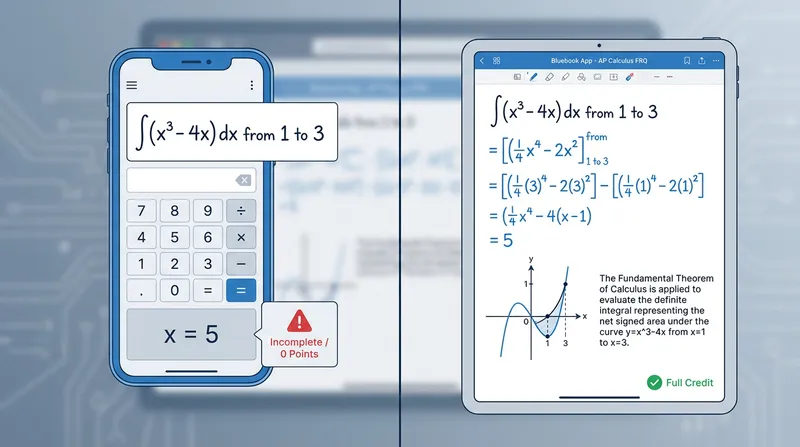
Many parents are confused when their child gets an "A" on their homework but scores a 1 or 2 on a practice AP exam. The secret lies in the grading rubric.
The AP Calculus AB scoring guidelines are notoriously strict. The exam uses a total-point scoring system, and the free-response questions are graded by trained AP Readers who look for very specific written evidence.
If a question asks a student to find the maximum volume of a container, simply writing "V = 54.3" might earn zero points, even if 54.3 is the exact correct answer.
To earn full points, a student must typically:
- State the correct initial equation or integral setup.
- Show the derivative and set it equal to zero to find critical points.
- Justify why this point is a maximum (using the First or Second Derivative Test).
- State the final answer accurately to exactly three decimal places (e.g., 54.300).
- Include the correct units of measurement (e.g., cubic centimeters per second).
Basic scanner apps skip straight to the final number, leaving students completely unprepared for the rigorous justification required by the College Board.
Why Basic Math Solvers Fall Short on AP Calculus Word Problems
When a student is stuck late at night, they often turn to the fastest solution available. They might use Mathway for calculus word problems, snap a picture with Photomath, or search for a Socratic AI math tutor.
While these tools are perfectly fine for checking basic algebra, they were designed for a different purpose and often struggle with the context required for college-level AP Calculus.
Why? Because basic solver apps are primarily computational engines. They are designed to read a clean, straightforward equation and output a number. They cannot read a paragraph about water leaking from a cone-shaped tank and understand the context required to set up a related rates problem.
Even community platforms like Brainly or Chegg have drawbacks. The answers are often user-generated, unverified, or skip the crucial AP-specific steps. Furthermore, relying on these sites can lead to the hidden cost of paywalled homework apps, where students are forced to pay hefty monthly fees just to see how a problem was solved.
Recent academic studies back this up. According to peer-reviewed research published on arXiv, large language models often experience severe reasoning failures on high school math word problems. They rely on shallow pattern matching rather than true logical deduction. This means a basic AI might give your student a highly confident explanation that is entirely mathematically incorrect.
To succeed, students need more than an answer engine. They need a tool that understands the context, the curriculum, and the pedagogy of learning.
Math Solver vs AI Tutor: Which is Best for AP Exams?
Understanding the difference between a math solver and an AI tutor is critical for your student's exam preparation strategy.
A standard math solver gives you the destination. An AI tutor gives you the map, the compass, and the driving instructions.
When evaluating the best AI tutoring apps for step-by-step explanations, you should look for tools that act as conceptual coaches.
For example, Tutor AI is built on the philosophy of "Snap. Solve. Learn." When a student snaps a photo of an AP Calculus FRQ, the AI does not just spit out a decimal. It breaks the problem down into logical, bite-sized steps. It explains the reasoning behind each step, highlights the key calculus formulas used, and models the exact type of mathematical notation that AP graders want to see.
If you want to know why standard math apps fail the hardest high school exams, it is because they encourage passive copying. An AI tutor encourages active learning.
How to Help Your Student Study for AP Calculus FRQs
If your child wants to secure a 4 or a 5 on their AP exam, they may need to change how they interact with their study materials. Here are four actionable strategies to implement today.
1. Master the "Setup" Before the "Solve"
When practicing FRQs, students should spend 80 percent of their time on the setup. Graders award the majority of points for writing the correct integral, stating the correct theorem, or taking the correct derivative. If they make a tiny arithmetic error at the very end, they will only lose one point. Focus on the concepts first.
2. Learn the "AP Language"
The College Board requires specific phrasing. If a student is using the Mean Value Theorem, they must explicitly state that the function is "continuous on the closed interval and differentiable on the open interval." Have your student memorize these justification phrases.
3. Use AI for Active Homework Practice
Encourage your child to stop using apps to bypass the work. Instead, try using AI for active homework practice. They should attempt the problem on their own first. Then, use Tutor AI to check their work step-by-step. If they made a mistake on step three, they can identify exactly where their logic went wrong without feeling overwhelmed.
4. Track Weak Spots
Calculus builds upon itself. If a student is struggling with integration by parts, it might be because they have a weak foundation in the chain rule. Tutor AI features personalized learning paths and progress tracking, allowing students and parents to see exactly which topics need more review before test day.
AP Statistics FRQ Practice: Adapting to the New Tools
While calculus gets a lot of the spotlight, AP Statistics students are also facing major shifts. The 2026 AP Statistics exam is also utilizing the hybrid digital format, and the built-in Desmos graphing calculator is now fully integrated into the Bluebook app for statistics students.
AP Statistics FRQ practice requires an incredibly high level of written communication. Students must describe distributions, check conditions for inference tests, and write conclusions in the context of the problem.
For example, if an FRQ asks for a conclusion about a p-value, simply writing "Reject the null hypothesis" is a weak response. A strong conclusion must be contextualized: "Because the p-value of 0.03 is less than alpha = 0.05, we reject the null hypothesis. There is convincing evidence to conclude that the true mean volume of the containers is less than 54.3 cubic centimeters."
A basic math scanner cannot write this contextual conclusion. You need an AI math tutor that understands statistical vocabulary and can guide students through the rigid inference processes.
Actionable Tip for AP Statistics
Have your student practice the strict four-step inference process (State, Plan, Do, Conclude) using Tutor AI to verify they are hitting every required vocabulary word and context clue before moving on to the next practice problem.
Best AI Study Tools for AP Exams: Getting Step-by-Step Help
As we approach exam season, the anxiety in your household does not have to peak. You just need the right tools in your corner.
While platforms like Chegg or Caktus AI might offer generalized help, they often lack the instant, curriculum-aligned focus that high school students need. Furthermore, many parents wonder, is Brainly legit, or is it just a shortcut to cheating?
The safest and most effective route is to use a dedicated educational platform designed for true comprehension.
Tutor AI is designed to act as a 24/7 conceptual coach. Whether it is a late-night study session or last-minute exam prep, it provides instant photo-based problem solving with detailed, step-by-step explanations that model AP grading standards. With offline mode availability and comprehensive progress tracking, parents get peace of mind while students build genuine academic confidence.
By breaking down complex problems into logical steps, Tutor AI reduces overwhelm and helps students master the material for the exam and beyond.
Conclusion: Prepare for the 2026 AP Exams with Confidence
The transition to the 2026 AP exam hybrid format and the Bluebook app might seem intimidating, but it is entirely manageable with the right preparation.
Remember that the College Board is testing your student's ability to think, reason, and justify their work. Basic math solvers will fall short because they only provide the final destination. To succeed, students must understand the journey.
Encourage your child to practice their FRQs on paper, familiarize themselves with the digital Desmos calculator, and memorize the strict grading rubrics. Most importantly, upgrade their study routine with tools that support active learning.
Ready to build real confidence before May? Tutor AI's step-by-step explanations are designed to help students understand the work, not just copy it. Download Tutor AI free on iOS and Android and start practicing today.
Note: Every student learns differently. While these strategies are research-backed, results may vary. Adapt these techniques to fit your unique learning style and circumstances.
Frequently Asked Questions
Why do basic math solvers fail on AP Calculus word problems?
Basic solvers act as computational engines. They can calculate straightforward equations but cannot understand the complex context of word problems or provide the written, conceptual justifications required by the College Board grading rubric.
How will the 2026 AP exams use the Bluebook app for math subjects?
For math subjects like AP Calculus and AP Statistics, the 2026 exams will use a hybrid format. Students will read the Free Response Questions (FRQs) on the Bluebook app screen but write all their mathematical steps and justifications in a physical paper booklet.
Can you use a calculator on the 2026 AP Calculus exam?
Yes, but only on specific sections. The Bluebook app now includes a built-in Desmos calculator for the calculator-allowed sections. Students can also bring up to two approved handheld calculators. However, there is still a strict no-calculator section where students must rely entirely on their own algebra skills.
How do students show their work on the digital AP exams to get full credit?
To earn full points on FRQs, students must write out their complete setup, apply correct mathematical notation, state relevant theorems, and include proper units. Simply writing the final correct number without justification will often score zero points.
What is the difference between an AI math tutor and a standard math solver?
A standard solver gives you the final number without explaining the process. An AI math tutor, like Tutor AI, breaks the problem down step-by-step, explaining the "why" behind the math so students can actually learn the concepts needed to pass their exam.


