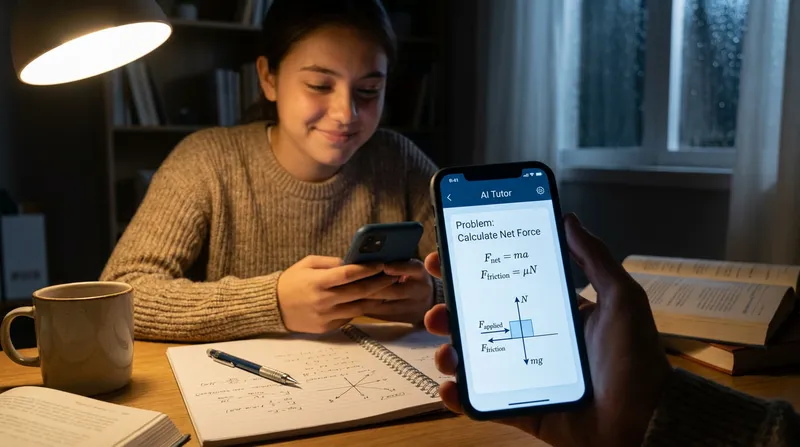
Picture this scenario: It is 10 PM on a Tuesday night. Your teenager is staring blankly at a physics worksheet, trying to figure out how a block sliding down a ramp relates to the friction coefficient and initial velocity. The textbook is no help, and when you type the question into a standard AI chatbot, it spits out a confusing essay that completely misses the point. You just need a hint, but instead, you get a wrong answer that skips all the crucial explanatory steps. This leaves students feeling overwhelmed and leaves parents feeling entirely helpless to assist.
You are not alone in this struggle. High school physics is notoriously difficult, but the right tools can completely transform the experience. A specialized AI physics tutor does not just give you the final answer. It acts as a 24/7 study partner that breaks down complex word problems, explains the underlying equations, and visualizes concepts step by step, even without a Wi-Fi connection.
In this guide, we will explore exactly how to use a step-by-step physics solver to master everything from kinematics to electromagnetism, ensuring you build real academic confidence along the way. Whether you are working through nightly homework or preparing for the AP Physics, SAT, or ACT exams, these strategies will help you succeed.
Why High School Physics is So Hard (And Why General AI Fails)
Physics is uniquely challenging compared to other high school subjects. It is not just about memorizing facts or plugging numbers into a calculator. It requires a deep level of critical thinking to translate dense, text-heavy word problems into abstract mathematical equations. You have to visualize the scenario, identify the invisible forces at play, and know exactly which formula applies.
When students hit a wall, they often turn to general AI tools for a quick fix. However, standard chatbots are built to predict text, not to perform strict mathematical logic. Because of this, they frequently fail at physics. They might hallucinate a formula that does not exist, ignore critical unit conversions, or completely misunderstand the direction of a vector. Worse yet, they often provide a final answer without showing the pedagogical steps required to get there.
This creates a frustrating experience. Students just want to understand the "why" behind the answer, but they receive a confusing block of text that they cannot verify. Relying on these general tools can actually harm a student's learning process. As we discussed in our article on The AI 'Cognitive Debt' Crisis: Why MIT Warns That Standard Math Solvers Are Deskilling Students, bypassing the struggle of problem-solving prevents the brain from building necessary neural pathways.
Furthermore, research published by the International Academy of Technology, Education and Development (IATED) highlights a realistic perspective on AI hallucinations in physics education. The study emphasizes that while AI can provide instantaneous solutions, students must actively check and analyze the results. General AI can sometimes provide inaccurate physical parameters if the problem is not clearly defined, which is why specialized tools are so essential.
What Makes the Best AI for Physics Problems Different?
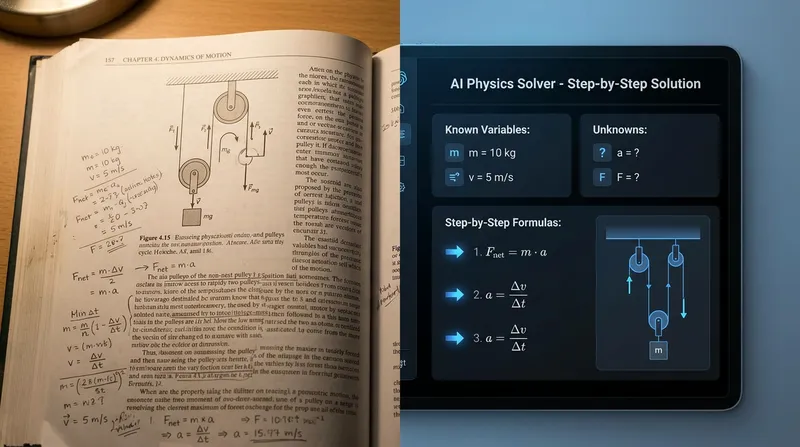
If standard chatbots fall short, what makes a dedicated AI physics tutor effective? The best AI for physics problems is specifically trained on mathematical logic and scientific principles. These specialized tools excel in three critical areas: formula recognition, handling of standard (SI) units, and vector direction comprehension.
First, a specialized solver like Tutor AI knows how to read a problem and instantly identify the correct formulas. Whether you are dealing with Newton's laws of motion or the complexities of electromagnetism, the AI can cross-reference the known variables with established physics equations.
Second, it understands the importance of units. A common trap for high school students is forgetting to convert kilometers to meters or grams to kilograms. A smart solver will flag these necessary conversions before doing the math.
Finally, physics involves vectors (quantities with both magnitude and direction). Specialized AI understands that a negative sign might indicate a downward direction, which is a nuance that general AI often misses.
Beyond just the math, the best tools employ the Socratic method. Tutor AI utilizes this exact approach by guiding students with targeted hints, asking them questions that lead to the solution rather than just handing over the final answer. Research from the Stanford University Graduate School of Education demonstrates that this conversational approach is highly effective. Their studies show that as students interacted with a Socratic AI physics chatbot, the specificity of their questions rose dramatically, correlating positively with higher expected course grades. The AI acts like a patient, 24/7 tutor, building confidence and real understanding.
For a deeper dive into the top tools available today, check out our guide on The Best AI Science Solvers of 2026: Step-by-Step Homework Help for Physics, Chemistry, and Biology.
How to Use a Step-by-Step Physics Solver to Actually Learn
Having a powerful AI homework assistant at your fingertips is fantastic, but how you use it determines whether you actually learn the material. It is easy to fall into the trap of passively copying answers, but that will not help you when test day arrives. To truly benefit from a step-by-step physics solver, you need to adopt a healthy homework workflow.
Here is the ideal process to follow:
- Attempt the problem first: Always give the problem your best effort before reaching for your phone. Write down what you know and try to set up the equation.
- Use the AI for guidance: If you get stuck, use the AI to check your setup or provide the next step.
- Study the breakdown: Read through the AI's explanation carefully. Understand why a specific formula was chosen.
- Hide the answer: Once you understand the concept, put your phone away.
- Reproduce the work: Try to solve the rest of the problem (or a similar problem) entirely on your own.
Many students worry that using an AI tool is a form of cheating. However, when framed correctly, AI is simply a highly accessible study partner. It is there to help you overcome roadblocks, not to do the work for you. If you struggle with feeling like you are taking the easy way out, read our post on Is Using AI for Homework Cheating? How to Beat Homework Imposter Syndrome. By actively engaging with the material and critically evaluating the AI's outputs, you are practicing active recall, which is one of the most effective ways to cement new information in your long-term memory.
Step 1: Scan and Break Down the Word Problem
The hardest part of any physics assignment is usually the very first step: figuring out what the question is actually asking. Physics word problems are notorious for burying important numbers inside paragraphs of confusing text. This is where you can scan physics homework AI tools to save time and reduce frustration.
Modern physics homework helper apps, like Tutor AI, allow you to snap a picture of your textbook or worksheet. The Optical Character Recognition (OCR) technology instantly reads the text and mathematical symbols. But the real magic happens in the breakdown.
To get the most out of this feature, you need to practice extracting the "knowns" and "unknowns." A good physics problem solver will automatically categorize the information for you. For example, it will identify that "starts from rest" means the initial velocity is zero. If you are typing a prompt manually, be as specific as possible. State the variables clearly and ask the AI to identify the missing piece.
Educational research highlights the importance of prompt engineering in physics education. Studies show that well-specified prompts significantly improve the completeness of AI physics solutions. Conversely, underspecified prompts expose weaknesses in the AI's physical reasoning. By learning how to properly feed information into the AI, you are actually practicing the first crucial step of physics problem-solving: organizing your data.
Step 2: Review the Physics Calculator with Steps
Once the problem is broken down, the AI will generate a solution. This is where a physics calculator with steps becomes your most valuable learning asset. Do not just scroll to the bottom to find the final number. Take the time to review the entire process.
A high-quality step-by-step breakdown should include the following elements:
- Formula Selection: The AI should state which equation it is using (like the kinematic equations or Ohm's law) and explain why it applies to this specific scenario.
- Variable Substitution: You should see exactly where each number is plugged into the equation.
- Unit Verification: The AI should demonstrate how the units cancel out or convert to give you the correct final unit (such as meters per second squared for acceleration).
- Final Calculation: The step-by-step math leading to the final answer.
As you review these steps, get into the habit of double-checking the math. AI is a powerful tool to solve physics equations, but it is not infallible. Ensure the units make sense in the context of the real world. Seeing this logical progression reduces anxiety, demystifies the math, and builds the long-term memory you will need for your exams. For more on finding reliable platforms, explore our guide on Need Help With Math Homework? Safe, Step-by-Step Online Tools (That Aren't Cheating).
Step 3: Visualizing Forces with Free-Body Diagrams
High school physics covers a wide range of topics, and an AI solver can adapt to help you through all of them. Let us look at a concrete example using a kinematics problem solver.
Imagine a problem that asks: "A ball is thrown upward with an initial velocity of 15 m/s. How high does it go?"
When you snap a photo of this problem, a specialized high school physics AI solver will immediately identify the knowns: initial velocity (15 m/s), final velocity at the peak (0 m/s), and acceleration due to gravity (-9.8 meters per second squared). It will then select the correct kinematic equation that does not require time, plug in the numbers, and solve for the distance. Seeing this structured approach helps you realize that kinematics is just a puzzle where you need to find the missing piece.
When dealing with forces and Newton's laws, the challenge is slightly different. These problems often require you to understand friction, tension, and gravity acting on an object simultaneously. While an AI can provide the text-based mathematical breakdown, it is highly recommended that you draw a free-body diagram on your own paper alongside the AI's output. Sketching out the arrows for normal force and gravity will help you visualize what the AI's equations represent. By breaking down these specific, intimidating topics into manageable steps, the subject becomes much less scary.
Track Your Progress and Personalize Your Learning
One of the standout features of Tutor AI is its ability to track your progress over time. The app identifies if you repeatedly struggle with specific topics, like vector directions or kinematic equations, and adapts your practice accordingly. This personalized learning path ensures you are focusing on the exact areas that need the most attention, turning weaknesses into strengths before exam day.
A Parent's Guide to Supporting Physics Homework
While students can take charge of their own learning using these personalized paths, parents also play a crucial role in this educational journey. For parents, watching a child struggle with high school physics can be incredibly stressful. Most adults have not calculated a coefficient of friction or analyzed a circuit in decades, making it difficult to offer meaningful help late at night. However, you do not need to be a physics expert to support your teen.
You can use Tutor AI as a co-tutor. Instead of leaving your child alone with the app, sit down with them. When they scan a problem using the physics homework helper app, review the AI's steps together. Ask your teen to explain the concept back to you. Questions like, "Why did the app choose that formula?" or "What does that negative sign mean?" encourage them to articulate their reasoning. This practice of teaching someone else is one of the most powerful ways to solidify knowledge.
It is important to emphasize that guided, step-by-step instruction is scientifically proven to be more effective than just providing the final answer. Research from the Lehigh University College of Education supports the angle that educational AI tools are most effective when they provide guided problem-solving hints. These tools help students understand the underlying concepts rather than simply completing the work for them.
By monitoring their AI usage and asking probing questions, you ensure the technology aids their learning rather than enabling a quick shortcut. For more strategies on safely integrating technology into your home routine, read our Best Free Online Homework Help: A Parent's Guide to Safe Sites & Apps (2026).
The Future of STEM: Boosting Confidence with AI
The integration of artificial intelligence into education is changing the landscape of STEM (Science, Technology, Engineering, and Mathematics) for the better. According to a meta-analysis by the National Institutes of Health (NIH), AI-supported instruction has a statistically significant positive effect on student learning outcomes, particularly at the high school level.
AI is not a replacement for human teachers, nor is it a magic wand that makes hard work disappear. Instead, it is a powerful tool designed to build confidence, reduce late-night stress, and make complex subjects like physics accessible to everyone. By providing instant, personalized, and step-by-step guidance, AI homework assistants empower students to take control of their own education.
Ready to snap, solve, and actually learn?
Download Tutor AI today on iOS and Android. Take advantage of our limited free tier to turn tonight's physics problem into tomorrow's confidence!
Note: Every student learns differently. While these strategies are research-backed, results may vary. Adapt these techniques to fit your unique learning style and circumstances.
Frequently Asked Questions
Can AI solve physics word problems accurately?
Yes, but it heavily depends on the tool you use. Specialized AI physics solvers are highly accurate because they are specifically trained to recognize mathematical formulas, physical laws, and unit conversions. General AI chatbots, on the other hand, often struggle with the strict logic required for complex word problems and may provide incorrect answers.
What is the best AI physics solver for high school students?
The best tools offer step-by-step breakdowns rather than just spitting out final answers. Apps like Tutor AI (which includes a limited free tier) provide guided solutions that act like a digital tutor, helping students actually understand the concepts behind kinematics, forces, and energy, rather than just copying a number.
How do I use a physics calculator with steps without cheating?
The key is to use the AI as a study partner or tutor. Always attempt the problem yourself first. If you get stuck, scan the problem to get a hint, study the provided steps closely, and then hide the screen. Finally, try solving the problem yourself from memory to ensure you actually learned the concept.
Can I just scan my physics homework to get the answers?
While you certainly can scan your homework to get instant answers, doing so without reviewing the steps will hurt you on test day. Teachers test your understanding of the process, not just the final result. Always take the time to read through the AI's explanation of the formulas used.
Why does standard AI get physics math wrong?
Standard AI models are essentially advanced text predictors. They generate responses based on language patterns rather than calculating strict mathematical logic. Because of this, they often miss crucial details in physics, such as vector directions, friction coefficients, or the need to convert units to the metric system.