
Navigating the final years of high school in Queensland can feel like solving a puzzle with half the pieces missing. You hear terms like QCE, ATAR, scaling, and credit points, and it's easy to feel overwhelmed.
For students, the pressure to make the right choices is immense. For parents, figuring out how to best support your child can be just as stressful.
This isn't just another article with dry definitions. This is your roadmap. The core problem many families face is the lack of a single, clear strategy that connects all the dots-from subject selection in Year 10 to receiving an ATAR in Year 12. You're trying to make crucial decisions with fragmented information, leading to anxiety and uncertainty.
This ultimate guide for 2026 is designed to solve that. We will walk you through the entire system, step-by-step, and translate complex rules into a clear, actionable plan to help you or your child achieve academic success with confidence.
What is the Difference Between the QCE and ATAR? (And Why You Need to Know)
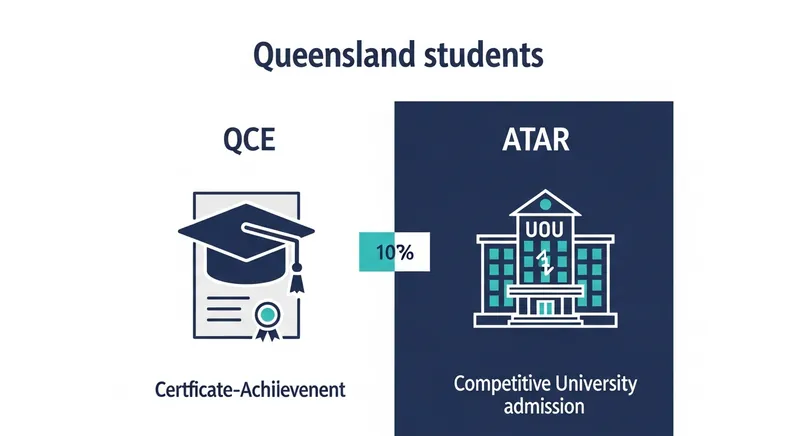
First, let's clear up the most common point of confusion. The QCE and the ATAR are related, but they measure two very different things. Understanding this distinction is the first step to building your strategy.
The QCE: Your High School Diploma
The Queensland Certificate of Education (QCE) is Queensland's senior school qualification. Think of it as the certificate you receive for successfully completing high school. It confirms you have achieved a significant amount of learning, at a set standard, that meets the state's requirements. It's a measure of completion.
The ATAR: Your Rank for University Entry
The Australian Tertiary Admission Rank (ATAR) is not a score, but a rank. It shows your position relative to all other students in your age group across the state. If you have an ATAR of 80.00, it means you performed better than 80% of your peers. Its primary purpose is to help universities select students for their courses. According to the Queensland Tertiary Admissions Centre (QTAC), the ATAR is the main pathway for Year 12 leavers to get into tertiary study.
Myth-Busting: Can You Get a QCE Without an ATAR?
Yes, absolutely. The QCE is about completing your high school studies, while the ATAR is specifically for tertiary admission. Many students pursue vocational training, apprenticeships, or enter the workforce directly after school. They will receive a QCE for their efforts without needing an ATAR. However, you cannot get an ATAR without also meeting the requirements for a QCE.
Navigating the QCE System: A Step-by-Step Guide
Getting your QCE isn't automatic. It requires careful planning to meet several key criteria. Let's break them down.
QCE Eligibility Requirements Explained
To earn your certificate, you need to meet requirements for amount, standard, and pattern of learning. According to the official Queensland Curriculum and Assessment Authority (QCAA), this includes passing a minimum number of subjects and meeting literacy and numeracy standards.
The Magic Number: Understanding QCE Credit Points
The QCE system is built on credits. To be eligible, you need to earn 20 credits in a specific pattern. Here's a simple breakdown based on information from the Good Schools Guide:
- Total Credits: You need 20 credits.
- Core Requirement: At least 12 credits must come from 'Core' courses, which include most General and Applied subjects. You must pass these subjects (achieve a 'Satisfactory' or C grade or higher) for the credits to count.
- Remaining Credits: The final 8 credits can come from a mix of Core, Preparatory (e.g., Certificate I qualifications), or Enrichment (e.g., university subjects undertaken in high school) courses.
Actionable Tip: Use your myQCE student account on the QCAA website to track your credits. At the start of each semester, map out the credits you plan to earn and check your progress at the end. This prevents any nasty surprises in Year 12.
NEW for 2026: The QCAA Academic Integrity Requirement
A significant change for the 2026 graduating cohort is the introduction of a mandatory academic integrity course. The QCAA has made this a compulsory part of QCE eligibility to ensure all students understand the importance of honest and ethical academic work. You will need to complete this short course during your senior studies to be awarded your QCE. This is a simple but non-negotiable step!
How is the ATAR Calculated in Queensland? Demystifying the Numbers
If your goal is university, the ATAR is your key. The calculation process can seem mysterious, but it's based on a clear set of rules designed for fairness.
ATAR Eligibility: The First Hurdle
Before an ATAR can be calculated, a student must be eligible. The QTAC website outlines that to be eligible for an ATAR, you must:
- Qualify for a QCE.
- Complete five General subjects, OR four General subjects plus one Applied subject or VET qualification (Certificate III or higher).
- Have English as one of your subjects (English, Literature, or English as an Additional Language).
The Calculation Formula: From Subject Results to a Single Rank
Here is the simplified process:
- Raw Scores: You receive a numerical result out of 100 for each of your eligible subjects.
- Scaling: These raw scores are adjusted through a process called inter-subject scaling. This allows for a fair comparison between students who studied different combinations of subjects.
- Best Subjects: QTAC takes your best five scaled subject results and adds them together to create a tertiary entrance aggregate.
- Final Rank: This aggregate is then converted into a percentile rank from 99.95 down to 0.00-this is your ATAR.
What is a "Good" ATAR in Queensland?
This is a common question, and the answer depends entirely on your goals. As a guide, The University of Queensland notes that the median or average ATAR is typically around 70.00. A 'good' ATAR is one that gets you into your desired university course. An ATAR of 85.00 might be excellent for one student, while another might only need a 65.00 for their chosen degree. It's personal.
Actionable Tip: Don't guess! Use the official resources and estimators provided by QTAC to understand how your subject choices and results might translate into an ATAR. Playing with the numbers can be a powerful motivator and help you focus your study efforts.
The Elephant in the Room: QCE Subject Scaling Explained for 2026
Scaling is easily the most misunderstood part of the ATAR. Let's demystify it.
Why Does Scaling Exist? The Fairness Principle
Imagine trying to compare the results of a student who took Specialist Mathematics with a student who took Drama. The academic challenge and competition within those subjects are different. Scaling adjusts subject results to account for this.
It looks at the overall academic strength of the students taking each subject and adjusts the scores accordingly. The goal is to ensure that a 90 in one subject is equivalent to a 90 in another after scaling.
How to Read the QTAC Scaling Report
Every year, QTAC releases an ATAR report which includes scaling data. You can find the latest reports on their ATAR publications page. The tables show how raw scores in each subject were adjusted. Don't just look at what scaled up the most; look at the average raw score required to achieve a certain scaled score.
Myth-Busting: "Should I only choose high-scaling subjects?"
No! This is a dangerous trap. Here's how to think about it strategically:
- The Trap: Choosing a subject you have no interest or aptitude in (like Specialist Mathematics or Chemistry) simply because it scales well. This is a recipe for a low raw score, which will still be low even after scaling up.
- The Reality: A high raw score in a subject that scales down can often be worth more than a low raw score in a subject that scales up.
- The Smart Strategy: Choose subjects based on a mix of three factors:
- Interest: What do you genuinely enjoy? You'll be more motivated to study.
- Aptitude: What are you good at? Play to your strengths.
- Prerequisites: What subjects do you need for your desired university course?
If your strengths are in the humanities, you will get a better ATAR by acing those subjects than by struggling through STEM subjects you dislike.
A Strategic Roadmap: Maximising Your ATAR from Year 10
Your ATAR journey starts long before your final exams. A strategic approach from the beginning is critical.
Quick Start Checklist for Year 10s
- Research Careers: Brainstorm 3-5 potential career paths that interest you.
- Check Prerequisites: Look up university courses for those careers and list the required Year 12 subjects.
- Assess Your Strengths: Make an honest list of the subjects you enjoy and excel in.
- Draft a Subject List: Create a balanced subject list that meets prerequisites and plays to your strengths.
- Talk to Your Counsellor: Book a meeting with your school guidance counsellor to review your plan.
A Year 11 & 12 Timeline: Key Dates and Milestones
- Year 11, Term 1: Finalise your subject choices. Focus on building strong foundational knowledge.
- Year 11, Term 4: Your first summative internal assessments (IAs) begin. These count towards your final result!
- Year 12, Term 1-3: Consistent effort is key. This is a marathon, not a sprint. Track your IA results and identify areas for improvement.
- Year 12, Term 3: Trial exams. Use these as a crucial diagnostic tool to prepare for the final external assessments.
- Year 12, Term 4: External Assessment (EA) period. This is the final push.
- Mid-December: QCEs and ATARs are released.
Actionable Study Tips for QCE External Assessments (EAs)
The EAs can be worth up to 50% of your final mark. Generic advice isn't enough. Consider science-backed methods like active recall and spaced repetition, which are proven to be effective. Our guide, Acing STEM: A Practical Guide to Using Active Recall and Spaced Repetition, provides a framework for this.
When you hit a roadblock on a tough Mathematical Methods or Chemistry problem at 10 PM, having instant access to step-by-step explanations (through tools like Tutor AI) transforms frustration into a learning moment. This is the core of an effective AI Study System.
The Parent's Guide to QCE and ATAR
For parents, this journey can be just as daunting. Your role is to be a supportive guide, not a source of pressure.
How to Be a Supportive Guide
Focus on effort, not just results. Encourage a healthy balance between study, sleep, and social life. Help create a dedicated study space at home and be a listening ear for their anxieties. Remind them that their ATAR does not define their worth or their future success. For more tips on reducing homework battles, check out The Parent's Guide to New Math.
Key Questions to Ask the School
To stay informed, consider asking your child's school guidance counsellor or teachers:
- How does the school support students in tracking their QCE progress?
- What resources are available for students struggling with a particular subject?
- Can you explain the school's approach to preparing students for external assessments?
Understanding Alternative Pathways (VET, Selection Ranks)
An ATAR isn't the only way into university. As QUT explains, completing a VET qualification like a Diploma can give your child a separate selection rank. For example, a Diploma can be equivalent to an ATAR of 87.00 for entry to QUT. This is a fantastic strategic option for students who excel in hands-on learning.
Your 24/7 Support System for QCE Success
The QCE and ATAR journey is a marathon. What happens when you're stuck on a complex Physics problem at 10 PM, and your teachers are asleep? This is where modern learning tools can make a difference.
Instead of getting frustrated or giving up, platforms like Tutor AI provide an on-demand lifeline. You can get a detailed, step-by-step explanation for that exact problem, showing you how to solve it. This isn't about finding a shortcut; it's about turning a moment of being stuck into a genuine learning opportunity. This builds the skills and confidence you need for your exams in subjects like advanced mathematics, Physics, or Chemistry.
Your Future is Bright
Remember that puzzle with the missing pieces? You now have the complete picture. The QCE is your certificate of completion, the ATAR is your rank for university, and scaling exists to ensure fairness.
The anxiety that comes from fragmented information can be replaced with a clear, actionable roadmap. By choosing subjects you're good at and enjoy, studying effectively, and knowing the rules of the game, you can take control of your academic future. You've got this.
Frequently Asked Questions
How do QTAC adjustment factors work?
Adjustment factors (previously known as bonus points) are additional points added to your ATAR to create a higher selection rank for a specific university or course. They do not change your actual ATAR. Universities use them to attract students they want to encourage, such as those from a rural area or who have studied a specific subject like a Language other than English or high-level mathematics.
What is the highest ATAR possible, and how many people get it?
The highest possible ATAR is 99.95. This indicates that a student is in the top 0.05% of their cohort. According to QTAC's 2023 ATAR report, 33 students in Queensland received an ATAR of 99.95. It's an exceptional achievement, but most university courses do not require a rank nearly this high.
Do I need to pass all my subjects to get a QCE?
No, you do not need to pass every single subject. The key is to accumulate enough credits in the right pattern. The QCAA's eligibility rules state you need 20 credits total, with at least 12 coming from 'Core' subjects that you have passed (achieved a Satisfactory or C grade or higher). This means you could potentially fail a unit of a subject but still meet the overall credit requirement.
What are QCE credit points and how do I earn them?
QCE credit points are the building blocks of your high school certificate. You earn them by completing and passing units of study. As a general rule, successfully completing one semester (a unit) of a General or Applied subject earns you 1 credit. Completing a full two-year subject therefore earns 4 credits. VET qualifications also contribute credits; for example, a Certificate II is worth 4 credits, and a Certificate III can be worth up to 8.
Can you get a QCE without an ATAR?
Yes, and this is a very common pathway. The QCE is your high school qualification, while the ATAR is a rank used for university entry. If you plan to go straight into the workforce, an apprenticeship, or most TAFE courses, you will focus on achieving your QCE and won't need an ATAR.


