
The Rise of AI Homework Helpers: A New Era of Learning
From snapping a picture of a tricky math problem to asking for a quick summary of a historical event, artificial intelligence is changing homework forever. Tools like ChatGPT and photo-solving apps have become the modern-day equivalent of the calculator—incredibly powerful, but with the potential to be used as a shortcut that bypasses learning entirely. We've all been there: it's late, frustration is high, and getting a quick answer feels like the only way out.
But this convenience raises a huge question for students, parents, and teachers: is using an AI homework helper cheating? The answer isn't a simple yes or no. This family-friendly guide will help you navigate the ethics of using AI in education. We'll provide a clear framework to help you use these tools for their true purpose: to build understanding, boost confidence, and achieve real, lasting learning.
AI for Learning vs. Cheating: Where Is the Line?
Academic integrity is all about submitting work that reflects your own effort and original thought. The line between using AI for learning and using it for cheating comes down to one simple question: Are you using the tool to understand the process, or just to get the final answer?
Think of it like asking a tutor for homework help. Asking, "Can you explain the steps to balance this chemical equation?" is an act of learning. Asking, "What's the answer to question five?" is a request for a shortcut. The first builds a skill; the second just fills a blank.
Educational institutions take this distinction seriously. As guidance from Carnegie Mellon University points out, students are responsible for the validity of AI-generated content, and passing it off as their own, even if paraphrased, constitutes plagiarism. The goal is to use AI as a collaborator for learning, not as a ghostwriter.
Now that we understand where the line is, let's break this down into a practical framework you can use every day.
An Ethical Framework for Using AI in Schoolwork
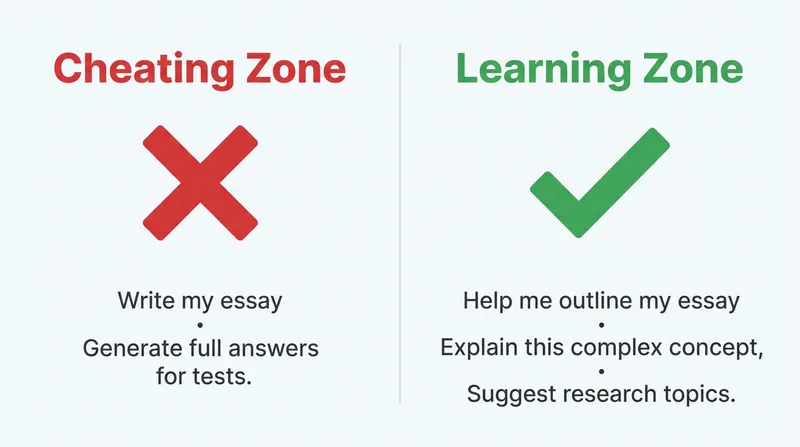
To make it easier to know which side of the line you're on, let's break it down into two zones: the 'Cheating Zone' and the 'Learning Zone.'
The 'Cheating' Zone: How Students Misuse AI
Using an AI helper falls into the cheating zone when the tool does the critical thinking for you. This approach not only violates academic integrity but also robs you of a learning opportunity. Avoid these actions:
- Copying and pasting: Submitting AI-generated text, such as an essay or paragraph, as your own work.
- Answer-grabbing: Using an app to get the final answer to a math or science problem and writing it down without understanding the process.
- Full assignment completion: Asking an AI to complete an entire worksheet, write a full book report, or create a whole presentation.
- Shallow paraphrasing: Taking an AI-generated answer and changing a few words to make it sound like your own.
The 'Learning' Zone: How to Use AI for Homework Ethically
AI becomes an incredible study partner when you use it to support your own thinking process. This is where true learning happens. Here are some powerful and ethical ways to use AI:
- As a brainstormer: "Help me come up with a list of potential topics for my history paper on the Civil War."
- As an outliner: "Can you help me structure a five-paragraph essay about the water cycle?"
- As a concept clarifier: "Explain the concept of photosynthesis to me like I'm in middle school."
- As a process guide: "Walk me through the steps to solve a quadratic equation using the quadratic formula."
- As a practice generator: "Create five practice questions about the periodic table for me to study for my chemistry test."
- As a work-checker: "I solved this algebra problem and got this answer. Can you check my work and tell me if I made a mistake?"
- As a perspective-shifter: "Summarize the arguments for and against the Louisiana Purchase to help me understand both sides."
This approach, which prioritizes mastering the underlying concepts, is a cornerstone of effective study habits. According to education experts at Edutopia, shifting the focus from performance to learning is key to reducing the temptation to cheat.
Quick Check: Am I Using AI Ethically? Ask yourself these questions before you use an AI tool:
- Have I tried to solve this problem on my own first?
- Am I asking the AI to explain how to do something, or just to give me the final answer?
- Will this help me learn the material so I can do it myself later?
- Does my school's academic integrity policy allow for this type of AI use?
The Long-Term Rewards of Ethical AI Use
While getting a zero on an assignment or facing school disciplinary action are serious consequences, the benefits of using AI ethically are even more significant. Committing to the 'Learning Zone' helps you build a powerful foundation for the future.
- Stronger Critical Thinking Skills: When you struggle with a problem and use AI to guide you through it, you build the mental muscles needed to solve future challenges. Critical thinking is a skill that comes from practice, not from watching something else do the work.
- Deeper Knowledge Retention: Ethically using AI to understand algebra homework means you'll have the foundational skills needed for geometry or calculus. This prevents knowledge gaps from snowballing, making future learning less stressful.
- Healthy Academic Habits: A study in the International Journal of Educational Technology in Higher Education highlights that over-reliance on AI can lead to stress and dependency. In contrast, using AI as a tool to improve your study skills is a more effective way to manage academic pressure and build confidence.
A Guide for Students: Use AI as Your Ultimate Study Partner
Ready to use AI the right way? Here are four actionable tips to turn any AI tool into a powerful study partner:
- Be the 'Project Manager,' Not the Intern: You are in charge of your assignment. Use AI as your assistant for research, brainstorming, and outlining, but you must do the core work. Example: Use AI to find key dates for a history project, but you write the analysis of their impact.
- Focus on the Process: When you're stuck on a math problem, don't just ask for the answer. Use a tool that shows you the step-by-step process. Your goal is to master the methodology so you can solve the next problem on your own. This is key for mastering complex tasks, like learning how to solve algebra word problems.
- Personalize Your Learning: Use AI to create a custom study experience. Ask it to generate a quiz on your weakest topics or explain a concept using an analogy you understand. Example: Ask, "Explain quantum physics using a cooking analogy," or "Create a 10-question quiz on cellular respiration for me."
- Test Your Understanding: After getting help from an AI, close the app and try a similar problem on your own. If you can solve it without help, you've truly learned the concept. If not, go back and review the steps you were stuck on.
A Guide for Parents: How to Monitor AI Use and Foster AI Literacy
For parents, the rise of AI can feel like a new, unknown challenge. Here's how you can guide your child toward ethical and effective use:
- Start the Conversation: Talk openly with your child about the difference between using AI to learn versus cheat. Review your school's academic integrity policy together and frame AI as a new, important digital literacy skill.
- Focus on the Process, Not Just the Grade: When your child shows you their completed homework, ask them to explain how they arrived at an answer. If they can teach it to you, they truly understand it. If they can't, it's a sign they may have relied too heavily on a tool.
- Set Clear Boundaries: Work together to establish family rules for how and when AI tools can be used for homework. A great rule is, "You must try the problem on your own for at least 15 minutes before using an app for math help."
- Promote AI Literacy: According to guidance from TeachAI, a coalition of education leaders, one of the best things families can do is teach students how to use AI responsibly and be aware of its risks, like misinformation and bias.
The Teacher's Perspective on AI Homework Helpers
It's a common misconception that teachers are against AI. In reality, most educators are excited about its potential but are primarily concerned with its misuse for cheating. The National Education Association (NEA) emphasizes that AI in education should be evidence-based and support the work of human teachers.
Many teachers are adapting by designing 'AI-proof' assignments that require personal experience, in-class discussion, and deep critical analysis—things AI can't replicate. Their goal is the same as yours: to ensure students are genuinely learning. Most importantly, always follow your school's specific rules on AI. If a teacher's policy is stricter than the advice here, the school's policy is the one you must follow.
The TutorAI Difference: A Focus on True Learning
Navigating this new landscape is exactly why we built TutorAI with a 'True Learning Focus.' We believe that an AI tutor should do more than just give answers—it should build understanding and confidence. This is the essence of our Snap. Solve. Learn. philosophy.
Our mission is to empower students to learn independently. That's why, when you snap a picture of a problem, you don't just get a final answer. TutorAI provides detailed, step-by-step explanations that guide you through the entire problem-solving process. We designed our platform to be a partner in the 'Learning Zone'—helping you break down complex concepts, understand the 'why' behind every step, and build the skills you need to succeed on your own.
Conclusion: Building AI Literacy for a Smarter Future
In the end, AI is just a tool. The responsibility for how it's used lies with us. Choosing to use an AI homework helper for learning instead of cheating is a decision that pays off far beyond a single assignment grade. It's an investment in building the critical thinking skills and deep knowledge that lead to long-term success.
As global organizations like UNESCO develop guidance for AI in education, one thing is clear: AI literacy is no longer optional. Learning to use these powerful tools ethically and effectively is one of the most important skills for a student's future.
Ready to build confidence and truly understand your homework? Empower your learning journey by downloading TutorAI for free today!
Frequently Asked Questions
Is using ChatGPT for homework considered plagiarism?
Yes, if you copy its output and submit it as your own work. Plagiarism is presenting someone else's (or an AI's) work as your own. However, using it for brainstorming, outlining, or understanding a topic is a great study strategy.
Is using an app like Photomath or Socratic considered cheating?
It depends entirely on how you use it. If you only scan a problem to get the final answer for your homework, most schools would consider it cheating. If you use the step-by-step explanations to learn the process so you can solve similar problems on your own, it becomes a powerful study tool.
Can my teacher detect if I used AI?
Often, yes. Teachers are becoming skilled at spotting AI-generated text, which can be generic or lack personal insight. Many schools also use AI detection software. More importantly, over-reliance on AI will show in your performance on in-class assignments and tests where you can't use the tool.
What is the best way to use AI as a study tool?
The best way is to stay in control. Use AI to create study plans, generate practice quizzes, explain complex topics in simple terms, or get step-by-step guidance on a problem you've already attempted yourself. Always focus on understanding the 'why,' not just the 'what.'
How can I avoid becoming too dependent on AI?
Always try to solve the problem on your own first. Use AI as a secondary step to check your work or get help only when you are truly stuck. After getting help, make sure you actively engage with the explanation and try to repeat the process yourself without the tool to ensure you've learned it.


