
Is the ACT Math section a source of stress in your home? For many students, the pressure of 60 questions in 60 minutes feels like an impossible race against time. It's not just about knowing the math; it's about applying formulas and concepts you haven't seen in months, all while the clock is ticking. This pressure is real, and it's reflected in the scores. In 2024, the national average ACT composite score fell to 19.4, the lowest point in over three decades, making effective preparation more critical than ever.
But what if you had a guide from someone who has conquered the test? My journey to a perfect 36 on the ACT Math section wasn't about being a genius—it was about being strategic. I remember feeling stuck and frustrated, but I learned that the test is designed to be just as much a test of your thinking and time management skills as it is your math knowledge. While many resources offer generic formula lists, they often overlook the strategic framework and mindset shifts crucial for tackling the test's pressure effectively.
This guide is different. It's my personal playbook, filled with the exact strategies, mindset shifts, and actionable tips that took me from feeling stuck to scoring perfectly. We'll go beyond simple memorization to cover pacing, advanced problem-solving, and the mental game required to perform at your best. Whether you're a student aiming for a higher score, a parent looking for ways to help, or a tutor seeking new strategies, these tips will build the confidence and skills needed to excel.
First, Know Your Opponent: The ACT Math Test Breakdown
Before you can master the test, you need to know exactly what you're up against. The ACT Math test is a 60-question, 60-minute sprint that covers a wide range of mathematical topics. According to the official test-makers at ACT, Inc., the questions fall into two main categories: Preparing for Higher Math (57–60%) and Integrating Essential Skills (40–43%).
The higher math portion is further broken down into five areas:
- Number & Quantity (~7-10%): Real and complex number systems, integers, and matrices.
- Algebra (~12-15%): Solving and graphing expressions, equations, and inequalities.
- Functions (~12-15%): Understanding function notation, definition, representation, and application.
- Geometry (~12-15%): Properties of shapes, solids, and trigonometric relationships.
- Statistics & Probability (~8-12%): Data interpretation, measures of center, and probability calculations.
One key difference from the SAT, as noted by sources like The Princeton Review, is that the ACT does not give you a formula sheet. Here's a quick comparison:
| Feature | ACT Math | SAT Math |
|---|---|---|
| Time per Question | 60 seconds | ~75-85 seconds |
| Formula Sheet | No | Yes, provided in test booklet |
| Calculator Use | Allowed on all questions | Allowed on one section only |
| Key Topics | Broader scope, includes more Geometry, Trigonometry, and advanced topics like Matrices. | Heavier focus on Algebra and Data Analysis. |
This means preparation is everything.
1. Master the Mental Game: My #1 Tip for a 36
This might surprise you, but the single biggest factor in my improvement wasn't a math trick—it was a mindset shift. Test anxiety is a major hurdle. When you panic, your working memory suffers, making it harder to recall formulas and think logically. The secret to a top score is staying calm, confident, and strategic from question 1 to question 60.
The 36-Scorer Mindset:
- Every question is a puzzle, not a threat. Approach each problem with curiosity.
- There is no such thing as a 'trick question.' The ACT tests concepts in unfamiliar ways. Your job is to find the underlying math.
- A mistake on a practice test is a gift. It's a spotlight on exactly what you need to work on.
Actionable Tip: The Perfect 36 Pre-Test Ritual Before any practice section or the real test, run through this 5-minute checklist:
- Hydrate: Drink a small amount of water.
- Breathe: Take three slow, deep breaths, in through your nose and out through your mouth.
- Affirm: Say to yourself, "I am prepared. I have a strategy. I will focus on one question at a time."
- Review: Glance at the first and last questions to mentally bookend the test. Acknowledge the finish line.
- Start: Begin with confidence on question #1.
Building this simple habit can make a world of difference on test day.
2. Implement the Two-Pass Strategy for Perfect Pacing
The biggest mistake students make is getting bogged down on a single difficult question, wasting precious minutes and losing confidence. Remember: every question is worth the same single point. A hard geometry problem is worth no more than a simple algebra question.
To combat this, I used the Two-Pass Strategy, a time management technique also recommended by academic advisors at the University of Iowa. Here's how it works:
- Pass One (35-40 minutes): Go through the entire test and answer every question that you immediately know how to do. If a question seems too hard or time-consuming, circle it and move on instantly. Don't let your ego get in the way. Your goal is to lock in all the easy points first.
- Pass Two (20-25 minutes): With your remaining time, go back to the questions you circled. Now you're working on the hardest problems with the bulk of your points already secured. This reduces panic and allows you to focus more clearly.
Actionable Tip: Use a full practice test section to try this. Time your first pass. Were you able to get through all 60 questions in under 40 minutes? Adjust until you find a rhythm that works for you.
3. Create a 'Cheat Sheet' to Understand Formulas, Not Just Memorize Them
Unlike the SAT, the ACT gives you no formulas. You are expected to know them cold. However, simply memorizing a long list is ineffective. The key is to understand what the formulas mean and when to use them.
Actionable Tip: Create your own "Formula Cheat Sheet." Don't just write the formula. Make three columns to transform memorization into deep understanding. For more foundational math help, reinforcing these core concepts is the first step.
Here's an example of what it looks like:
| The Formula | When to Use It | Common Traps |
|---|---|---|
a² + b² = c² |
To find a missing side in a RIGHT triangle when you know two sides. | The hypotenuse 'c' is ALWAYS the longest side, opposite the right angle. Don't mix it up! |
Area = ½(b₁ + b₂)h |
To find the area of a trapezoid. | Remember to average the bases (b₁ + b₂)/2 before multiplying by the height. Don't confuse it with a parallelogram. |
4. Master Shortcuts: Backsolving & Smart Calculator Use
A 36-scorer knows the fastest path to the right answer. Often, this means skipping complex algebra and using the test's structure to your advantage. Your calculator is a tool, not a crutch, and sometimes the answer choices themselves are the best tool you have.
Actionable Tips:
- Backsolve from Choice C: For many algebra problems where the answer choices are numbers, work backward. As recommended by test prep experts at Kaplan, start with answer choice C. Since answers are in numerical order, this tells you if you need a larger or smaller number, often eliminating three choices at once.
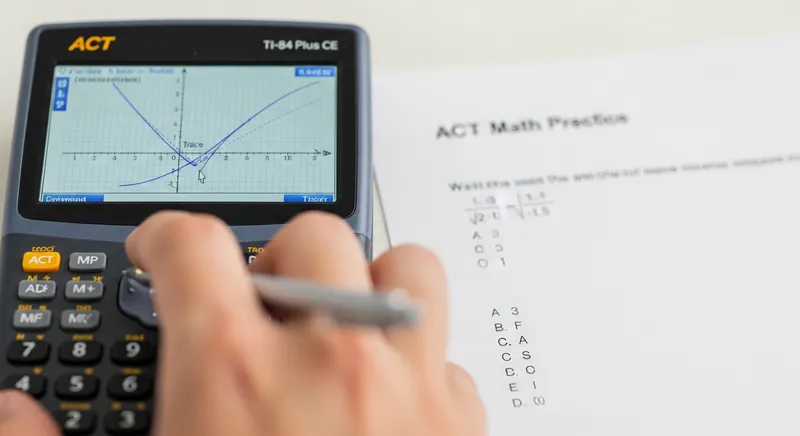
- Graph to Find Intersections: For questions like, "Where do the functions f(x) and g(x) intersect?", algebraically solving can be slow. Graphing both and using the "intersect" function on your calculator can give you the answer in seconds.
- Pick Numbers for Variables: If a question has variables in the answer choices (e.g., "Which of the following is equal to
2x + 4y?"), pick simple numbers for x and y (like 2 and 3), solve the expression, and then plug your numbers into the answer choices to see which one matches.
5. Read Every Word: The #1 Way to Avoid Careless Errors
How many times have you known how to do a problem but gotten it wrong because you solved for x when the question asked for 2x? The ACT loves to reward careful readers. Rushing through the question to get to the math is a recipe for losing easy points.
Actionable Tip: As you read a question, use your pencil to underline or circle the specific thing you are being asked to find. Is it the radius or the diameter? The perimeter or the area? The value of x or the value of x + y? Before you bubble in your answer, glance back at what you underlined one last time. This two-second check can save you from countless simple mistakes.
6. Tame Tricky Word Problems by Translating
Word problems are often just simple math dressed up in confusing language. The key is to systematically translate the English into the language of math. Don't try to understand the whole paragraph at once.
Actionable Tip: Read one sentence or phrase at a time and translate it into an equation or expression. Underline key terms and quantities.
- "Is," "are," "was" usually mean =
- "Of" often means multiply
- "Per" means divide
- "What number" or "a number" is your variable, x
If you find yourself consistently stuck on translating these, check out this 4-Step Guide to Solve Algebra Word Problems. When you're practicing and hit a wall, use a tool like Tutor AI. By taking a picture of the problem, you can see the step-by-step translation from words to a solvable equation, which helps you learn the pattern for next time.
7. Practice with Purpose: The Error Log
Everyone will tell you to take practice tests. A top scorer will tell you to analyze your mistakes with purpose. This is the secret to turning practice into progress.
Actionable Tip: Create an "Error Log" in a notebook or spreadsheet. For every single question you get wrong on a practice test, log the following:
- Question # and Topic: (e.g., #45, Trigonometry)
- Why I Got It Wrong: Be brutally honest. Was it a...
- Careless Error? (e.g., I solved for x but the question asked for 2x).
- Content Gap? (e.g., I didn't know the formula for the area of a trapezoid).
- Time Pressure Mistake? (e.g., I rushed and misread the question).
- Hard Question Misunderstanding? (e.g., I didn't understand what the question was asking).
- What I Will Do to Fix It: (e.g., "I will write the area of a trapezoid on my formula sheet and do 5 practice problems.")
This process transforms passive practice into active, targeted learning, which is the fastest way to improve.
8. Conquer the Hardest Questions (Matrices, Logs, & More)
To get from a good score to a great score, you have to be ready for the handful of advanced topics the ACT throws in at the end of the test. These often include matrices, logarithms, vectors, or advanced trigonometry. While there may only be a few, they are critical for hitting a score in the 30s.
Actionable Tip: Don't be intimidated and don't skip them in your prep. You don't need to be an expert. Often, you only need to know one or two basic rules to solve the problem. For example, knowing how to add or multiply matrices is often enough. When you encounter these in your practice, spend time learning the core concept behind the question. Seeing a complex logarithm problem broken down into simple, understandable steps makes it far less scary and prepares you for test day.
9. Never Leave an Answer Blank: The Art of Guessing
This is a simple but crucial rule. As confirmed in the official guide from ACT, Inc., there is no penalty for guessing on the ACT. A wrong answer is worth the same as a blank answer: zero points. Therefore, you must answer every single question.
Actionable Tip:
- Eliminate First: Before you guess blindly, always try to eliminate one or two obviously wrong answers. This dramatically increases your odds.
- Pick a "Letter of the Day": If you have 30 seconds left and 5 questions blank, don't waste time trying to solve them. Pick one letter (e.g., B) and bubble it in for all remaining questions. Statistically, this gives you a better chance of snagging a point than random guessing.
10. Simulate Test Day
Finally, all the strategies in the world won't help if you're not used to the pressure of test day. You must take at least 2-3 full-length, timed practice tests in a realistic environment.
Actionable Tip:
- Wake up at the same time you would on test day.
- Time yourself strictly for 60 minutes. No extra time.
- Use a paper test and a bubble sheet to simulate the real experience.
- Do it in a quiet room without your phone or other distractions.
This builds the mental and physical stamina you need to perform your best when it counts.
Your Journey to a Higher Score
Achieving a top score on the ACT Math test is not a matter of luck; it's a matter of smart, strategic preparation. By focusing on your mindset, mastering your time, and practicing with purpose, you can overcome the pressure and show what you truly know.
Feeling overwhelmed with a specific topic? You don't have to do it alone. The journey to a higher score is a marathon, not a sprint, and having the right support makes all the difference.
Turn Your Weak Spots into Strengths with Tutor AI
Get 24/7, step-by-step guidance for the tricky problems holding you back. Snap. Solve. Learn. and build the skills and confidence you need for test day. Download Tutor AI today and take the next step on your journey to a better score.
Frequently Asked Questions
How can I get faster at the ACT Math section?
Speed comes from strategy, not just rushing. Master the Two-Pass Strategy to ensure you answer all the easy questions first. Actively learn when to use shortcuts like backsolving and when mental math is faster. Finally, practice with an error log to turn your common mistakes into strengths. The more you practice recognizing question types, the faster your brain will identify the quickest solution path.
What are the most common mistakes students make on the ACT Math test?
There are three common mistakes: 1) Poor time management, where students get stuck on hard questions early on and run out of time. 2) Careless errors, like solving for 'x' when the question asks for '2x' or misreading a question. 3) Content gaps, especially with forgotten formulas from geometry and Algebra II. Creating an error log is the best way to identify and fix your specific pattern of mistakes.
What do I do if I see a question I've never seen before?
First, don't panic. The ACT is designed to present concepts in unfamiliar ways. Take a deep breath and try to identify the underlying math principle being tested. Is it a geometry shape hidden in a graph? Is it a function question disguised as a word problem? If you're still stuck after 30 seconds, circle it, make your best guess, and move on. You can come back to it during your second pass if you have time.
Should I solve the ACT Math questions in order?
No. This is one of the biggest myths and a highly inefficient strategy. The questions generally increase in difficulty, but an "easy" question for you might be #45, while a "hard" one might be #20. The Two-Pass Strategy is far more effective. By answering all the questions you know first, regardless of their order, you secure your points and build confidence before tackling the harder problems.
How many questions do I need to get right for a 36 on the ACT Math?
A perfect score of 36 typically requires you to get all 60 questions correct. On some rare occasions, depending on the test's curve, you might be able to miss one question and still score a 36. However, you should always operate under the assumption that you need to answer every question correctly to achieve a perfect score.