
That feeling of dread. Your heart starts pounding, your palms get sweaty, and you stare at the math test as the numbers and symbols blur into an incomprehensible mess. You know you studied, but your mind has gone completely blank. If this sounds familiar, you are not alone. In fact, research reviewed by the National Institutes of Health (NIH) shows that a staggering 93% of U.S. adults report some level of math anxiety. It is not a sign that you are "bad at math."
This experience is called math anxiety, and it's an intensely real and common challenge. The core pain point isn't just about struggling with a difficult subject; it's the feeling of isolation and helplessness that comes with it. It's the voice in your head that says you're the only one who doesn't get it, leading to a cycle of fear and avoidance. But what if you could change your entire relationship with math?
This guide offers proven, actionable strategies not just for students, but for the parents and teachers who support them. We'll explore the science behind why it happens and provide practical tips to manage panic in the moment, prepare effectively, and build lasting confidence. It's time to stop the cycle of fear and unlock your true potential.
What is Math Anxiety (and What It Isn't)?
Math anxiety is more than just disliking algebra; it's a genuine emotional and psychological response to mathematics. It involves feelings of tension, apprehension, or fear that interfere with math performance. And as mentioned, it's incredibly widespread, with about 17% of people suffering from high levels of it.
It's crucial to distinguish this from a learning disability. While they can coexist, they are not the same thing. As experts at Understood.org explain, dyscalculia is a specific learning disability that affects a person's ability to understand, learn, and perform math and number-based operations. For someone with dyscalculia, math anxiety is often a symptom—a valid stress response to repeated difficulty. For others, math anxiety is the primary problem, an emotional barrier that stands in the way of their true ability.
Why Do I Get Anxious During Math Tests? The Science Explained Simply
If you've ever felt like your brain physically hurts when you anticipate doing math, you're not imagining it. Groundbreaking research published in the journal PLOS ONE found that for people with high math anxiety, the mere anticipation of a math task activated brain regions associated with visceral pain. Your brain can react to the thought of math the same way it reacts to physical pain.
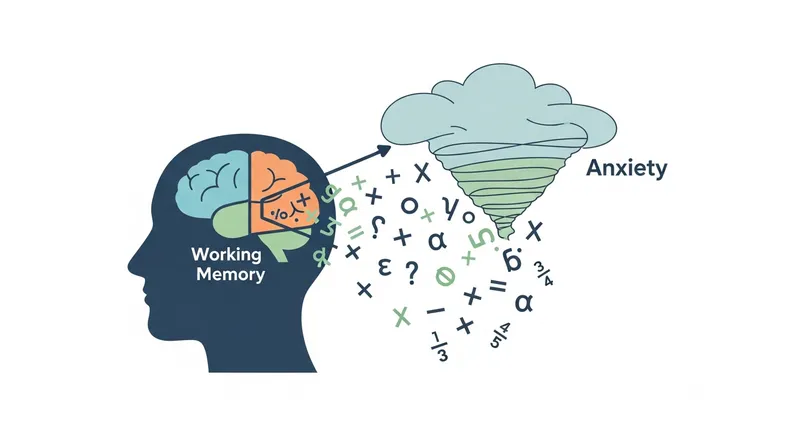
This stress has a direct impact on your ability to think. Cognitive scientists at the University of Cambridge have shown that anxiety consumes your working memory. Working memory is like your brain's temporary notepad—it's what you use to hold and manipulate information to solve problems.
When anxiety floods your system, it hogs all the space on that notepad, leaving little room for the actual math. This is why your mind can "go blank" even when you know the material.
This experience creates a vicious cycle. As leading cognitive scientist Sian Beilock discovered in her research, anxious individuals will avoid math even when they are perfectly capable of doing it. This avoidance prevents them from getting the practice that builds confidence, which in turn makes them more anxious. Our goal is to break that cycle.
Symptoms of Math Test Anxiety: It's Not Just in Your Head
Recognizing the symptoms is the first step toward managing them. They can be physical, psychological, and behavioral.
- Physical Symptoms: Racing heart, shortness of breath, sweating, nausea, dizziness, or your mind completely freezing up during a test.
- Psychological Symptoms: Intense negative self-talk (e.g., "I'm going to fail," "I'm terrible at this"), feelings of panic, a persistent fear of being wrong, and low self-esteem related to academics.
- Behavioral Symptoms: Procrastinating on homework, avoiding classes that require math, or rushing through tests just to get them over with.
Recognizing these symptoms is the first step. Now, let's move to the second: taking action. Here are 11 proven strategies you can use to fight back against anxiety and reclaim your confidence.
11 Proven Strategies to Reduce Exam Stress
Overcoming math anxiety requires a multi-layered approach. Think of it like first aid: you need immediate techniques for when you're panicking, short-term strategies for the days leading up to a test, and long-term habits to build a healthy relationship with math.
In the Moment: How to Stop Panicking During an Exam
- Practice the 4-7-8 Breath. When your mind starts to race, this simple technique can calm your nervous system instantly.
Inhale quietly through your nose for 4 seconds. Hold your breath for 7 seconds. Exhale completely through your mouth for 8 seconds. Repeat this 3-4 times.
- Do a "Brain Dump." As soon as you get your test, turn it over and write down every formula, rule, and process you memorized. This offloads them from your working memory and serves as a personal cheat sheet you created yourself.
- Start with What You Know. Scan the test and find the easiest problem you can solve. Gaining a quick win builds momentum and confidence, proving to your brain that you can do this.
- Re-read and Re-frame. If a problem seems overwhelming, read it again slowly. Underline key information. Sometimes anxiety comes from misunderstanding the question, not the concept. When tackling complex algebra word problems, breaking them down is key.
The Week Before: Smart Prep to Build Confidence
- Study Actively, Not Passively. Don't just re-read your notes. As recommended by experts at Purdue University Northwest, use active learning techniques. Try teaching the concepts to a friend or family member, or create your own practice quizzes. The goal is to retrieve information from your brain, not just put it in.
- Simulate Test Conditions. A few days before the exam, do a practice run. Set a timer, put your phone away, and work through problems in a quiet space. This helps desensitize you to the pressure of the real test and improves your study skills.
- Prioritize Sleep. A tired brain is an anxious brain. Sacrificing sleep to cram is one of the worst trade-offs you can make. Aim for a full night's sleep, especially the night before the exam.
Long-Term Habits: Build a Healthy Relationship with Math
- Focus on Process, Not Just Answers. Shift your goal from "getting the right answer" to "understanding the process." When you're stuck, tools that provide step-by-step solutions can be a game-changer. An AI Tutor like Tutor AI breaks down the how and why, building a foundation of real understanding—the ultimate confidence booster.
- Embrace a Growth Mindset. Acknowledge that abilities can be developed through dedication and hard work. Instead of saying "I'm bad at math," try saying "I'm still learning how to do this." Celebrate your progress and treat mistakes as learning opportunities.
- Practice Low-Stakes Math. Make math a small, regular part of your life. Use an app for 15 minutes a day, calculate the tip at a restaurant, or figure out a sale discount. Frequent, low-pressure exposure reduces the fear associated with the subject.
- Get Consistent Support. Don't wait until you're overwhelmed to seek help. Regular math help builds skills incrementally. Whether it's a study group or a digital tool, having support available 24/7 can prevent late-night stress. An app like Tutor AI ensures you can get unstuck on algebra homework at 10 PM without the anxiety of waiting for the next day.
A Guide for Parents: How to Help Your Child with Math Anxiety
Your attitude toward math can have a huge impact on your child. Here's how you can be a supportive partner in their learning.
- Watch Your Words: Avoid saying things like "I was never good at math either." This can signal to your child that math ability is a fixed trait they may have inherited. Instead, say, "We can figure this out together," or "Math can be tricky, but practice makes it easier."
- Praise Effort, Not Just Grades: Focus on their hard work, persistence, and courage in tackling difficult problems. This reinforces a growth mindset and values the learning process over the outcome.
- Create a Stress-Free Homework Zone: Homework battles increase anxiety for everyone. Set a consistent time and place for homework help. If you find yourself getting frustrated, it's okay to take a break. Tools like Tutor AI can be a neutral third party, providing explanations without the emotional baggage. You can use the parental progress tracking feature to stay involved and celebrate their achievements, reducing conflict and empowering your child to learn independently.
A Message for Educators: Creating an Anxiety-Aware Classroom
Teachers are on the front lines of this issue. A 2020 survey highlighted by EdWeek.org found that 67% of teachers see math anxiety as a challenge for their students. Creating an anxiety-aware classroom can make a world of difference.
One of the most impactful changes involves re-evaluating timed tests. Influential research from Stanford professor Jo Boaler shows that for about a third of students, timed tests are the beginning of math anxiety. The stress blocks their working memory, preventing them from accessing facts they actually know. Consider alternative assessments that focus on problem-solving and reasoning over speed.
It's Time to Change Your Relationship with Math
Overcoming math anxiety isn't about suddenly becoming a math genius; it's about dismantling the fear that's holding you back. By using these strategies—calming your mind in the moment, preparing effectively, and building healthier long-term habits—you can break the cycle of panic and avoidance. You have the ability to succeed. It's time to prove it to yourself.
Ready to Build Your Confidence?
Turn math anxiety into math confidence. Tutor AI provides instant, step-by-step help 24/7, so you never have to feel stuck or alone again. Download the app today and start your stress-free learning journey!
Frequently Asked Questions
How can I stop my mind from going blank during a math test?
This happens because anxiety overloads your working memory, which you need for problem-solving. The best immediate strategy is to use a relaxation technique like the 4-7-8 breathing exercise mentioned above to calm your nervous system. Then, perform a "brain dump" by writing down all the formulas and rules you remember on scrap paper. This frees up mental space and gives you a reference sheet. Finally, start with the easiest problem on the test to build confidence and momentum.
How can I help my child with math if I was bad at math myself?
This is a common concern. The most important thing is to manage your own language. Avoid saying "I was bad at math, too," as this frames math ability as an inherited, fixed trait. Instead, focus on a positive, collaborative attitude. Say things like, "This looks tricky, let's try to figure it out together," or "I'm proud of you for working so hard on this." Your role is to be a cheerleader for their effort, not a math expert. You can also use tools like Tutor AI as a neutral resource to provide expert explanations, allowing you to support your child without having to know all the answers yourself.
Does timed testing make math anxiety worse?
Yes, for many students, it does. Research from education experts like Jo Boaler at Stanford University shows that timed tests are a primary source of math anxiety. The pressure to perform quickly can cause stress that blocks access to working memory, making it impossible for students to recall math facts they actually know. While speed can be one aspect of fluency, focusing on flexible thinking and deep understanding is often more effective and less anxiety-inducing.
What is the difference between math anxiety and dyscalculia?
Math anxiety is an emotional and psychological reaction of fear or dread toward math. Dyscalculia is a neurological learning disability that affects a person's innate ability to understand and process numbers. A person with dyscalculia often experiences math anxiety as a result of their struggles. However, a person can have severe math anxiety without having dyscalculia at all. If basic number concepts (like comparing quantities or understanding place value) are consistently challenging, it may be worth exploring an evaluation for dyscalculia.
At what age can math anxiety start?
Math anxiety can start surprisingly early. Research indicates that the pressure of learning math facts and the introduction of timed tests in early elementary school can be a trigger for young children. Negative experiences, pressure from teachers or parents, and social comparison in the classroom can all contribute to the development of math anxiety in children as young as six or seven years old. It's crucial to foster a positive and encouraging environment around math from the very beginning.


