
Introduction: The 11 PM Homework Panic
It's 11 PM. You're staring at a physics problem about projectile motion or a chemical equation that just won't balance. The textbook explanation feels like it's written in another language, and every search online leads to a different, equally confusing answer. We've all been there. That feeling of mounting pressure is when you're most tempted to find a tool that will just give you the answer. But a nagging voice in your head asks, "If I just get the answer, will I actually learn anything for the test?"
This is the core dilemma for modern students. You're not just looking for AI homework help; you're looking for a way to build real understanding without the stress. If you're feeling overwhelmed by homework, the good news is you don't have to choose between getting help and genuinely learning, and many tools offer free ways to start. In this guide, you'll learn the critical difference between AI solvers and tutors, plus a 4-step framework to turn any AI tool into your most effective study partner.
AI 'Solver' vs. AI 'Tutor': Why the Difference is Critical for Your Grades
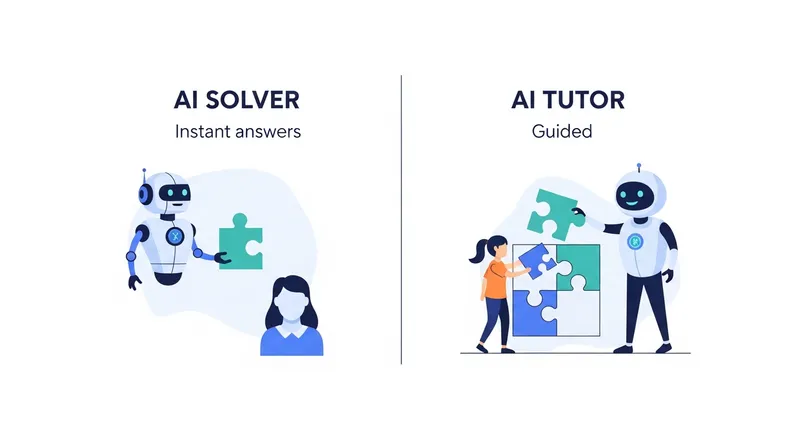
The first step to using AI effectively is understanding that not all tools are created equal. Most fall into two categories: solvers and tutors. The difference is critical for your long-term success.
An AI Solver is a powerful calculator. You give it a problem, and it gives you the answer. While useful for checking your work, they function like a GPS that only tells you the next turn without showing you the whole map. You get to your destination, but you have no idea how you got there or how to do it again on your own.
An AI Tutor, on the other hand, is a guide. Its goal isn't just to give you the answer but to help you find the answer yourself. It acts like a real tutor, asking questions, providing hints, and explaining concepts in different ways until you have that "aha!" moment. Think of it this way: a solver gives you a fish, but a tutor teaches you how to fish.
| Feature | AI Solver | AI Tutor |
|---|---|---|
| Goal | Provide the final answer quickly. | Help you understand the process. |
| Method | Gives you the solution and steps. | Asks guiding questions and provides hints. |
| Result | You finish the homework. | You build skills for the exam. |
This isn't just a philosophical difference; it has a measurable impact on learning. A study highlighted in Education and Information Technologies found that while AI tutors providing hints improved student performance, students who were simply given answers by an AI performed 17 percent worse on a later test without AI access. Relying on a solver can create a dangerous illusion of knowledge that disappears under exam pressure. When comparing tools, it's less about a direct Photomath vs. Chegg debate and more about which one encourages a tutoring mindset.
The Socratic Method Reborn: How a True AI Tutor Teaches
A good tutor, whether human or AI, aims to keep you in what educators call the 'zone of proximal development'. As described in a report by The Hechinger Report, this is the sweet spot where a task is challenging enough to promote learning but not so difficult that it causes you to give up. Solvers often bypass this zone entirely, robbing you of the learning opportunity.
True AI tutors achieve this by reviving a 2,400-year-old teaching technique: the Socratic method. Instead of lecturing, they ask guiding questions. This is the philosophy behind leading educational tools. For instance, Khan Academy's founder has explained that their AI, Khanmigo, is intentionally designed to not just give answers. This approach forces you to engage, think critically, and build the problem-solving muscles you need for exams.
How to Use AI for Studying Science: A 4-Step Framework for Real Learning
Knowing the difference is one thing; putting it into practice is another. You can turn almost any AI tool into a better tutor by using the right approach. Here is a framework to get the most out of your AI study assistant.
-
Start with a Question, Not Just a Photo. Before you snap a picture, try to frame the problem in your own words. Type out, "I'm trying to solve this physics problem about momentum, but I'm stuck on which equation to use." This forces you to identify the core of your confusion, which is the first step to real learning.
-
Use Prompts That Force Deeper Thinking. Don't just accept the step-by-step solution. Treat the AI like a real tutor and ask follow-up questions. Here are some powerful prompts you can use:
- "Explain this concept to me like I'm in 10th grade."
- "What is a common mistake students make with this type of problem?"
- "Can you give me a real-world example of where this is used?"
- "Why is this step necessary? What would happen if I skipped it?"
- "What's the most important formula to remember from this explanation?"
-
Ask the AI to Quiz You. This is the most crucial step for moving from passive learning to active recall. After you feel you understand a concept, turn the tables on the AI. Use prompts like:
- "Ask me three questions to check if I understood this."
- "Give me a similar practice problem, but don't show me the answer."
- "Let's pretend you're my teacher. What would you ask me on a test about this?"
-
Connect the Concept to the Bigger Picture. Build a web of knowledge instead of a list of isolated facts. Use your AI tutor to see the bigger picture. Ask: "How does this concept of chemical equilibrium relate to Le Chatelier's Principle?" or "How does this law of motion connect to what I learned about energy conservation?" This is how you build the deep, flexible knowledge that earns top grades.
By following this framework, you transform the AI from a simple answer machine into a personalized learning partner. This is the most effective way to use any of the best AI homework solvers available.
Ready to turn your phone into a 24/7 science tutor? Try Tutor AI for free and experience the difference a true AI tutor makes.
Putting the AI Science Tutor to the Test: Examples for Physics, Chemistry, and Biology
Let's see how this works for specific science subjects.
-
AI Physics Tutor: You're stuck on a kinematics problem. Instead of just getting the final velocity, a tutor-driven approach has the AI ask you: "What are the known variables here? What are you trying to find? Based on that, which kinematic equation seems most appropriate?"
- Example Problems: Calculating a projectile's range, finding the final velocity of a falling object, or determining acceleration from a velocity-time graph.
- Expected Outcome: After using this approach, you'll be able to identify the right equation for any motion problem, even on exam day without AI help.
- For a concept like Faraday's Law of Induction, the AI can break down the abstract idea of magnetic flux into tangible steps.
-
AI Chemistry Tutor: You need to balance a chemical equation. An AI solver will just give you the final balanced equation. A true AI tutor will guide you, saying, "Let's start with the carbon atoms. How many are on the left side? How many on the right? What coefficient do you need to add to balance them?"
- Example Problems: Balancing combustion reactions, stoichiometry calculations, or determining limiting reactants.
- Expected Outcome: You learn the methodical process of balancing, a skill that's essential for all future chemistry topics. You can learn more in our guide on how to balance chemical equations.
-
AI Biology Tutor: You're trying to memorize the steps of cellular respiration. A solver might give you a diagram. An AI tutor can make it interactive. You could ask it to "Explain the Krebs cycle using an analogy," or "Quiz me on the inputs and outputs of glycolysis." This active engagement is what makes the information stick.
A Guide for Parents & Teachers: How to Champion Smart AI Use
For parents and teachers, the rise of AI can feel like a threat to academic integrity. But by embracing the "tutor, not solver" philosophy, you can guide students to use these tools responsibly. The goal is to build digital literacy alongside academic skills.
Here's how you can help:
- Discuss the 'Tutor vs. Solver' Difference: Have an open conversation about the long-term consequences of just getting answers. Frame it as a strategy for success, not a lecture on cheating.
- Model Good Prompting: When your child is stuck on homework, don't just give up or create conflict. Guide them to use an AI tutor with the kinds of questions from the framework above. For example: "Let's ask the AI to explain the first step, and then you try to do it."
- Look for Tutoring Features: When evaluating a tool, look for features that encourage learning. Does it offer step-by-step guidance? Can it ask follow-up questions? Does it track progress? A tool like Tutor AI is built around providing these step-by-step explanations to foster real understanding.
- Champion Ethical Frameworks: Support the adoption of clear guidelines for AI in education, like those from the International Society for Technology in Education (ISTE). The goal is to create a culture where AI is seen as a tool for learning, not just for getting work done. This helps students navigate the tricky question of whether a tool like Brainly is legit for learning or just for answers.
Conclusion: You Are the Pilot, AI is Your Co-Pilot
The power of any tool is determined by the person who wields it. An AI science tutor can be a mindless answer key, or it can be an infinitely patient, 24/7 personal tutor that helps you master difficult concepts. The choice is yours.
By focusing on the critical difference between an AI "solver" and an AI "tutor," you empower yourself to learn for real. You move beyond the fear of getting caught to the confidence of actually knowing the material. The goal isn't to just get the homework done; it's to walk into your next exam knowing you have the skills to succeed on your own.
Ready to transform late-night homework panic into confident understanding? Download Tutor AI for free and get your first step-by-step explanation in seconds.
Frequently Asked Questions
Is using an AI science tutor considered cheating?
It all comes down to your intent and your method. If you use an AI tool to copy an answer for a graded assignment without trying to learn the material, it's academic dishonesty. However, if you use it as a study partner to understand difficult concepts, work through practice problems, and check your work, then it is a powerful and ethical learning tool. The key is to use it to master the process, not just to grab the final product.
Can an AI tutor replace a human tutor?
AI tutors offer incredible benefits like 24/7 availability and affordability that are hard for human tutors to match. However, human tutors provide a level of emotional intelligence, personalized motivation, and mentorship that AI is still developing. Research from Carnegie Mellon University even found that a hybrid model combining human and AI tutoring led to the highest learning gains. The best approach is to view an AI tutor as a powerful, on-demand supplement to classroom instruction and human guidance, not a complete replacement.
What is the best free AI for learning science?
The "best" tool isn't a specific brand, but a type of tool. The best free AI for learning science is one that functions as a tutor, not just a solver. When evaluating options, look for these features: Does it provide clear, step-by-step explanations? Does it allow you to ask follow-up questions? Does it encourage you to try problems on your own? A tool that prioritizes the learning process over the final answer will always be the superior choice for your education.
How can I be sure the AI's science answers are accurate?
That's a very important question. While AI models are incredibly powerful, they are not infallible and can sometimes make mistakes or "hallucinate" incorrect information. The smartest way to use an AI tutor is to trust it for the process and the explanation but to remain a critical thinker. Always cross-reference final answers, key facts, and important formulas with your textbook, class notes, or teacher. This practice not only ensures accuracy but also deepens your own understanding.
Does using an AI tutor really improve grades?
Yes, but only if it's used correctly. A groundbreaking study from Harvard University showed that students using a well-designed AI tutor learned significantly more material in less time compared to traditional teaching methods. The grade improvement comes from using the tool for active learning - engaging with the material, asking questions, and testing your knowledge - not from passively copying answers. When you use an AI to build real understanding, the improved grades will follow.


