
Picture this: It's 11 PM, you're staring at an SAT practice test, and the questions are starting to blur. Sound familiar? You're not alone. For many, preparing for the SAT is a cycle of stress, pressure, and conflicting advice. Students fall back on old habits like cramming, parents struggle to know how to help, and tutors search for methods that truly stick.
But what if there was a smarter way to prepare? This guide cuts through the noise. We're moving beyond generic tips to bring you a plan grounded in cognitive science—proven strategies that help your brain learn and retain information more effectively. Whether you're a student aiming for your dream score, a parent supporting your child's journey, or a teacher looking for new techniques, this is your roadmap to success on the new digital SAT.
Why Traditional Study Methods (Like Cramming) Often Fail
Have you ever spent an entire night re-reading a textbook, only to forget most of it by test day? You've experienced the limits of passive review. Methods like cramming and highlighting give a false sense of familiarity but don't create the strong neural pathways needed for true recall. Your brain needs to actively work to store information for the long term.
Effective studying isn't about the number of hours you put in; it's about the quality and strategy behind those hours. The science-backed methods below are designed to make your study time count. So, where does this strategic approach begin?
Start with the Official Source: Your Diagnostic Baseline
Before you can create a winning strategy, you need to know your starting point. Your first and most important step is to take a full-length, official practice test. The College Board, the creators of the SAT, provides the best tools for this. Their Bluebook™ app offers free, full-length digital practice tests that perfectly mimic the real testing experience.
Additionally, the College Board's partnership with Khan Academy provides a wealth of free, official practice questions and lessons. By taking a diagnostic test, you get a detailed score report that pinpoints your exact areas of weakness. This isn't just a score; it's a treasure map showing you exactly where to focus your energy.
The Core Four: Science-Backed Strategies for Effective SAT Prep
Instead of falling into passive habits, build your study plan around these four powerful principles from cognitive science. These techniques are proven to enhance learning and memory.
Strategy 1: Active Recall (Stop Re-reading, Start Retrieving)
Active recall is the process of actively retrieving information from your brain, rather than passively reading it. Every time you force yourself to remember an answer, you strengthen that memory. Research published by the American Psychological Association confirms that this practice, also known as retrieval practice, is one of the most effective ways to study. A recent review further found that active recall strategies are directly correlated with higher test scores.
Actionable Tip
- After reading a passage, close the book and summarize its main point out loud. For math, cover up the solution to a problem and work it out from scratch. Use flashcards for vocabulary, but force yourself to say the answer before you flip the card.
Strategy 2: Spaced Repetition (Study Smarter, Not Harder)
Spaced repetition involves reviewing information at increasing intervals over time. This technique works with your brain's natural forgetting curve. Reviewing a concept right before you're about to forget it tells your brain that this information is important and strengthens its storage.
Actionable Tip
- Create a study calendar. If you learn a new math concept on Day 1, plan to review it again on Day 3, then Day 7, and then Day 15. This is far more effective than cramming it all in one night.
Strategy 3: Interleaving (Mix It Up for Deeper Learning)
While it feels productive to study one topic for hours (known as "blocking"), research from institutions like UC Berkeley shows that mixing, or interleaving, different types of problems or subjects within a single study session leads to deeper, more durable learning. This forces your brain to switch gears and learn to identify which strategy is needed for each problem, just like on the real SAT.
Actionable Tip
- Don't just do 50 algebra problems in a row. Create a practice set with a mix of algebra, geometry, and data analysis questions. This will feel harder, but it will prepare you much better for the test.
Strategy 4: Elaborative Encoding (Connect New Info to What You Know)
Elaboration is the process of giving new information meaning by connecting it to things you already know. The more you can explain a concept in your own words and link it to existing knowledge, the more likely you are to remember it.
Actionable Tip
- When you learn a new grammar rule, find examples of it in a book you're reading. When you solve a challenging math problem, try to explain the steps and the logic to a friend or family member. Better yet, explore our study skills articles for more ways to make learning stick.
The Core Four at a Glance
- Active Recall: Test yourself instead of just re-reading.
- Spaced Repetition: Review information at increasing intervals.
- Interleaving: Mix different subjects or problem types in one session.
- Elaborative Encoding: Connect new concepts to what you already know.
Creating Your Personalized Digital SAT Study Plan
With these scientific principles in mind, you can build a truly effective study plan.
Analyze Your Mistakes (The Right Way)
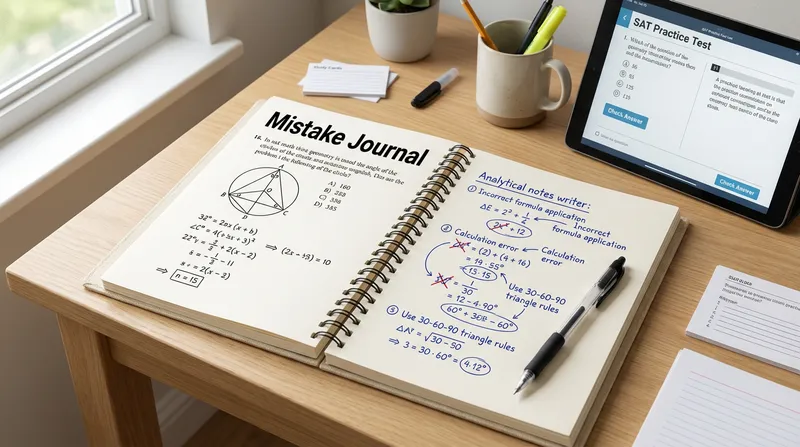
Every wrong answer on your practice test is an opportunity. Create a "mistake journal." For each error, write down:
- The question itself.
- Why you got it wrong (e.g., careless mistake, concept gap, misunderstood the question).
- The correct answer and a step-by-step explanation of how to get there.
Focus on Your Weaknesses
Your diagnostic test showed you where to focus. Dedicate the majority of your study time to these areas. If you're struggling with specific concepts, you need clear, reliable explanations. When you're stuck on tough math help problems, an AI-powered tool like Tutor AI can be invaluable. Instead of just getting an answer, you get step-by-step solutions that walk you through the logic, turning a moment of frustration into a learning opportunity.
Master the Digital SAT Format
The new digital SAT is an adaptive test. This means your performance on the first module of a section determines the difficulty of the second module. It's crucial to be accurate from the start. Get comfortable with the built-in tools, including the Desmos graphing calculator, the answer-eliminating tool, and the question-flagging feature, all available in the official Bluebook™ practice app.
Section-Specific Strategies: Applying the Science
Reading and Writing Section
This section tests your ability to understand, analyze, and use information from short passages, as well as your command of grammar. For grammar, don't just memorize rules; understand them. The Purdue Online Writing Lab (OWL) is a fantastic, credible resource for in-depth explanations. Use active recall by creating practice sentences to test yourself on comma usage or subject-verb agreement. Applying these rules consistently is one of the most powerful study tips you can adopt.
Math Section
The math section covers a wide range of topics, making it perfect for interleaving practice. When complex algebra or tricky word problems stop you in your tracks, having instant access to step-by-step explanations transforms that frustration into understanding. With a tool like Tutor AI, you can snap a photo of the problem and instantly receive a detailed breakdown, helping you master the underlying concepts for next time. Check out our 4-Step Guide to Solve Algebra Word Problems to build your skills.
The Mental Game: Managing Stress and Building Confidence
Your mindset is as important as your knowledge. Test anxiety is real, and it can impact performance. A study in Psychological Science suggests that high test anxiety can even interfere with the learning process itself, making study sessions less effective.
Combat this by:
- Practicing Mindfulness: A few minutes of deep breathing can calm your nervous system. Try one of these simple exercises before a study session or the real test:
- Box Breathing: Inhale for 4 seconds, hold for 4, exhale for 4, and hold for 4. Repeat 3-5 times.
- 5-4-3-2-1 Grounding: Name 5 things you can see, 4 things you can feel, 3 things you can hear, 2 things you can smell, and 1 thing you can taste. This pulls your focus to the present.
- Getting Enough Sleep: Sleep is critical for memory consolidation. Don't sacrifice it to cram.
- Focusing on Effort, Not Just the Score: Celebrate your hard work and progress. Your goal is to learn and improve, not just to hit a number.
Quick Answers to Common SAT Prep Questions
How long should I study for the SAT? It varies, but most experts recommend 10-20 hours of focused study in total. Consistency is more important than duration. A solid plan might involve 2-4 hours per week over 2-3 months.
When should I take my first practice test? As soon as possible! Taking a diagnostic test at the very beginning of your prep is the best way to get a baseline score and identify your specific areas of weakness.
Is the digital SAT harder than the paper one? It's not designed to be harder, but it is different. The digital format is adaptive, shorter, and includes a built-in calculator (Desmos). The best way to prepare is by using the official digital practice tests to get comfortable with the format.
A Guide for the Support Team: Parents and Tutors
Success on the SAT is a team effort. Here's how parents and educators can provide the best support.
For Busy Parents
Your role is to be a source of support, not pressure. Create a quiet, consistent space for studying and encourage a balanced schedule with breaks. When your child gets stuck on homework late at night, it can create stress for the whole family. This is where 24/7 availability from a tool like Tutor AI becomes a lifesaver. Furthermore, features like progress tracking can give you peace of mind, allowing you to see your child's improvement without having to become an expert in trigonometry yourself.
For Tutors and Teachers
Incorporate these scientific principles into your sessions. Use interleaving when creating practice sets and encourage students to use active recall instead of just listening to explanations. Structured preparation programs are proven to be effective, a finding supported by research from the U.S. Department of Education's What Works Clearinghouse. Consider supplementing your instruction with an AI Tutor that students can use for independent practice, allowing them to get instant feedback and reinforcement between your sessions.
Your SAT Prep Checklist: Putting It All Together
- Take an Official Practice Test: Use the College Board's Bluebook™ app to get your baseline score.
- Analyze Your Results: Create a mistake journal to identify specific areas for improvement.
- Build a Study Schedule: Use spaced repetition to plan when you'll study and review different topics.
- Study with Science: Use active recall, interleaving, and elaboration in every session.
- Focus on Weaknesses: Dedicate extra time to your challenging areas, using tools for step-by-step help when needed.
- Manage Your Mindset: Prioritize sleep, practice mindfulness, and focus on progress.
Preparing for the SAT is a marathon, not a sprint. By replacing inefficient habits with science-backed strategies, you can study more effectively, build lasting knowledge, and walk into the test with confidence. You're not just studying for a test; you're building powerful learning habits that will last a lifetime.
Note: Every student learns differently. While these strategies are research-backed, results may vary. We encourage you to adapt these techniques to fit your unique learning style and circumstances.
Ready to Supercharge Your Study Plan?
Stop struggling and start understanding. Download Tutor AI today to get instant, step-by-step help and personalized practice that turns weaknesses into strengths.


