
Online SAT Prep: Your Guide to a Smart Investment
Choosing the right SAT prep for your child can feel like a high-stakes decision, wrapped in a dizzying array of options, price tags, and promises. Should you invest thousands in a big-name course? Is a self-paced program effective? Are there affordable alternatives that actually work? The pressure is real, and as a parent, you want to make a smart investment in your child's future without adding unnecessary stress or financial strain to your family.
This guide is here to help you cut through the noise. We'll provide a balanced, clear-eyed look at the SAT prep landscape, from the expensive heavyweights to the flexible, modern alternatives. Our goal is to give you a simple cost-benefit framework to help you make a confident choice that's right for your student and your budget.
Why SAT Scores Still Matter (and Why Prep is So Confusing)
Even with many colleges adopting test-optional policies, a strong SAT score can still be a significant advantage in a competitive admissions landscape. It provides a standardized data point that helps colleges assess readiness. To put scores in perspective, the National Center for Education Statistics (NCES) reports that the average total SAT score for the class of 2023 was 1028. Knowing this benchmark can help you and your child set realistic goals.
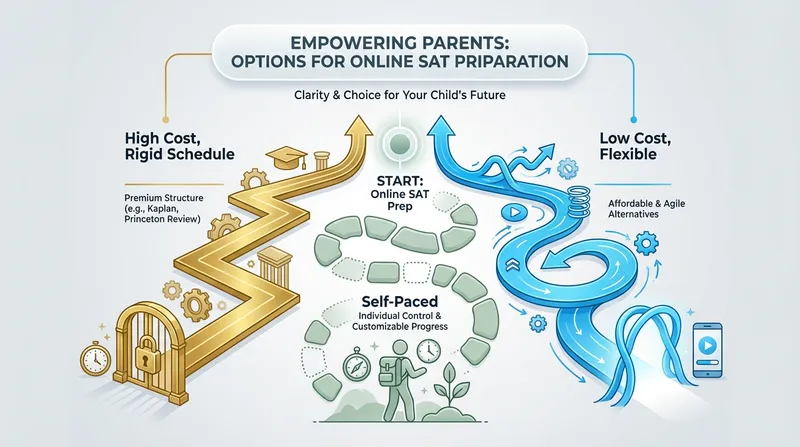
The test prep industry knows the pressure parents feel, and it's filled with bold marketing claims and confusing options. This makes it incredibly difficult to determine what's truly effective versus what's just expensive.
The Heavyweights: Kaplan vs. Princeton Review
When you think of test prep, Kaplan and The Princeton Review are the two names that immediately come to mind. They have built their reputations over decades, offering comprehensive programs that promise significant results. But what do they actually provide, and what is the real cost?
What They Offer and What They Cost
These programs typically offer a range of services, from live online classes that can cost upwards of $1,000 to intensive one-on-one tutoring packages that can run into several thousand dollars. They often come with a "score improvement guarantee," which sounds reassuring. However, it's important to look at these claims with a critical eye. Independent research, including a comprehensive review of 30 studies mentioned by ACT, Inc., suggests that the average score gains from commercial test prep are often more modest than advertised.
The Pros and Cons
- Pros: These courses offer a highly structured curriculum, experienced instructors, and a wealth of proprietary practice materials. For students who need external accountability and a clear schedule, this format can be very effective.
- Cons: The primary drawbacks are the high cost and lack of flexibility. Class schedules are rigid, which can be a major challenge for students juggling school, sports, and other extracurriculars. The one-size-fits-all curriculum may also spend too much time on concepts a student has already mastered or not enough on their specific weak spots.
Comparing Your SAT Prep Options at a Glance
To make it easier to see the trade-offs, here is a quick comparison of the main categories of SAT prep.
| Feature | High-Cost Courses (Kaplan, Princeton Review) | Self-Paced Platforms (Magoosh, PrepScholar) | AI-Powered Tools (TutorAI) |
|---|---|---|---|
| Typical Cost | $1,000 - $2,000+ | $100 - $300 | Free - Low-Cost Subscription |
| Format | Live online classes, rigid schedule, 1-on-1 tutoring | Video lessons, question banks, practice tests | 24/7 on-demand help, photo-based problem solving |
| Flexibility | Low | High | Very High |
| Best For | Students needing structure and external accountability. | Self-motivated students who manage their own time well. | Independent learners needing targeted help on specific problems. |
Popular Self-Paced Alternatives: Magoosh & PrepScholar
For families looking for a middle ground, self-paced online courses like Magoosh and PrepScholar have become popular. These platforms offer a more affordable and flexible approach, typically centered around a library of video lessons, extensive question banks, and practice tests.
The main advantage is clear: students can learn whenever and wherever they want. This is ideal for self-motivated learners who are good at managing their own time. The trade-off, however, is that the onus is entirely on the student to stay disciplined and engaged without a live instructor to hold them accountable. Before committing, parents should have an honest conversation with their child about their ability to stick to a schedule and proactively seek help when they're stuck. Honing these study skills is crucial for success with this model.
The Smart Alternative: How AI-Powered Tools Are Changing the Game
The Digital SAT is an adaptive test, meaning the difficulty of questions changes based on the student's performance. As the College Board explains, this format is designed to be more efficient. AI-powered prep tools are uniquely suited to this, as they can simulate an adaptive experience and personalize content to a student's individual strengths and weaknesses in real time.
Tools like TutorAI are at the forefront of this shift. With a mission to empower independent learners, TutorAI offers 24/7 support that is both incredibly affordable and highly personalized. Instead of following a rigid curriculum, a student can get targeted help exactly when they need it.
How On-Demand Help Builds SAT Skills
The SAT doesn't just test tricks; it tests a deep understanding of core concepts in math and reading. An AI tutor helps bridge the gap between nightly homework and long-term test readiness. Imagine your child is working through a practice test and gets stuck on a complex word problem. Instead of giving up, they can snap a photo of the problem with TutorAI and get an immediate, step-by-step explanation that clarifies the underlying concepts. This turns moments of frustration into learning opportunities, building the foundational skills needed for a high score.
This method aligns with academic research on effective online tutoring, which highlights that interactivity and immediate guidance are key to learner satisfaction. For more on how AI is transforming education, explore these AI Tutor Articles.
A Parent's Cost-Benefit Framework: How to Choose
So, how do you make the final decision? Instead of just looking at the price, think about the return on investment (ROI) for your child's specific needs. Use this simple framework to guide your choice.
Step 1: Assess Your Child's Needs
- Learning Style: Does your child thrive with live instruction, or do they prefer to work independently?
- Motivation & Discipline: Are they a self-starter, or do they need the external accountability of a scheduled class?
- Schedule: How much time can they realistically commit each week? Is their schedule predictable or constantly changing?
Step 2: Define Your Budget & Goals
- Budget: What is a realistic amount your family can spend without causing financial stress?
- Score Goal: What is a reasonable score improvement target? (Remember to be realistic!)
Step 3: Evaluate the ROI
- High-Cost (Kaplan/Princeton): Highest potential for structure, but also highest cost and lowest flexibility. The ROI is only high if your child fully utilizes the live classes.
- Mid-Tier (Magoosh/PrepScholar): Good balance of resources and cost, but the ROI depends entirely on your child's self-discipline.
- Low-Cost AI Tool (TutorAI): Highest flexibility and lowest cost. The ROI is extremely high for self-motivated students or as a supplement to other resources, providing targeted homework help exactly when needed.
Remember, research from Ohio State University has shown that access to expensive prep tools often correlates with family income. The rise of effective, affordable AI alternatives is helping to level that playing field.
Don't Forget the Best Free SAT Prep Resources
Before you spend a single dollar, make sure your child is using the incredible free resources available. These aren't low-quality substitutes; they are official, top-tier tools.
- Khan Academy: As the official partner of the College Board, Khan Academy offers a world-class, 100% free SAT prep program. It includes thousands of practice questions, video lessons, and full-length practice tests.
- College Board's Bluebook App: The best way to prepare for the Digital SAT is to practice on the official platform. The College Board provides free, full-length adaptive digital tests through its Bluebook™ app, which every student should use.
Conclusion: The Best Prep is the One Your Child Will Actually Use
Ultimately, there is no single "best" SAT prep course. The right choice is the one that fits your child's learning style, your family's budget, and a schedule they can realistically stick with. A thousand-dollar course is worthless if your child is too busy or unmotivated to engage with it.
For many families, the smartest strategy is a hybrid one. Start with the world-class free resources from Khan Academy and the College Board. Then, supplement that foundation with a flexible, powerful AI tool like TutorAI to provide instant help on the exact problems they struggle with. This approach empowers your child, builds their confidence, and delivers an outstanding return on a minimal investment. Download TutorAI for free today and give your child the on-demand support they need to succeed.
Frequently Asked Questions
Is online SAT prep actually effective?
Yes, online prep can be highly effective, but its success depends on the program and the student. Research shows that interactive tools with immediate feedback are key. The most effective course is one that matches your child's learning style, holds their interest, and fits their schedule.
How much should I realistically budget for SAT prep?
Costs can range from completely free to over $2,000. A smart strategy is to start with the excellent free resources from Khan Academy and the College Board. From there, you can supplement with a low-cost, high-value AI tool for personalized support before deciding if a more expensive program is necessary.
What is a realistic SAT score improvement to expect?
While some companies make bold claims, independent research shows that average score gains from commercial prep are often modest (around 20-30 points). The biggest driver of score improvement is a student's consistent, targeted practice, not the price of the course.
My child has a busy schedule. What's the best online SAT tutoring for them?
For students with busy schedules, flexibility is critical. A 24/7 AI-powered tool or a self-paced course is often a much better choice than a live online class with a rigid schedule. This allows them to study productively in the pockets of free time they have, reducing stress.
How can I support my child with a learning disability during SAT prep?
First, ensure you have applied for and received any available testing accommodations from the College Board. For preparation, tools that allow a student to work at their own pace without pressure are vital. AI tutors can be particularly helpful, as they provide patient, judgment-free, and repetitive explanations on difficult concepts.
When is the right time to start preparing for the SAT?
Most students begin focused preparation in the spring of their junior year. However, building a foundation early is always beneficial. Using accessible tools for light, consistent practice throughout sophomore and junior year can build skills and confidence long before the high-pressure cramming period begins.


