
Introduction: Turn a Free Practice Test into Your Secret Weapon for a Higher SAT Math Score
Taking a practice SAT and seeing a score that's lower than you hoped for can be discouraging. You might feel overwhelmed, wondering, "Where do I even start?" Many students think the only answer is to grind through more and more practice tests, hoping for a different result. But studying harder isn't always the same as studying smarter.
What if you could turn a single practice test into a personalized roadmap that shows you exactly what to work on? This guide will show you how. We'll go beyond just linking to a test and give you a powerful, step-by-step strategy to transform free resources into significant score improvements. By following this 'Practice, Analyze, Learn' cycle, you'll discover the best way to study for the SAT math section and walk into test day with confidence.
Step 1: Find the Right Fuel: Where to Get Free, High-Quality Digital SAT Math Practice Tests
Before you start, it's essential to use the right materials. Not all practice tests are created equal. Using low-quality or outdated tests can give you a false sense of your abilities and lead you to study the wrong things. For the Digital SAT, it's crucial to practice with tests that accurately reflect the new adaptive format, question types, and on-screen tools.
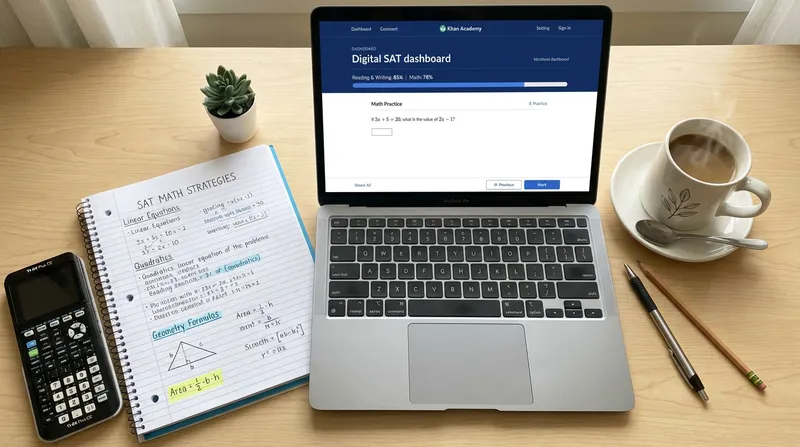
Luckily, the best resources are completely free. You don't need to spend a fortune to get top-tier practice materials. Focus your efforts on official sources to ensure every minute you spend studying is as effective as possible.
Official Practice from the Test-Makers
To get the most realistic experience, start with the creators of the exam. These resources are the gold standard for SAT prep:
- The College Board's Bluebook™ App: This is the most important tool in your arsenal. The College Board provides full-length adaptive digital SAT practice tests through its Bluebook™ software. It perfectly simulates the real testing experience, from the user interface to the way the test adjusts to your performance.
- Khan Academy: As the official practice partner for the SAT, Khan Academy offers a massive library of practice questions, articles, and videos tailored to the Digital SAT. After you take a practice test in Bluebook, you can link your College Board account to Khan Academy for personalized practice recommendations based on your results.
Using these official resources ensures that the question difficulty, content, and format are exactly what you'll see on test day.
Step 2: Set the Stage: How to Simulate Real SAT Test Conditions at Home
Taking a practice test on your couch with music playing won't prepare you for the real thing. The goal is to build mental stamina and get used to the pressure of the testing environment. As education experts at Signet Education recommend, taking a full, timed practice test under realistic conditions is a critical first step. It helps you identify weaknesses and manage your time effectively.
Here's a checklist to create an authentic testing environment. While a perfect setup is ideal, do the best you can with your available space and resources. Consistency is more important than perfection.
- Find a Quiet Space: Choose a room where you won't be interrupted for about 2.5 hours.
- Use the Right Device: Take the test on the same type of device (laptop or tablet) you'll use on test day.
- Stick to the Clock: Use the built-in timer in the Bluebook™ app. Don't pause it or give yourself extra time.
- Gather Your Tools: Have only what's allowed: your device, scratch paper, a pencil, and an approved calculator.
- Eliminate Distractions: Turn your phone off and put it in another room. No texting, no social media.
- Use Breaks Wisely: Only take breaks during the scheduled times. Stand up, stretch, and step away from your screen.
For more ideas, check out our general Study Tips Articles | Tutor AI Blog.
Step 3: Become a Detective: How to Review SAT Math Mistakes for Maximum Improvement
This is the most important step in the entire process. Your practice test score is just a number; the real value is in the mistakes you made. Each wrong answer is a clue pointing to an opportunity for growth.
A simple review isn't enough—you need to perform an 'error analysis.' This method, supported by academic institutions like the University of Minnesota Crookston, helps you categorize your mistakes and understand why you made them.
Create a 'mistake journal' in a notebook or spreadsheet and categorize every question you got wrong or felt unsure about:
- Conceptual Gap: You didn't know how to approach the problem because you didn't understand the underlying math concept (e.g., properties of exponents, vertex of a parabola). The Fix: This is your top priority. Go back and relearn the concept from the ground up using textbooks or online resources.
- Careless Error: You knew the concept but made a simple mistake, like a calculation error, dropping a negative sign, or misreading your own handwriting. The Fix: Slow down. Practice double-checking your work. Improving your focus is one of the key study skills that can quickly boost your score.
- Time Pressure Mistake: You rushed and made a mistake you wouldn't have made with more time. The Fix: This often points to a lack of fluency with a concept. The more you practice a specific skill, the faster and more automatically you'll be able to perform it.
- Misreading the Question: You solved for x when the question asked for 2x+1, or you missed a key word like "not" or "except." The Fix: Before you start solving, underline or circle exactly what the question is asking for. Reread the question one last time before selecting your answer.
Pro Tip: A Real-World Example Imagine you got a question about quadratic equations wrong. Was it because you forgot the quadratic formula (Conceptual Gap)? Or did you calculate
-bincorrectly becausebwas a negative number (Careless Error)? Pinpointing the why tells you whether to re-learn a formula or to slow down and double-check your signs.
As you analyze your test, you'll start to see patterns. Test prep experts at The Princeton Review point out that students often make the same types of errors, such as forgetting to distribute a negative sign or mixing up area and perimeter. Word problems, especially those involving algebra, are another common stumbling block. By identifying these recurring issues, you can focus your practice where it will have the biggest impact.
Step 4: Close the Gaps: Using AI to Understand the 'Why' Behind Wrong Answers
So, you've identified a Conceptual Gap. Your practice test tells you the correct answer is 'C', but you have no idea how to get there. This is the moment when most students either give up or waste hours searching YouTube for explanations that don't quite match their problem. There's a better way.
This is the perfect moment to leverage technology. Instead of falling down a rabbit hole of confusing online videos, you can get instant, clear guidance. This is where an AI Tutor becomes invaluable. With an app like TutorAI, you can simply snap a picture of the problem from your practice test. You don't just get the answer; you get a detailed, step-by-step explanation that walks you through the entire process.
This 'Snap. Solve. Learn.' approach turns a moment of frustration into a powerful learning opportunity. The app breaks down the solution, explaining the 'why' behind each step, just like a personal tutor would. It helps you truly learn the concept so you can tackle similar problems with confidence in the future.
Step 5: Build a Smart SAT Math Study Plan from Your Analysis
Now it's time to turn your analysis into action. Your mistake journal is the foundation for a personalized SAT math study plan that targets your unique weaknesses. This is how you make significant gains, like improving an SAT math score from 600 to 700.
- Prioritize Your 'Conceptual Gaps': These are the areas where you'll gain the most points. List the top 3-5 concepts you need to relearn.
- Schedule Targeted Practice: Dedicate specific study sessions to each concept. Use Khan Academy to find practice questions by topic or explore our other Math Help Articles | Tutor AI Blog for focused guides.
- Drill for Fluency: For topics where you made time-pressure mistakes, drill sets of practice problems to improve your speed and accuracy.
- Review and Repeat: At the end of each week, quickly review the concepts you've studied. After a few weeks of targeted practice, take another full-length practice test to measure your progress and identify new areas to focus on.
Conclusion: You're in Control of Your SAT Success
Improving your SAT Math score isn't about magic; it's about strategy. By using the 'Practice, Analyze, Learn' cycle, you take control of your prep. You move from aimlessly doing problems to intelligently diagnosing your weaknesses and systematically fixing them.
A free practice test is more than an assessment—it's your guide. By simulating real test conditions, diving deep into your mistakes, and using powerful tools to understand the 'why,' you create a virtuous cycle of improvement. The tools are free, the strategy is proven, and the results are in your hands.
Ready to turn your mistakes into real progress? When you get stuck, remember that reliable homework help is just a snapshot away. Download TutorAI to get step-by-step explanations and start learning smarter today.
Frequently Asked Questions
How often should I take a full-length SAT practice test?
It's best to start with one full-length test to get a baseline score and identify your initial weaknesses. After that, focus on targeted practice for 3-4 weeks before taking another full test. Quality of review is far more important than the quantity of tests you take; taking them too frequently can lead to burnout without giving you enough time to improve.
Is it possible to improve my SAT math score from 600 to 700?
Yes, a 100-point jump is a very achievable goal with strategic and consistent effort. The key is to move beyond just doing random practice and embrace the error analysis method described in this article. Identifying and systematically fixing your specific conceptual gaps is the fastest and most effective way to make significant score gains.
Can I use a calculator on the entire Digital SAT Math section?
Yes, the Digital SAT allows a calculator for the entire Math section. The testing software, Bluebook™, has a fantastic graphing calculator (Desmos) built right in. It's a powerful tool, so you should spend time practicing with it during your prep. Becoming comfortable with the exact features of the built-in Desmos calculator will make you more efficient on test day.
What's the best way to practice SAT math questions by topic?
Once you've analyzed your practice test and identified your weak areas, the best place for topic-specific practice is Khan Academy. Because it's the official partner of the College Board, you can link your accounts and get a personalized study plan. You can also manually filter their vast library of questions by math domain (e.g., Algebra, Advanced Math, Geometry) to focus on exactly what you need.
My biggest problem is running out of time. What are the best SAT math tips for that?
Time management issues often stem from a lack of confidence in certain concepts. The more you master a topic, the faster you'll solve it. However, you should also practice specific strategies. Don't get stuck on a single difficult question—it's okay to guess, flag it, and come back later if you have time. Practicing with timed mini-sections can also help you build a better internal clock for your pacing.


