
Digital SAT Study Plan: Free 1-Month & 3-Month Templates (2026)
Feeling the pressure of the upcoming Digital SAT? You're not alone. Preparing for this crucial exam can feel overwhelming, especially with its new digital format. But what if you could trade that stress for a clear, confident strategy?
Whether you're a student mapping out your prep or a parent supporting the process, this guide is here to help you build a personalized digital SAT study plan from the ground up. We'll walk you through a step-by-step process, provide free downloadable 1-month and 3-month templates, and show you how to turn a generic schedule into a powerful, adaptive learning strategy. Let's get you ready to earn the score you deserve.
Why You Need a Digital-First SAT Study Plan
Studying for the 2026 SAT isn't the same as it was for the old paper-and-pencil test. The biggest change is that the Digital SAT is adaptive. As test prep experts at PrepScholar note, your performance on the first module of a section determines if you get an easier or a harder second module. A generic study plan won't prepare you for this dynamic format.
A digital-first plan focuses on:
- Adaptive Strategy: Building the skills to handle questions that increase in difficulty.
- Pacing and Time Management: The test is shorter, so every minute counts. You need to practice with the new format and timing.
- Using Built-in Tools: Getting comfortable with the on-screen Desmos calculator and annotation features is key.
Your study plan needs to be as adaptive as the test itself, focusing on turning weaknesses into strengths.
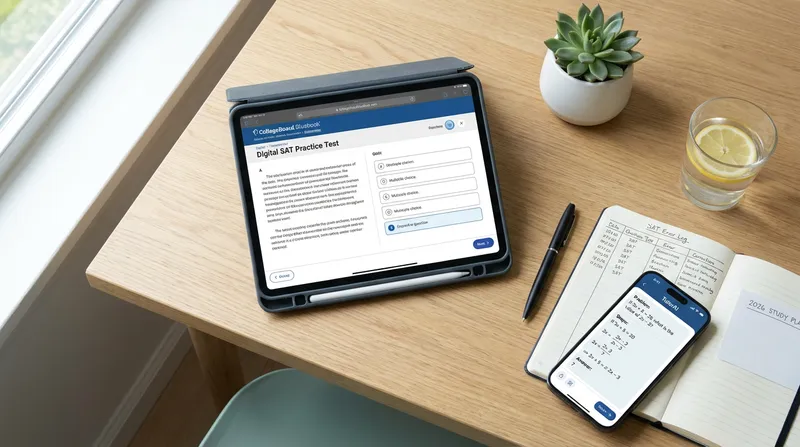
Step 1: Take a Diagnostic Test to Find Your Baseline
You can't create a road map without knowing your starting point. A diagnostic test is the essential first step to measure your current abilities and identify which areas need the most work. It's not about judging your score; it's about gathering data.
For the most accurate results, use official resources. The College Board offers the free Bluebook™ app, which has full-length, adaptive digital practice tests. This is the closest you can get to the real test-day experience.
To get a true baseline:
- Find a quiet space where you won't be interrupted.
- Time yourself exactly as the test instructs.
- Use only the allowed tools, like the built-in Desmos calculator.
Once you have your score, take a deep breath. This number doesn't define you—it's just the starting line for your improvement journey.
Step 2: Set a SMART Goal for Your SAT Score
Now that you have your baseline, it's time to set a target. Using the SMART goal framework helps you move from a vague wish ("I want a good score") to an actionable plan.
- Specific: Instead of "a higher score," aim for a specific number, like "1350."
- Measurable: Your practice test scores will show your progress toward your goal.
- Achievable: Research the average SAT scores for the colleges you're interested in. Set a goal that is challenging but realistic based on your baseline and timeline.
- Relevant: Your score goal should align with your broader college admission aspirations.
- Time-bound: Your test date is your deadline.
Break your overall goal into section goals (e.g., 650 in Reading and Writing, 700 in Math). This will help you focus your efforts and is one of the most important study skills you can develop.
Step 3: Choose Your Timeline & Download Your Free SAT Study Plan
Every student's schedule is different. That's why we've created two flexible templates. The 3-month plan allows for a steady, comprehensive pace, while the 1-month plan is an intensive sprint for those short on time. Choose the one that best fits your life and download it to get started!
🗓️ Download Your Free 3-Month SAT Study Plan PDF
🗓️ Download Your Free 1-Month SAT Study Plan PDF
The Comprehensive 3-Month SAT Study Plan
This plan is ideal for students who want to build a deep, lasting understanding of the content without cramming. It balances practice, learning, and rest to prevent burnout.
- Month 1: Building Foundations. Take your first diagnostic test. Spend this month reviewing core concepts you're shaky on. Use official prep materials from a source like Khan Academy, the College Board's official partner, to fill in knowledge gaps.
- Month 2: Skill Development. Take a second practice test. Now, your focus shifts to targeted practice on the weak areas you've identified. Start doing timed practice sections to build your pacing and endurance.
- Month 3: Refine and Review. Take two more practice tests, spaced a week or two apart. This final month is all about strategy. Analyze your error log daily, perfect your time management, and do a final, light review the week of the test.
The Intensive 1-Month SAT Study Plan
Have a packed schedule or a late start? This plan is for you. It's an intense sprint that requires focus and dedication. As test prep company Kaplan advises, the key is to schedule your prep time like any other important appointment.
- Week 1: Diagnose & Prioritize. Take Diagnostic Test 1. Immediately analyze your results and identify your top 3-5 weakest areas. This is where you will spend the majority of your time.
- Week 2: Targeted Practice. Take Practice Test 2. Drill down on the weak areas you identified. For busy students, getting quick help on tough problems can be a lifesaver.
- Week 3: Strategy & Pacing. Take Practice Test 3. Focus less on content and more on strategy. Are you using the 'mark for review' feature effectively? Are you managing your time well in each module?
- Week 4: Final Review. No more full tests. Spend this week doing a final, thorough review of your error logs from all three practice tests. The day before the exam, relax. Your brain needs to rest!
Step 4: Personalize Your Plan with an Adaptive Strategy
Remember, these templates are your starting point, not your final destination. Real score improvement comes from creating an adaptive study guide—a plan that changes as you improve. The key is the diagnose -> practice -> review loop.
After every practice session or test, you'll diagnose your errors. This tells you what to practice next. After practicing, you'll review to confirm you've mastered the concept. This loop ensures you're always spending your time as effectively as possible.
An error log is the single most powerful tool for this process.
How to Use an Error Log to Pinpoint Weaknesses
An error log is a simple document where you track every question you get wrong and, more importantly, why you got it wrong. This prevents you from making the same mistakes again.
✍️ Download Your Free SAT Error Log Template Here
For each mistake, log the following:
- Question & Topic: What was the question and the skill it tested (e.g., linear equations, vocabulary in context)?
- Why I Got It Wrong: Be honest. Was it a careless mistake? A content gap? Did you misread the question?
- What I'll Do Differently: Write down the correct process or the rule you need to remember for next time.
Here's a sample entry:
| Question & Topic | Why I Got It Wrong | What I'll Do Differently |
|---|---|---|
| Math Q12: Linear Equation Word Problem | Misidentified the variable for 'cost per item'. | Underline exactly what the question is asking for before setting up the equation. |
When you hit a content gap and aren't sure why your answer was wrong, tools can help you understand the underlying concept. For example, you can use TutorAI's "Snap. Solve. Learn." process:
- Snap: Take a picture of the practice problem.
- Solve: Instantly see the correct answer.
- Learn: Follow the detailed, step-by-step explanation to understand the process. You can then summarize this correct method in your error log's final column, turning a passive review into an active learning moment.
Core Strategies for Digital SAT Sections
As you practice, keep these digital-first strategies in mind. Test prep leader The Princeton Review emphasizes using the test's built-in features to your advantage.
-
Reading and Writing: With short passages for each question, focus on precision. Use the annotation tool to highlight key phrases or evidence. For vocabulary questions, always read the full sentence to understand the context before choosing an answer.
-
Math: You have access to the powerful Desmos calculator on every single math question—use it! For complex equations, the calculator can save you valuable time. For word problems, use the "mark for review" feature. If a question seems too time-consuming, mark it and come back after you've answered the ones you're confident about. If you're struggling with algebra, our guide on how to solve algebra word problems can be a great resource.
Conclusion: Your Path to SAT Success
Building an effective digital SAT study plan isn't about having a perfect, rigid schedule. It's about following a smart, four-step process: Diagnose, Goal Set, Schedule, and Adapt.
You have the tools and the strategy. You have free templates to build your foundation and a clear process for personalizing your prep. Remember that a good plan is a flexible one that evolves as you get stronger. You have everything you need to walk into that test center with confidence and achieve your goal.
Ready to build your personalized SAT study plan? Download TutorAI to analyze practice test mistakes with instant step-by-step explanations and turn your weaknesses into strengths.
Frequently Asked Questions
How many hours a day should I study for the SAT?
There's no single magic number, as it depends on your timeline and score goal. A good rule of thumb for the 3-month plan is about 4-6 hours per week, while the intensive 1-month plan may require 10-15 hours per week. Remember, consistent, focused study sessions are more effective than long, infrequent cramming sessions.
Is 1 month enough to prepare for the Digital SAT?
Yes, it can be, but it requires a very disciplined and intensive effort. A one-month timeline is best suited for students who already have a solid academic foundation and are aiming for a moderate score improvement. Success will depend on your ability to quickly identify your weak spots and dedicate daily, targeted practice to fixing them.
What is a good score on the Digital SAT?
A "good" score is ultimately determined by the requirements of the colleges you're interested in. For context, the national average is around 1030. A score above 1200 will make you a competitive applicant at many universities, while a score above 1400 is considered excellent and places you in the top percentile of test-takers.
How many practice tests should I take before the Digital SAT?
Quality trumps quantity. Aim to take 3 to 5 full-length, official practice tests from the College Board's Bluebook™ app. The most crucial part of practice testing is the review; you should spend more time analyzing your results and understanding your errors than you spent taking the actual test.
What is the best way to study for the SAT for free?
You can build an excellent and completely free study plan by combining top-tier resources. Start by using the official digital practice tests in the Bluebook™ app. Supplement this by linking your College Board account to Khan Academy for unlimited, personalized practice. Finally, use our free downloadable study plan and error log templates to provide the structure needed to stay on track.


