
Introduction: Your ATAR Isn't the Whole Story
That moment when Year 12 results are released can feel like everything. For many students and parents, the Australian Tertiary Admission Rank (ATAR) seems like a final, unchangeable number that will define the future. The stress, the late nights, the constant worry-it all comes down to that single figure. But what if we told you it's not the whole story?
The university admissions system is more complex and, thankfully, more flexible than you might think. While your ATAR is the starting line, it's your Selection Rank that gets you into your dream course. The bridge between those two numbers is built with ATAR adjustment factors, often called 'bonus points'.
Navigating this system can feel like trying to solve a puzzle with pieces scattered across dozens of websites. We get it. That's why we've created the only comprehensive, state-by-state guide you'll need for 2026. Let's demystify the process, empower you with knowledge, and show you how to take control of your university journey.
What Are ATAR Adjustment Factors and How Do They Work?
First, let's clear up the biggest point of confusion: the difference between your ATAR and your Selection Rank. Think of it with this simple formula:
Your ATAR + Adjustment Factors = Your Selection Rank
According to leading institutions like The University of Sydney, adjustment factors do not change your actual ATAR. Your official ATAR certificate will always show the same number. Instead, these 'bonus points' increase the rank a university uses to assess your application for a specific course. It's like getting a head start in a race-your personal best time doesn't change, but you start a few meters ahead of the line.
For example: Sarah has an ATAR of 88.00. She applies for a Bachelor of Science course with a published minimum Selection Rank of 91.00. Through the Educational Access Scheme (EAS), she is eligible for 4 adjustment points. Her final Selection Rank for that course becomes 92.00 (88.00 + 4), and she now meets the entry requirement.
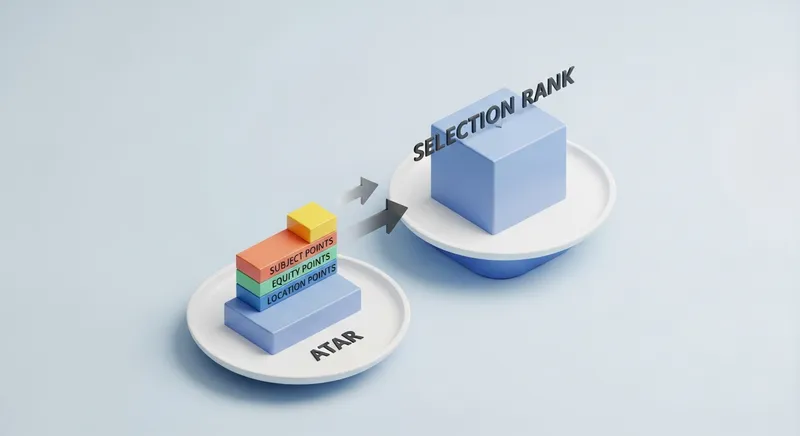
These adjustments exist to create a more level playing field and recognize circumstances that might not be reflected in your final exam results. They generally fall into a few key categories:
- Equity or Hardship Schemes: To account for challenging circumstances that may have impacted your studies.
- Subject-Based Adjustments: To reward high performance in specific subjects relevant to your chosen degree.
- Location-Based Adjustments: For students from regional, rural, or specific schools.
- Elite Performance: For achievements in areas like sport, music, or leadership.
A Crucial Detail: The Bonus Point Cap Before you dive in, here's a rule many students miss: you can't stack bonus points forever. Nearly every university has a 'cap' on the total number of adjustment factors you can receive, usually between 10 and 15 points. This means even if you qualify for points across multiple schemes, you can only use them up to the university's limit. Always check the admissions page for your chosen universities to find their specific cap.
The Ultimate State-by-State Guide to University Adjustment Factors 2026
Australia's university system is managed on a state level, which means the rules and schemes change depending on where you live and apply. Each state has a central body called a Tertiary Admission Centre (TAC) that processes applications and manages most adjustment schemes. Here is your state-by-state breakdown.
New South Wales (NSW) & ACT: UAC Schemes
For students in NSW and the ACT, the Universities Admissions Centre (UAC) is your go-to source. The main program is the Educational Access Scheme (EAS), which covers a wide range of disadvantages. Beyond that, look for:
- Subject Adjustments: Points awarded for strong performance in relevant HSC subjects.
- Elite Athletes, Performers and Leaders (EAPL) Scheme: For significant extra-curricular achievement, like the program offered by UNSW Sydney.
Victoria (VIC): VTAC Schemes
In Victoria, the Victorian Tertiary Admissions Centre (VTAC) manages the Special Entry Access Scheme (SEAS). It is designed to allow selection officers to consider any circumstances that have affected your education. SEAS covers four main categories, from personal information and location to difficult circumstances. Individual universities also offer their own scholarships and entry schemes, so be sure to check their websites directly.
Queensland (QLD): QTAC Schemes
The Queensland Tertiary Admissions Centre (QTAC) runs the Educational Access Scheme (EAS) for Queensland applicants. It covers five categories of disadvantage, including financial hardship and home environment. QTAC also manages other adjustments, such as the regional preference scheme and subject-based upgrades.
South Australia (SA) & Northern Territory (NT): SATAC Schemes
Students applying in SA and the NT will use the South Australian Tertiary Admissions Centre (SATAC). SATAC offers two main types of adjustments:
- Universities Equity Scheme: For students who have faced long-term disadvantage.
- Universities Language, Literacy and Mathematics Scheme: For students who perform well in specific SACE/NTCET subjects.
Western Australia (WA): TISC & University Schemes
In Western Australia, the Tertiary Institutions Service Centre (TISC) processes applications, but universities largely manage their own adjustment schemes. This makes it crucial to check with each university. Key programs include:
- StepUp: A major equity pathway used by Curtin, ECU, Murdoch, and Notre Dame for students who have faced disadvantage.
- UWA Broadway: A similar scheme specifically for The University of Western Australia applicants from designated schools.
According to research from centres like the National Centre for Student Equity in Higher Education (NCSEHE), these targeted programs are vital for improving access to higher education.
Tasmania (TAS): UTAS Schemes
As the primary institution, the University of Tasmania (UTAS) manages its own schemes directly. These are particularly important for Tasmanian students and include:
- Regional Adjustments: Points awarded based on school location.
- Schools Recommendation Program: An early entry pathway based on your school's assessment of your abilities.
- TCE & VET Pathways: UTAS has clear processes for converting Tasmanian Certificate of Education (TCE) and VET results into a competitive selection rank, providing strong options for students who may not receive a standard ATAR.
Deep Dive: 4 Key Ways to Earn Bonus Points
Now that you know where to look, let's explore the most common adjustment schemes in more detail. Understanding these is the first step to maximizing your selection rank.
1. Educational Access Schemes (EAS/SEAS): For Challenging Circumstances
These schemes are the most common and exist to level the playing field. The principle, supported by policy from the Australian Government Department of Education, is that your educational opportunities shouldn't be defined by your circumstances. You may be eligible if you have experienced:
- Financial hardship
- A disruptive home environment or excessive responsibilities
- Severe personal or family illness
- Attending a school identified as having a low socioeconomic status
Actionable Tip: These applications require documentation. Start early! Check your state's TAC website for a list of required documents, which might include Centrelink statements, medical letters, or a personal statement. Mark the deadline in your calendar today.
A Note for Parents Applying for EAS or SEAS can feel overwhelming. Your role can be that of a supportive project manager. Help your child by creating a checklist of required documents (like Centrelink statements or medical letters) and marking key deadlines on a family calendar. Your encouragement and organizational support can make all the difference.
2. Subject Adjustments: Get Rewarded for Your Hard Work
This is where your classroom performance can directly earn you bonus points. Universities offer adjustments for high achievement (usually a Band 5/6 or equivalent) in specific Year 12 subjects that are relevant to the degree you're applying for. For example, scoring well in advanced Mathematics or Physics could earn you points for an Engineering or Science degree, as outlined in schemes like the one from SATAC.
Actionable Tip: This is the most direct way to boost your selection rank through academic merit. Review the subject adjustment schemes for your preferred courses before you finalize your Year 12 subjects to make strategic choices.
3. Regional & Rural Location: Bonus Points for Living Outside the City
To encourage a diverse student body and support students who may have had fewer educational resources, universities often grant automatic adjustment points to applicants from regional, rural, or remote areas.
Actionable Tip: Eligibility is almost always determined by your school's or home's postcode. Every TAC website has a postcode checker. Take two minutes to search for your postcode and see if you automatically qualify. Don't assume-check and be sure!
4. Elite Athlete & Performer Programs: For Your Talents Beyond the Classroom
Are you a state-level athlete, a concert-grade musician, or a dedicated community leader? Your commitment can be worth bonus points! Programs like the Elite Athletes, Performers and Leaders (EAPL) Program at UNSW are designed to recognize the time and dedication required to excel outside of school, which may have impacted your studies.
Actionable Tip: Applying for these programs usually requires a portfolio or statement from a coach, teacher, or relevant authority. Start thinking now about who you would ask and what documentation you need to prove your level of achievement.
How TutorAI Helps You Secure Subject-Based Bonus Points
While some adjustment factors depend on your circumstances, subject-based points are earned purely through academic merit. This is the area where you have the most control, and it's where dedicated effort pays off-literally, in bonus points.
Achieving the high marks (like a Band 6) needed to qualify for these schemes requires a deep understanding of the material, not just last-minute cramming. This is where TutorAI can become your most valuable study partner. Our 'Snap. Solve. Learn.' approach is designed for true comprehension:
- Snap a photo of a difficult problem in your Maths or Science homework, and get instant help.
- Receive step-by-step explanations that guide you through the 'how' and 'why' of the solution, so you learn the process for your exams.
- Access help 24/7, meaning you're never stuck waiting for a tutor or teacher when you're doing a late-night study session.
By helping you master the core concepts, TutorAI empowers you to earn the high grades that unlock those valuable subject adjustment points.
Your Action Plan: 5 Steps to Maximize Your Rank
Feeling overwhelmed? Don't be. Here's a simple checklist to get you started:
- Shortlist Your Courses: Pick your top 3-5 university course preferences.
- Check Eligibility: Visit their admissions websites. Do you qualify for regional points? Do your subjects align with their adjustment schemes? What is their maximum point cap?
- Use the Postcode Checker: Go to your state's TAC website and confirm if your school or home address qualifies for location-based points.
- Gather Documents: If you're eligible for EAS/SEAS, start collecting the required paperwork now. Don't wait for the deadline.
- Mark Your Calendar: Note the application deadlines for your TAC and any direct university schemes. Put them in your phone with reminders.
Conclusion: Take Control of Your University Entry
Your ATAR is just a starting point, not a final destination. By understanding the system of adjustment factors, you can move from feeling anxious and powerless to feeling informed and proactive. You have the power to influence your Selection Rank by applying for the schemes you're eligible for and, most importantly, by striving for excellence in your subjects.
Remember to be organized, check deadlines, and read the fine print on every university website. Your future is in your hands, and a few bonus points can make all the difference.
Ready to master the subjects that can earn you bonus points? Download TutorAI today and build the deep understanding you need for top grades.
Frequently Asked Questions
Do bonus points or adjustment factors change my ATAR?
No, and this is the most important distinction to understand. Adjustment factors do not change your ATAR. Your ATAR is a rank that shows your overall position relative to all other students in your state. That number is final. Instead, bonus points are added to your ATAR to create a Selection Rank for a specific course at a specific university. Think of it as the university giving your application a boost.
How many bonus points can I get in total?
This depends entirely on the university, but there is almost always a cap. You cannot stack points indefinitely. Most institutions cap the total number of adjustments you can receive at around 10 to 15 points. For example, even if you qualify for 5 points for a regional location, 5 points for financial hardship, and 5 points for subject performance, a university with a 10-point cap will only raise your selection rank by 10. Always check the admissions page of your preferred universities for their specific cap.
Is it difficult to apply for the Educational Access Scheme (EAS/SEAS)?
The process itself is not necessarily difficult, but it does require you to be organized and proactive. It involves filling out online forms and providing supporting documents, such as letters from doctors or counselors, government financial statements, or a personal impact statement. The biggest challenge students face is not starting early enough to gather this information and missing the strict deadlines. The application is designed to be completed by a student, so as long as you read the instructions carefully on your state's TAC website, it is very manageable.
What subjects give you bonus points?
This varies widely between universities and the courses you apply for. However, there are common patterns. Typically, high achievement (a Band 5/6 or equivalent) in the following areas may earn you points:
- Advanced Mathematics for Engineering, Commerce, and Computer Science degrees.
- Physics or Chemistry for Science and Health Science degrees.
- Specific Languages for International Studies or Arts degrees.
Always check the specific course entry requirements at the universities you are interested in.
I live in a regional area. Do I get bonus points automatically?
In many cases, yes. Regional and rural access schemes are often the easiest to qualify for because they are applied automatically based on the postcode of your school or permanent home address. Your Tertiary Admissions Centre (TAC) will have a postcode lookup tool on its website. You should use this tool to confirm your eligibility. If your postcode is on the list, the adjustment is usually added to your application without you needing to do anything extra.
When do I find out about my adjustment factors?
You generally don't receive a separate notification about your bonus points. Instead, they are applied behind the scenes by the universities. You will see the result when you receive your university offers. If you receive an offer for a course where your ATAR was below the advertised cut-off, it's a clear sign that your Selection Rank (your ATAR + adjustment factors) was high enough to secure your place.


