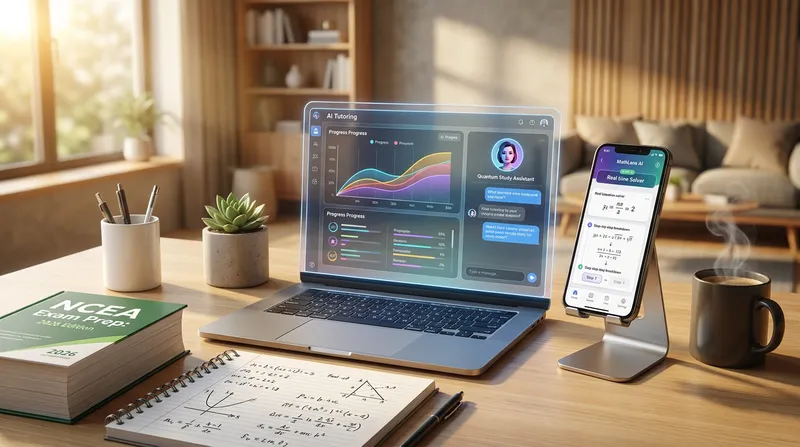
Welcome to the ultimate guide for navigating the New Zealand NCEA system in 2026. If you are a US student, an expat family transitioning to the New Zealand education system, or a busy parent trying to make sense of high school exam prep, you probably have a massive headache right now. You are certainly not alone.
The core problem most international families face is that standard study tools and generic AI solvers do not understand the unique NCEA grading system. When you use generic platforms, you get generic answers that might earn a passing grade in an American high school but completely fail to meet the specific standards required by the New Zealand Qualifications Authority (NZQA). Students and parents are deeply confused by the difference between an "Achieved" grade and an "Excellence" grade, and they cannot find tools that guide them according to these specific rubrics.
Today, we will show you exactly how to pass NCEA, understand the latest 2026 curriculum updates, and use AI as a personalized tutor to ace your exams while keeping your family's stress levels low.
A US Parent's Guide to Understanding NCEA
Before you can master NCEA exam revision, you need to understand how the grading actually works. The National Certificate of Educational Achievement (NCEA) is the main school-leaving qualification in New Zealand. Unlike the traditional American GPA system where students earn a single letter grade for an entire semester of work, or the SAT which tests a broad range of skills in a single sitting, NCEA breaks subjects down into specific "standards."
According to the Ministry of Education, a student needs to achieve a total of 60 credits to attain an NCEA qualification at each level. Each standard is worth a certain number of credits. When you complete an assessment, you do not just get a percentage score. Instead, you are awarded one of four grades:
- Not Achieved (N): The student did not meet the basic requirements of the standard.
- Achieved (A): The student demonstrated a foundational understanding of the topic.
- Merit (M): The student demonstrated an in-depth understanding, often requiring them to explain concepts clearly.
- Excellence (E): The student demonstrated comprehensive understanding, which requires evaluating, justifying, and applying knowledge to new situations.
For US parents trying to translate this to a GPA, it can be tricky. While there is no official universal conversion, many US credential evaluation services treat Achieved as roughly equivalent to a C, Merit to a B, and Excellence to an A. However, you should always use a certified evaluation service like World Education Services (WES) when applying to US colleges, as interpretations vary by institution.
The 2026 NCEA Curriculum Changes
The NZQA has been rolling out significant updates under the NCEA Change Programme since 2024, starting with completely new Level 1 achievement standards across core subjects like Science, English, and Mathematics.
Furthermore, the most critical change is the strict enforcement of the Literacy and Numeracy co-requisites. As detailed by NZQA guidelines, students must earn 10 literacy credits and 10 numeracy credits to be awarded any NCEA level certificate. These foundational standards are now a mandatory gateway. If you are starting your NCEA Level 1 revision, securing these co-requisite credits should be your very first priority.
NCEA External Exams vs. Internal Assessments
One of the most confusing aspects of New Zealand high school exam prep is the split between internal and external assessments.
To help you and your student stay organized, here is a simple breakdown of how the two assessment types differ:
| Feature | Internal Assessments | External Assessments |
|---|---|---|
| Who marks it | Your classroom teachers | NZQA examiners |
| When it occurs | Throughout the school year | November and December |
| Examples | Research projects, speeches, lab experiments | Standardized written exams |
| How AI can help | Brainstorming, structuring reports, reviewing rubrics | Explaining past paper solutions step-by-step |
This split is exactly why generic homework apps fail NCEA students. An app that just gives you a final math answer will not help you write an internal assessment report, nor will it teach you how to format your working out for an external exam marker.
Using AI for High School Homework Help (Without Cheating)
With the rise of artificial intelligence, many students are turning to AI to help them study. However, using AI incorrectly can lead to severe consequences, especially with internal assessments where plagiarism is strictly monitored.
The secret to using an NCEA AI tutor is to use it for learning, not just copying. If you simply ask a generic chatbot to write your English essay, you will likely fail the standard because the AI does not understand the NCEA grading rubric. Instead, you must use AI to explain concepts, generate practice questions, and provide step-by-step breakdowns.
If you are wondering about the ethics of this, check out our comprehensive breakdown in Can AI Do My Math Homework For Me? How to Use AI Math Solvers to Learn (Not Cheat) | Tutor AI Blog.
Math and Science Step-by-Step Solutions
STEM subjects (Science, Technology, Engineering, and Mathematics) are notoriously difficult in the NCEA framework. To achieve Merit or Excellence in these subjects, you must show all your working and explicitly state the scientific or mathematical principles you are using.
This is where a step-by-step AI tutor makes a real difference. Tools like Tutor AI operate on a simple philosophy: Snap. Solve. Learn.
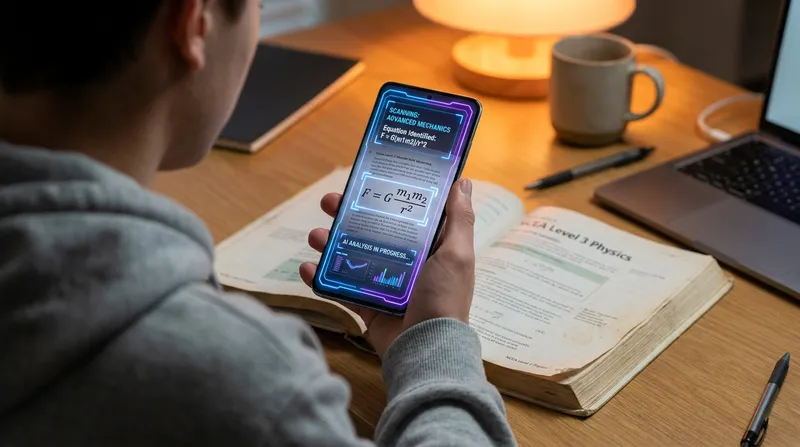
When you are stuck on a physics equation at 10 PM, you can simply take a photo of the problem. Tutor AI uses advanced image recognition to instantly provide a step-by-step solution. But more importantly, it explains the reasoning behind each step. This process prevents the deskilling of students, a major concern highlighted in our article on The AI 'Cognitive Debt' Crisis: Why MIT Warns That Standard Math Solvers Are Deskilling Students | Tutor AI Blog.
Whether you are tackling Level 1 Algebra or Level 3 Calculus, showing your steps is mandatory. If you struggle with kinematics or electromagnetism in physics, you can learn how to break down these concepts in our guide on How to Use an AI Physics Problem Solver for Step-by-Step Homework Help | Tutor AI Blog.
AI Prompts to Go from "Achieved" to "Excellence"
One of the biggest content gaps we see online is the lack of specific, actionable advice for pushing a passing grade to a top grade. If you want to train an AI to act like an NZQA marker, you need to use highly specific prompts. Here are three copy-and-paste prompts you can use to elevate your study sessions:
The "Excellence Evaluator" Prompt:
"Act as an expert New Zealand high school teacher marking an NCEA Level 2 external exam. I am going to provide my practice answer. Do not rewrite the answer for me. Instead, tell me what specific information, justifications, or evaluations I need to add to move this answer from an 'Achieved' grade to an 'Excellence' grade based on standard NZQA rubrics."
The "Concept Linker" Prompt:
"I am studying for my NCEA Level 1 Science external. Explain the concept of genetic variation to me. First, explain it simply (Achieved). Then, explain how it relates to survival in a changing environment (Merit). Finally, evaluate the long-term impacts of genetic diversity on a species' evolution (Excellence)."
The "Internal Assessment Authenticity" Prompt:
"I am writing an NCEA internal assessment report on historical perspectives. Review my current draft. Highlight any areas where my argument is weak or lacks evidence. Suggest three specific questions I should ask myself to deepen my analysis, but do not write the new paragraphs for me."
By using these prompts, you ensure that you are doing the intellectual heavy lifting while the AI acts strictly as a tutor and guide.
How Parents Can Support NCEA Study Without Becoming Experts
For US expats and international parents, helping your child with NCEA homework can feel like learning a foreign language. You do not need to memorize the NZQA rubrics to be supportive.
Using a platform with dedicated family features allows parents to stay involved without micromanaging. Tutor AI offers a Family Ecosystem that includes student progress tracking for parents. This means you can monitor which subjects your child is practicing, see where they are getting stuck, and celebrate their progress, all without having to decipher Level 2 Chemistry yourself. It is the perfect way to end evening homework battles and foster independent learning.
Beating NCEA Exam Anxiety
It is important to acknowledge that NCEA exam pressure is very real. The transition to a system that demands deep evaluation rather than rote memorization can be highly stressful for students. Remind your child that NCEA is designed to reward genuine understanding. Taking breaks, using AI as a patient tutor, and focusing on the "why" behind the answers will build long-term academic confidence and significantly reduce exam anxiety.
How to Pass NCEA Level 1, 2, and 3 Using Past Papers
Ask any top-performing New Zealand student how they study for NCEA external exams, and they will all give you the same answer: NCEA past papers.
However, there is a right way and a wrong way to use them. Reading through past papers and nodding along with the marking schedule is a classic example of passive learning. Educational experts at StudyTime highlight that attempting past exam papers allows you to practice what you know, identify what you do not know, and prepare for exam time pressures.
Here is your actionable step-by-step strategy for mastering past papers:
- Master the Foundation First: Do not touch a past paper until you have reviewed your core class notes. Past papers are designed to test knowledge, not teach it from scratch.
- Simulate Exam Conditions: Print out a past paper from the NZQA website. Clear your desk, set a timer for the allocated time, and complete the paper without looking at your notes or your phone.
- Become the Marker: Once the timer goes off, open the official NZQA Assessment Schedule (the marking guide). Be brutally honest with yourself. Did you explicitly state the formula? Did you justify your conclusion? Mark your paper exactly how an examiner would.
- Target Your Weaknesses: Identify the specific questions where you scored "Not Achieved." Take those exact concepts to Tutor AI, snap a photo of your failed working out, and ask the AI to explain where you went wrong step-by-step.
- Spaced Repetition: Do not just do a paper once and forget it. Revisit the same difficult questions a week later to ensure the concepts have actually stuck in your long-term memory.
Conclusion
Navigating the 2026 NCEA exams does not have to be a stressful, tear-filled experience. By understanding the unique credit system, mastering the difference between internal and external assessments, and using past papers effectively, you can set yourself up for absolute success.
Remember, generic homework tools will only get you so far in a system that demands critical thinking and deep evaluation. If you want to study smarter, reduce your homework anxiety, and truly understand the material, you need a tool designed for real learning.
Ready to boost your confidence and your grades? Get unstuck instantly and start your journey to Excellence. Try Tutor AI today and experience 24/7 personalized homework help that actually teaches you the "why" behind every answer.
Note: Every student learns differently. While these strategies are research-backed, results may vary. Adapt these techniques to fit your unique learning style and circumstances.
Frequently Asked Questions
How do you get Excellence in NCEA exams?
To get an Excellence grade, you must go beyond simply stating facts. You need to demonstrate a comprehensive understanding of the topic. This usually involves evaluating evidence, justifying your decisions, linking different concepts together, and applying your knowledge to unfamiliar contexts.
Can I use AI for NCEA internal assessments without cheating?
Yes, but you must use it as a brainstorming and tutoring tool. You can use AI to explain difficult concepts, help you create a study schedule, or review your work for structural weaknesses. You cannot copy and paste AI-generated text into your assessment, as schools use advanced detection software and you must sign an authenticity declaration.
What is the difference between NCEA internal and external exams?
Internal assessments are completed during the school year and marked by your teachers. They test skills like public speaking, research, or practical experiments. External exams are standardized, end-of-year written tests set and marked by the NZQA across the entire country.
How does the NCEA credit system translate to US high school grades?
While there is no official universal conversion, many US credentialing agencies view an "Achieved" as roughly a C, a "Merit" as a B, and an "Excellence" as an A. If you are applying to US colleges, you will typically need to use a certified third-party credential evaluation service like WES to convert your NCEA Record of Achievement into a standard US GPA.
How many credits do you need to pass NCEA Level 1 in 2026?
You need a total of 60 credits at Level 1 or above. Crucially, you must also pass the mandatory co-requisite standards, which consist of 10 Literacy credits and 10 Numeracy credits.
Where can I find NCEA past papers for exam revision?
You can find all official past papers, exemplars, and assessment schedules directly on the NZQA website under the specific subject resources pages. Studying past papers alongside the official marking schedule is one of the most effective ways to prepare for external exams.