
It's 10 PM. Your physics homework is due tomorrow. You're staring at a problem about a car accelerating down a hill, and you have no idea where to even begin. You see words, numbers, and a question, but the path from problem to solution feels completely hidden. Sound familiar?
This is the core challenge of physics: translating a story into a solvable equation. While AI problem solvers and calculators can give you an instant answer, they can't join you in the exam room. They provide a quick fix but don't build the critical thinking skills you need to earn a great grade and truly understand the material.
This guide is different. We're not just giving you answers. We're giving you a universal, step-by-step strategy to deconstruct any physics problem, from basic kinematics to complex energy conservation. By learning the process, you'll build the confidence to solve problems on your own, turning homework stress into academic success.
Why Physics Word Problems Are So Hard (And It's Not Just You!)
If you find physics word problems difficult, you are not alone. The challenge isn't just about the math; it's about translating the narrative of the problem into the language of physics. Research from the University of Nebraska-Lincoln highlights a key difference between how experts and novices approach problems. Novices tend to hunt for equations that contain the variables they see in the problem. Experts, on the other hand, first identify the major underlying concepts—like conservation of energy or Newton's Laws—and then select the appropriate formulas.
This guide will teach you to think like an expert. The goal is to move beyond formula-hunting and develop a deep understanding of the problem-solving process itself.
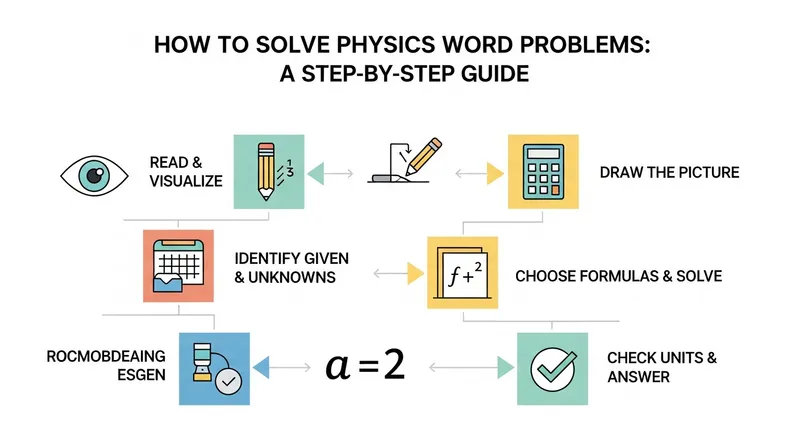
The Ultimate 7-Step Strategy to Solve Any Physics Problem
This seven-step method breaks down the most intimidating problems into manageable parts. By following these steps every time, you'll create a routine that makes problem-solving systematic instead of stressful.
Step 1: Read, Visualize, and Deconstruct
Before you even touch your calculator, you need to understand the story of the problem. Read it through once to get the general idea. Then, read it again, slowly.
- Actionable Tip: As you read, physically circle or highlight key pieces of information: numbers with their units (like 10 m/s or 5 kg), directional words (like "north," "up," "left," or "at rest"), and the specific question being asked. Visualize the action in your head. Is a car speeding up? Is a ball being thrown? A clear mental picture is the foundation for a correct solution.
Step 2: Draw the Picture (e.g., A Free-Body Diagram)
This is the single most important step for problems involving forces, and it's a huge help for almost every other type of problem. Drawing a diagram translates abstract words into a concrete visual model. As explained in resources from Lumen Learning, a good diagram clarifies which forces are acting on the object of interest.
- Actionable Tip: For force problems, always draw a free-body diagram. Represent the object as a simple dot or box. Then, draw arrows representing every external force acting on that object (gravity, normal force, friction, tension, etc.). Label each arrow clearly. A crucial rule is to never include the forces that your object exerts on other things; only the forces acting on it.
Step 3: Identify the 'Givens' and the 'Unknown'
Now, it's time to get organized. Create a list of all the information you have and what you need to find. This strategy is emphasized by top educational resources like The Physics Classroom as a critical precursor to solving.
- Actionable Tip: Write down every known value from the problem, assigning it the correct variable (e.g., initial velocity, v₀ = 10 m/s; mass, m = 5 kg). Then, identify the target variable you need to solve for (e.g., acceleration, a = ?). This simple act of organization makes it much easier to see which formula you might need.
Step 4: Choose the Right Physics Concept and Formula
This is often the biggest hurdle. The key is to think about the core concept first. Is the problem about motion at a constant acceleration (kinematics)? Is it about forces and acceleration (Newton's Second Law)? Or does it involve a change in height or speed without non-conservative forces like friction (conservation of energy)?
- Actionable Tips:
- If the problem involves or asks for time, it's a strong clue to use kinematics, a point highlighted by guidance from the University of Wisconsin-Green Bay.
- If the problem involves forces like friction, tension, or a normal force, you'll likely need Newton's Second Law (F=ma).
- If the problem deals with changes in height and speed, consider the conservation of energy. First, identify if non-conservative forces (like friction or air resistance) are doing work. If not, you can set the initial total energy equal to the final total energy.
Step 5: Translate Words into Equations and Solve
With your chosen formula, it's time to do the math. Substitute your 'given' values from Step 3 into the equation. Be careful and methodical with your algebra. This is where foundational math skills, like solving linear equations or understanding the Pythagoras' Theorem, come into play.
- Actionable Tip: It's often best to solve the equation for your unknown variable algebraically first, before plugging in any numbers. This reduces the chance of calculator error and makes your work easier to check.
Step 6: Check Your Units and Sanity-Check the Answer
Don't just circle the number and move on! Your answer needs to have the correct units (e.g., m/s for velocity, kg for mass). More importantly, does the answer make sense? This is your "sanity check."
- Actionable Tip: Does your answer exist in the real world? If you calculated that a person is running at 500 miles per hour or a dropped apple accelerates upward, you've likely made a mistake. If the problem implies an object is slowing down but you calculated a positive acceleration, double-check your signs. This quick check catches a surprising number of errors.
Step 7: Review and Learn
Take a final moment to look back at the problem and your solution. This reflection is what solidifies learning and makes you better at solving the next problem.
- Actionable Tip: Ask yourself a few key questions: What was the core concept that unlocked this problem? Where did I get stuck, and why? Could I explain this solution clearly to a classmate? Consider keeping a 'mistake journal' to track common errors and the concepts they relate to.
Quick Reference: The 7-Step Method
- Read & Visualize: Read the problem twice. Highlight keys and form a mental picture.
- Draw: Create a diagram (like a free-body diagram) to visualize forces and motion.
- List Givens/Unknowns: Organize all known values and identify what you need to find.
- Choose Concept & Formula: Identify the physics principle (kinematics, energy, etc.) first, then select the matching equation.
- Solve: Substitute values into the equation and solve for the unknown, preferably doing the algebra first.
- Sanity-Check: Verify your units and ask if the answer is physically reasonable.
- Review & Learn: Reflect on the process to solidify your understanding for next time.
Now that you have the framework, let's see how it works in practice.
Putting It All Together: A Worked Example
Let's apply the 7-step strategy to a classic kinematics problem.
Problem: A car starts from rest and accelerates uniformly at 3 m/s². How far has it traveled after 5 seconds?
- Step 1: Read & Visualize: The car is starting still and speeding up. We need to find the distance it covers.
- Step 2: Draw: A simple sketch of a car at a starting point (x=0) and an arrow showing it moving to the right with increasing speed.
- Step 3: Givens & Unknown:
- Initial velocity (v₀) = 0 m/s ("from rest")
- Acceleration (a) = 3 m/s²
- Time (t) = 5 s
- Unknown: Displacement (Δx) = ?
- Step 4: Concept & Formula: The problem involves time, acceleration, and distance, so it's a kinematics problem. The formula that relates these four variables is: Δx = v₀t + ½at².
- Step 5: Solve:
- Δx = (0 m/s)(5 s) + ½(3 m/s²)(5 s)²
- Δx = 0 + ½(3 m/s²)(25 s²)
- Δx = 1.5 * 25 m
- Δx = 37.5 m
- Step 6: Check: The unit is meters, which is correct for distance. The car is accelerating, so it should cover a positive distance. The answer seems reasonable for a car accelerating for 5 seconds.
- Step 7: Review: The key was identifying the problem as kinematics and choosing the right formula based on the givens. The term "from rest" was crucial for setting v₀ to zero.
For more worked examples and excellent video explanations, Flipping Physics is a fantastic resource for students, especially those in AP Physics.
Common Mistakes in Physics Problems (And How to Avoid Them)
Even with a solid strategy, common pitfalls can trip you up. Here are a few to watch for:
- Unit Errors: Forgetting to convert kilometers to meters or minutes to seconds is a classic mistake. Solution: Before you calculate anything, convert all your given values into a standard set of units (usually meters, kilograms, and seconds).
- Vector vs. Scalar Confusion: Forgetting that velocity, acceleration, and force have a direction (they are vectors) can lead to sign errors. Solution: When you draw your diagram in Step 2, assign a positive and negative direction (e.g., up is positive, down is negative) and stick to it for the entire problem.
- Calculator Mode: Using degrees when your calculator is in radians mode (or vice-versa) is a frequent source of error in trigonometry-based problems. Solution: Always check your calculator's mode before starting a problem involving angles.
- Formula Hunting: As mentioned earlier, grabbing an equation just because it has the right letters is a novice move that often fails. Solution: Always follow Step 4: identify the core physics concept before you choose your formula.
How to Get Better at Physics (Beyond Just Homework)
True mastery in physics comes from building strong habits.
- Focus on Concepts: Spend time understanding the why behind the laws of physics. Why does energy conservation work? What does a derivative represent in motion? Understanding concepts like the Fundamental Theorem of Calculus or Derivative Rules can provide a deeper insight into the principles of physics.
- Explain it to a Friend: The best way to know if you understand something is to try to teach it. If you can explain a concept clearly to someone else, you've mastered it.
- Practice Consistently: Don't just do the assigned homework. Use tools like Tutor AI to get more practice problems with instant feedback. When you get stuck, our step-by-step solutions don't just give you the answer; they guide you through the process, reinforcing the strategies you learned here.
Frequently Asked Questions
How do you start a physics word problem?
The best way to start is to resist the urge to immediately search for a formula. First, read the problem carefully two times. The first time, get a general sense of the situation. The second time, use a highlighter to mark all the explicit numbers, units, and keywords (like "at rest," "constant velocity," or "how far"). Then, visualize the action in your mind. This initial 'deconstruction' phase is the most critical step to avoid confusion later on.
How do you identify the 'given' information in a physics problem?
After reading and visualizing, create an organized list. Go through the problem statement and write down every piece of information with its corresponding physics variable. For example, if you see "A 10 kg box," write down "m = 10 kg." If it says "starts from rest," that's a key piece of information: write down "v₀ = 0 m/s." Also, list what you need to find, such as "a = ?". This list turns a messy paragraph into a structured set of data.
What is the best way to choose the right physics formula?
Choosing the right formula is about matching the concept, not just the variables. First, ask yourself, "What area of physics is this?" Is it about motion (kinematics), forces (Newton's Laws), or energy? Once you've identified the concept, look at the set of formulas for that topic. Now, compare those formulas to the list of 'givens' and 'unknowns' you created. The correct formula is the one that contains the variables you know and the one variable you want to find.
What are the most common mistakes in physics problems?
The most common mistakes are often not in the complex physics but in the small details. The top three are: 1) Unit Errors: Forgetting to convert all units to a standard system (like meters and seconds) before calculating. 2) Sign Errors: Mixing up positive and negative directions for vectors like velocity and acceleration. 3) Conceptual Errors: Misidentifying the core principle of the problem (e.g., using kinematics when energy conservation is required). Always double-check units and draw a diagram with clear directions to avoid these.
Ready to Master Physics?
Learning a method is the first step, but consistent practice is what builds true confidence. The 7-step strategy gives you a reliable map for every problem you face. Instead of feeling lost, you'll have a clear process to follow, turning confusion into clarity.
Ready to put these strategies into practice? Download Tutor AI to get step-by-step guidance on thousands of physics problems. Stop hunting for answers and start building the skills to find them yourself.


